
Translated material
Great Chinese pipe
Report from Shanghai
The main result of the visit of Vladimir Putin to China was the “contract of the year”-the parties went to the contract on 30-year supplies of Russian gas to the Celestial Empire for a total of $ 400 billion for almost 10 years. How and why they came - the New Times sorted out
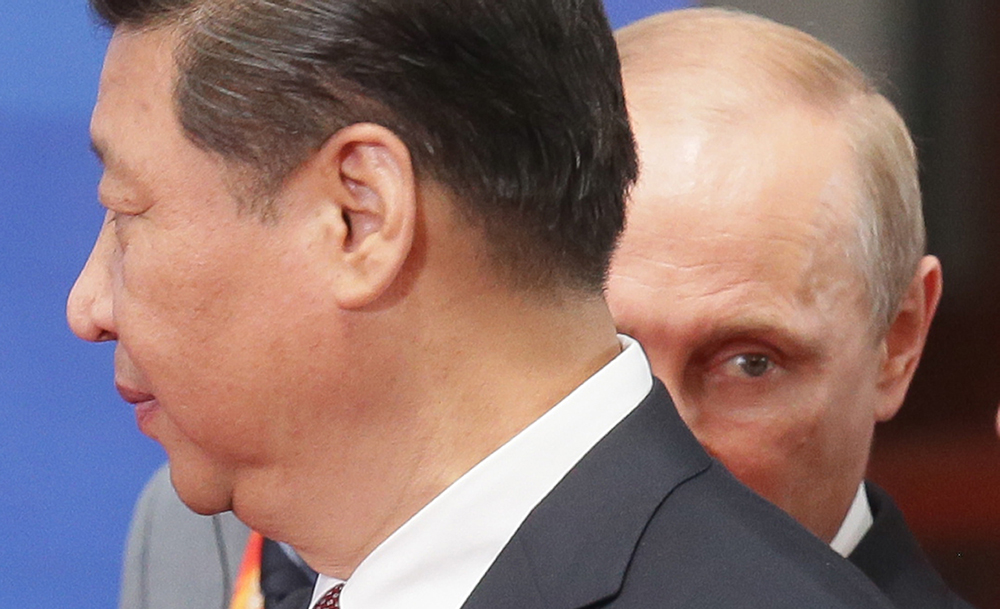
The mood of the leaders of China and Russia, apparently, is different. Shanghai, May 20, 2014 /Photo: Mikhail Metzel /ITAR-TASS
Russia under the leadership of Vladimir Putin is criticized for the annexation of Crimea, the “loosening” of Ukraine and the twisting of nuts within the country. China under the leadership of Xi Jinping-for the "unbridled" cyberspionage, violations of human rights and aggressive policy in relation to neighboring countries. Under the squall, critics from outside Moscow and Beijing decided to unite. At least- before photo and television cameras.
Signal for neighbors
On May 20–21, a huge Shanghai was like one big dead end: neither passing to pass. The main streets, avenues, highway and intersections fell under the tight control of the special services. The city hall did not work: its employees received a lot - they say, we can handle it without you. Children's gardens and schools closed, the official reason is "to reduce the flow of transport." And according to the old Chinese tradition, the authorities recruited experienced activists of the “neighboring committees”: 27 thousand already middle -aged women and men put on the orange vests of communal services and without sniffing their eyes vigilantly looked out in the zone of their appearance.
| *On May 22, another terrorist attack occurred in the market in Urumchi, which claimed the lives of 31 people. |
In fact, the reason for this was not only Putin. After the explosion of April 30 at the station in the city of Urumchi (the capital of the Xinjiang-Uyghur Autonomous Okrug in the north-west of the country, where the Uyghur separatism is strong.-The NEW Times), which occurred on the last day of the visit to the SI Jinping region, with special care, in a radius of 3 kilometers, they filter any point on the map, where The head of the party and the state appears*. Shanghai, a showcase of modernized and westernized China, is no exception. “We have already sent warships to the open sea,” a familiar teacher of the University of Shanghai University of Foreign Languages jokes about the security measures.
But in every joke there is only a share of a joke: indeed, on the day when Putin arrived in China, joint Russian-Chinese naval exercises began. Moreover, the leaders of the two countries personally opened them. The fact that the exercises are naval, and all the piquancy of the moment is.
"
“Of course, Putin made it clear to the Japanese that in the dispute around Diaoyudao is supporting his old Chinese friends"
"
The official Chinese press immediately began to make excuses: they say, the maneuvers were planned for a long time, they, by pure chance, coincided with the visit of the President of Russia. The remarks were addressed primarily to Tokyo, with which Beijing had an acute territorial dispute regarding the belonging of the islands of Senkaku (Dyaoyidao) in the East Chinese Sea, and with Russia-a sharp cooling of relations because of Ukraine that Tokyo supported anti-Russian sanctions. But whether Tokyo believed in a pure accident is a big question: the Japanese managed to study the Chinese well and send political signals to their manner. And then the signal was quite unambiguous: keep in mind, if that is Russia with us. No wonder the Pacific Fleet of the Russian Federation detached six ships for teachings. “Of course, Putin made it clear to the Japanese that in the dispute around the islands of Diaoyudao supports his old Chinese friends,” says political scientist and writer Dean Dong. On Shanghai, however, there was a rumor that at first Moscow was not enthusiastic about the idea of the “joint discovery of the exercises”, which the Chinese proposed to the peak of the Japanese: Russia outlined serious negotiations with Tokyo for Kurilov and even to prepare an agreement on mutual cancellation of visas. The Ukrainian crisis brought down everything. But in the end, Putin took a step towards - and the Chinese did not slow to thank him: Xi Jinping promised the Russian president a “winning visit” - and did not deceive.
Official Beijing was launched by Putin with rhetorical curtsies. The Chinese media sang a guest from Russia as a “strong politician”, which is “above criticism of the West”. During the Putin’s visit, a caricature of the German Chancellor Angela Merkel, who, standing next to the US President Barack Obama, was aiming from a toy pistol to the impossibility of a sweet bear from Russia - the drawing was called upon to demonstrate the ridiculous sanctions of the West against Russia.
Putin's visit was accompanied by bravura comments on Chinese officials who sought to assure: Russian-Chinese friendship is at the highest development point. Comments of the Sinhua news agency narrated about "who had never previously reached such heights of mutual trust."
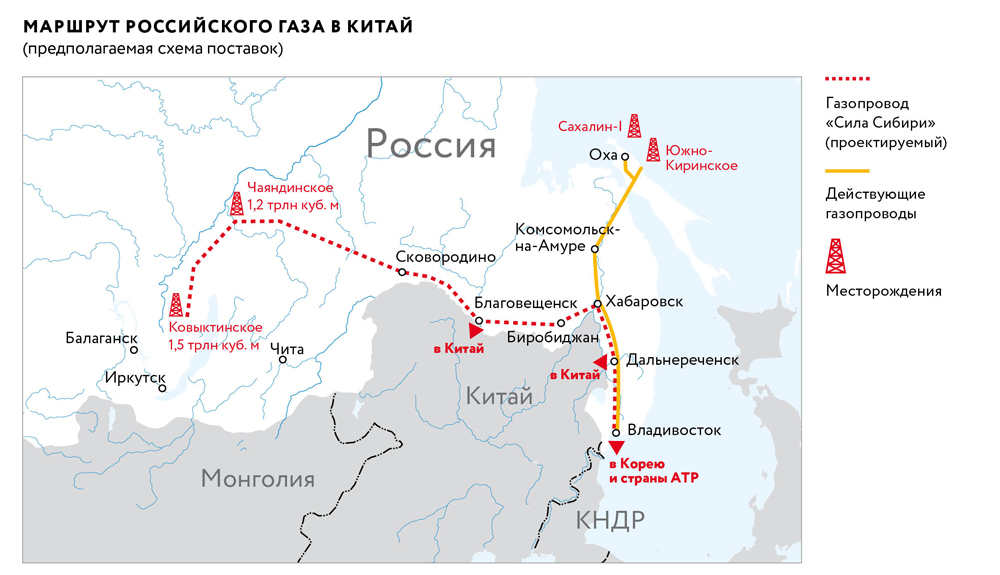
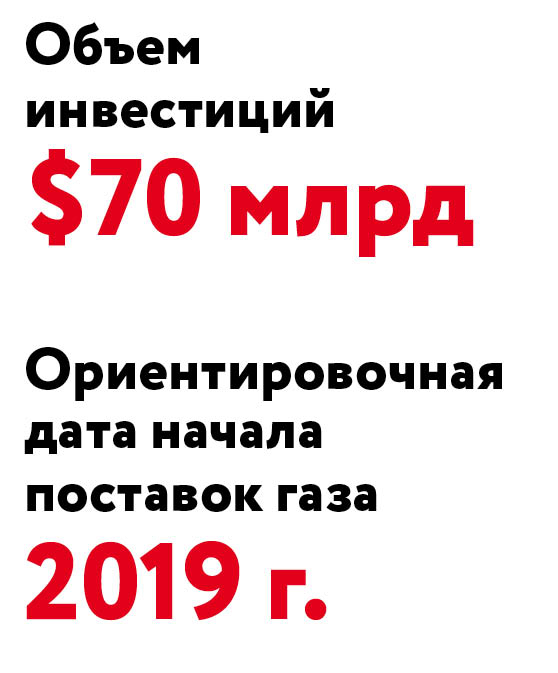
On May 21, in Shanghai, the parties signed a 400 million gas contract. In addition, according to the results of other signed agreements - and there were more than forty of them - the volume of trade between the Russian Federation and the PRC in 2015 will reach $ 100 billion for the first time, and after another five years, it would allegedly rise to $ 200 billion.

Game of silence
Chinese officials in confidential conversations were evaluated by the chances of signing the gas agreement as 50 to 50. See Jinping - he never at all hinted at China's readiness for agreements with Gazprom, and the rest of the Chinese synclite were silent. Now it is clear that it was a typical oriental game - to keep your trump cards with you until the last minute. And Beijing knows how to play this game. As one of the members of the Russian delegation in Shanghai told anonymity, even Putin himself was not fully sure that the contract would be signed: “The task was set to be the price of not lower than the cost of its production and transportation of gas to Vladivostok and Blagoveshchensk in the contract” - according to some estimates, this is $ 320, for a thousand cubic meters.
“On the first day of the visit (May 20), Putin and his people acted as petitioners here, although in essence, there was nothing to ask,” one of the officials of the Chinese National Oil Gazais Corporation (CNPC) said in a confidential conversation.
It was really not easy to guess about the real intentions of the Chinese: on the morning of May 21, the Financial Times newspaper with reference to the Petrochina press secretary Mao Zefena issued the news: you should not wait for the contract. “We will not sign,” said Mao Jephen. - At the moment, the price of imported gas and the price of gas in the domestic market are opposite. We are already losing money on the import of gas and cannot lose even more. ”
"The problem of gas lack of China is not worth it, we already get raw materials from Myanmar, Australia and other Asia -Pacific countries"
"
On the other hand, behind the scenes, negotiations have been going on since mid -April and their result promised to be positive for Gazprom.
On April 14, the Foreign Minister Frank Frank-Walter Steinmeier arrived in Beijing-in order to encourage Beijing to revise a neutral position in the Ukrainian issue. They say that along the way, Steinmeier was vividly interested in the details of the gas transaction with Moscow. One of the Chinese officials then told him, referring to the contract: "By and large, we have already agreed on everything."
| ** The main Russian manufacturer of liquefied natural gas, which signed a 3 million tons of LNGs on May 20, signed a contract to China annually for 20 years as part of the Yamal LNG project. |
The fact is that a few days before Steinmeyer, Deputy Prime Minister of the Government of the Russian Federation Arkady Dvorkovich, who met here with his Chinese colleague Zhang Gaoli, came to Pekin. As it became known later, it was during their negotiations that the fundamental readiness of the two countries was confirmed to expand cooperation in the oil and gas sector. “Dvorkovich came to reconnaissance in battle and received a clear signal: we are ready to accept both Novatek*and Gazprom, it remains only to agree on the price,” says the Chinese official from CNPC.
Steinmeier, according to Chinese sources, tried to delay the deal. The calculation was that China had great economic interests in Ukraine: Beijing takes wheat from there - their own crop to the Chinese to feed 1.2 billion people, is not enough. And stable food supply is the key to stability in the country, which the chairman of SI hinted at more than once.
In addition, the EU and the USA are the most important economic partners of Beijing. “Unlike Russia, the PRC does not export resources, but finished products. If demand falls in the West, Beijing will begin serious difficulties with sales. China does not want to provoke the West more than necessary, and therefore does not completely stand on the side of Russia (in the Ukrainian question), ”says analyst Din Dong. And he adds: - We will not go beyond condemnation of the policy of unilateral sanctions. "
“The problem of gas lack of China is not worth it, we already get a lot of energy raw materials from Myanmar, Australia and some other countries of the Asia-Pacific region,” says Lin Botskan, an expert at the Institute of Energy at Syamyn University in southern China. “If an agreement with Russia did not work out, we would have been sold by an increase in alternative supplies.”
But there is in such a position and cunning. China's need for natural gas until 2020 will increase annually by more than 400 million cubic meters per day. About half of the required volume of the PRC is forced to import from abroad. This means that Beijing, like Moscow, is under pressure and the agreement with Gazprom for him is a vital necessity.
The motionless pole
The parties announced the signing of the contract on May 21 at about three in the afternoon of Shanghai time. A little later, the head of Gazprom, Alexei Miller, clarified: the latest differences in the details of the agreement were eliminated on May 20 at midnight. This means that by the time the Financial Times came out with the commentary of the Petrochina press secretary, the game, in fact, was already played.
For politicians in China, Vladimir Putin is something like a motionless pole. They can always count on it. And so - years. Even during his first presidential term, Putin entered into an agreement on good neighborliness, friendship and cooperation with China, after which the ex-chairman of the PRC Hu Jintao dubbed him "a good old friend of the Chinese people." Never during his visits to Beijing - and only with Xi Jinping there were already seven such meetings - Putin does not speak of the rule of law or democracy - that they love to bring on the agenda of meetings with the Chinese of the heads of state and governments of Western countries. But he is happy to communicate with the former communist opponent of the USSR in the language of business and naked numbers more than necessary. And the Chinese leaders like this language the most.