
Translated material
Shanghai Nabat
The gas supply contract, signed during the visit of Vladimir Putin to China, is not so much about raw materials, business and profit. This, in fact, is a value choice, a new paradigm for Russia, which will affect not only external, but also domestic policy
For 30 years, Russia will supply gas to China from Eastern Siberia through a pipeline, which is not yet. But there is already its name - "The power of Siberia."
| *The price of gas is tied to the cost of oil and oil products and, obviously, will fluctuate. In addition, it is known that the transaction was made on the terms of “take or pay” - that is, China will be required to redeem the entire gas volume stipulated by the agreement or pay the penalty. ** Vladimir Putin, speaking at the St. Petersburg Forum, said that the total stocks of tea and coat exceeds 3 trillion cubic meters. m - "enough gas and 50 (years)." |
The price of the product was “packed” in an additional protocol and hidden from the eyes of mankind. (The New Times wrote a month ago that this issue will be the most difficult in negotiations. - See the Way to the East? ", No. 13 of April 21, 2014 ), experts nevertheless call the figure $ 350 per thousand cubic meters and so on. Where this figure came from, it is also difficult to understand, because it is poorly consistent with the declared supply schedule - 38 billion cubic meters per year for a period of 30 years*.
Riddle in Cuba
Already the fact that the price was hidden is serious suspicions that Russia agreed to sell gas at a price below the cost of its production and transportation, which, at the time of delivery to the border with China, is about $ 380–400 per thousand cubic meters. Another possible concession: we agreed to put the Chinese into their gas production projects or the construction of a gas pipeline. But this is the whole life and you can’t keep it secret: the list of participants in the construction of the Siberian Strength or developers of the Kovyktinsky deposit will help to set up points over I.
Finally, the Chinese may be directly involved in financing the project. That's why they went to zero over the imports of gas in exchange for the Putin proposal to reset tax on mining (NDPI) for developers of the East Siberian deposits.
However, the greatest skepticism is caused not only by the price, but also by the supply schedule. Who will undertake to answer the question: where, in fact, will Russia get so many gas supplied - 38 billion cubic meters?
The gas fence for large -scale supplies is most likely from two sources. The first is the Sakhalin deposit, from where the gas will go through the already finished pipe "Sakhalin - Khabarovsk - Vladivostok" and further to China (see map on page 14). The second is the Chayandinskoye field (it is also a tea) in Yakutia. There are two more probable sources-Kovyktinskoye (Kovykt) in the Irkutsk region and the South Kirinsky deposits on Sakhalin. With the most optimistic forecasts of Sakhalin and Kovikt by 2020, they will be able to give 7-8 billion cubes a year. Another 4 billion cubic meters per year will be able to give a tea - this is if you start working on the development of this deposit and the construction of a gas pipeline from Siberia to China. In total, it turns out about 11 billion. **
To bring this volume not only to the required 38, but at least to 30 billion cubic meters, Gazprom, according to calculations, will need another 10 years. That is, theoretically only by 2030 our monopoly will be able to begin to supply gas in the volumes that Alexei Miller promised to China. But what the price of gas will be in 16 years and in what volumes it will be at that time Kita, this is another big mystery.
That is, no matter what side to approach - on May 21, one of the most mysterious contracts in the history of international trade was signed in Shanghai.
The price of ambitions
A separate question is the price that Russia will have to pay for the implementation of this “historical agreement”: the cost of the basic version of the designed Siberian Pipeline is $ 46 billion. To this, the cost of developing and extracting gas and kovykt gas (about $ 25 billion) must be added, a couple of billion should be added to the construction of the gas processing complex in Belogorsk, which will “receive” the East Siberian Complex. Gas before export to China. Total in total - more than $ 70 billion in order to provide China with the required raw materials.
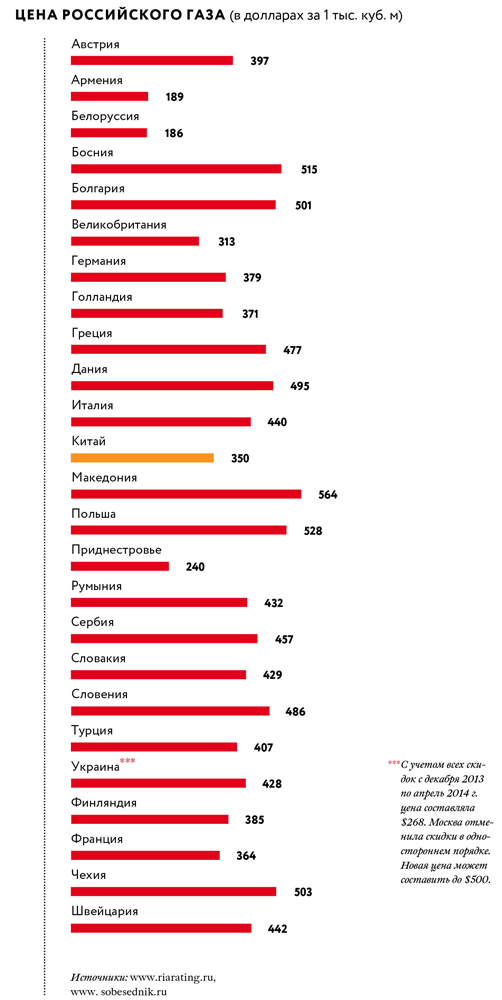

I repeat, the details of the contract are unknown to us. But if Russia really agreed to supply gas below the cost, then this stone on the stone does not leave a geostrategic line from the declared Moscow. But it was indicated on October 23, 2012 at a meeting of the Presidential Commission on FEC. Then Vladimir Putin directly said: we need to break through with his gas east, to Asia, since the world is experiencing a “shale revolution”, Europe does not take as much gas as we wanted to sell it, and Russia simply does not have time to occupy its share in the liquefied natural gas market - Canadians, the United States and other suppliers and other suppliers.
But after Shanghai, it turns out that they decided to make it east at all costs, even to the detriment of the Russian budget, not to mention Gazprom's budget. No benefit is only indulging in the geopolitical ambitions of our leadership: they say, if they do not want us in Europe, we will go to Asia. At the same time, everyone forgot that European deliveries do not depend on the Asian, and vice versa. In the case of China, we are talking, firstly, about completely new projects, and secondly, our eastern Siberia (with a coat, tea, etc.) is not connected to the western gas pipelines. Therefore, Russia's obvious desire to demonstrate successes to Europeans and Americans on the Asian front is a miserable sight.