
Translated material
Internet under the cap
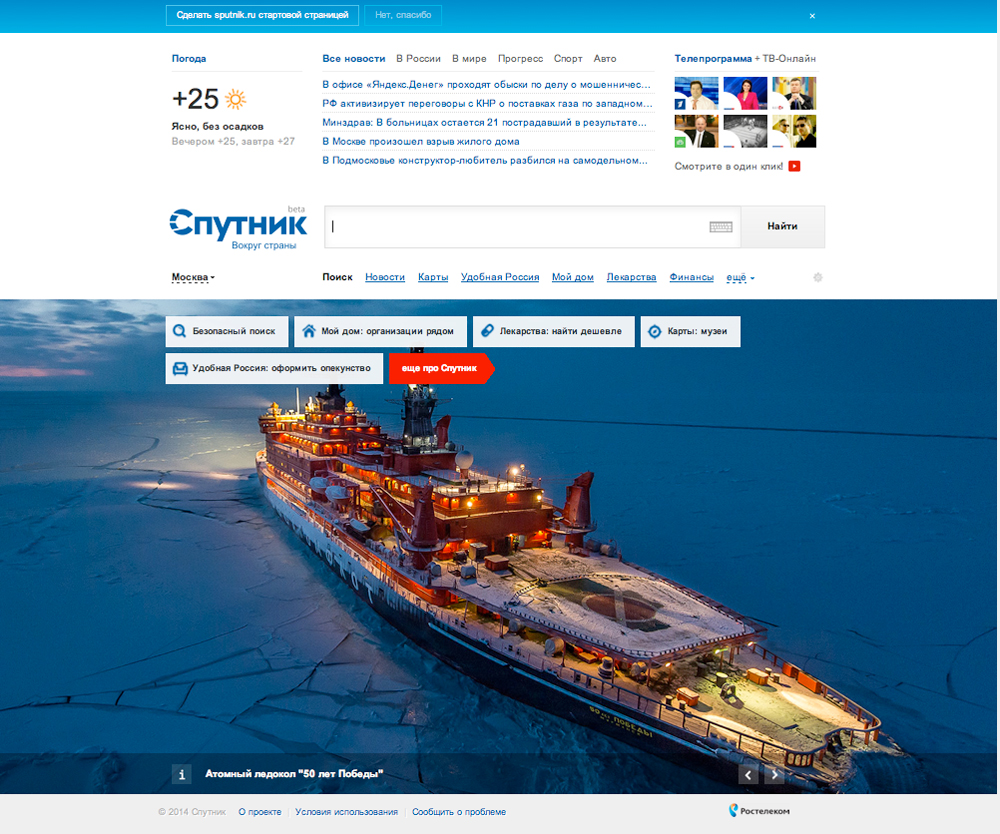
Rostelecom announced the launch of the new Russian search engine "Sputnik"
The market, meanwhile, is full of rumors about plans to establish total control over the Internet
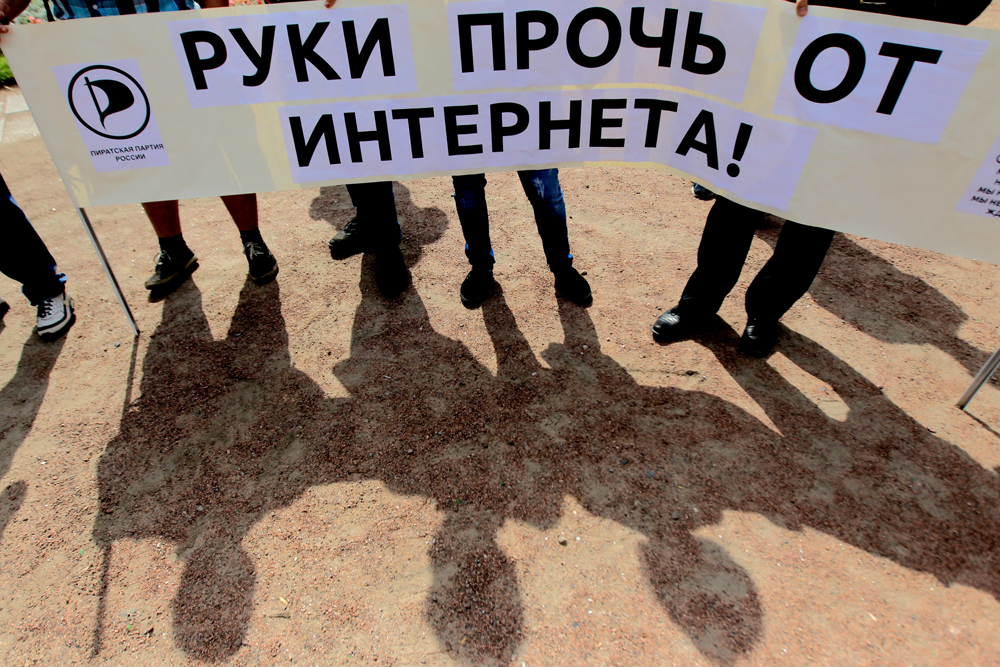
Photo: Peter Kovalev/ITAR-TASS
“The new search engine does not have a task at all to compete with Yandex or Google is a niche product that should facilitate the interaction of the population with the state, an online initiative like the public services portal,” Dmitry Chistov, representative of the satellite press service, explained to The New Times. The project began to be hastily done in 2013, although information about the new search engine leaked to the press back in 2010. Then the Russian Internet community spoke that the Kremlin needed a platform capable of "correctly" to filter the search results. So, deputy Ilya Ponomarev has repeatedly stated that the task of creating an alternative to Yandex, which occupies a 62% of the Internet market market, appeared after the Georgian war of 2008, when links that did not suit the Kremlin appeared on the Internet in the first lines, and the media wrote that Russia completely lost the Georgian information war. Representatives of the "satellite", however, say that there is no censorship on the "satellite" and at all, the filters relate only to illegal content. The experiment, however, showed: when introducing the word “Donbass” in the search line, Yandex first issued the latest news about the Civil War in the east of Ukraine, while the “satellite” is not related to the latest events. And on May 23, when the number one news was the resonant performance in St. Petersburg by German Gref, who announced the dramatic pace of the fall of economic growth, Yandex to the request “Gref Dramatic Fall” issued a whole list of portals with links to the performance of the head of Sberbank, “satellite” - references like “Gref does not expect a sharp fall in the price of oil” or “Gref. The stability of the ruble. "
Under the visor
According to an employee of one Internet company, who wished to maintain anonymity, the “satellite” will be installed primarily in state institutions, including universities and schools. “Today it will simply open by default, and tomorrow in state institutions, Yandex and Google will be disconnected - and now a huge part of the population will receive only“ correct ”information,” the journal interlocutor predicts the possible development of the situation. Indirectly, such a development was confirmed by the attacks on Yandex of the deputy Andrei Lugovoi, who asked the General Prosecutor's office to check Yandex for the compliance of the media law, since the news is published on the main page of the portal. As the press secretary of Yandex Asya Melkumova explained to The New Times, they have not yet received any requests from the deputy of the meadow or the prosecutor’s office in the company, and the initiatives themselves seem strange to them: “Yandex News” is an automatic generator that releases only the headlines of popular news from the sites of our partners. ” But the authorities are enough to suspect Yandex of engagement in order to limit its distribution in government agencies.
Vladimir Putin hinted to the second problem with existing search engines, answering questions on the media forum of the All -Russian Popular Front on April 24. It was then that the Russian president suddenly stated that the Internet is the CIA project. “Everything goes through the servers that are located in the States, everything is controlled there,” Putin said, answering the question of Google (27.6% of the online post market in Russia). Its servers and, however, are abroad, and the site itself is controlled by California, only the Google unit, which is engaged in the sale of advertising, works in Russia. It got from Putin to Yandex: “Yandex is a national system,” but “part of the registration of them also occurs abroad and not only for the purpose of taxation, but also for other reasons.” The employee of one of the Russian Internet companies in an interview with The New Times explained the President’s fears: “After the story of the collection of metadata by the American National Security Agency, which has surfaced thanks to Edward Snowden, the work to create a purely Russian search engine intensified. The Russian leadership has a special attitude to the protection of information. ” And a source in government circles appreciated Putin’s statement unequivocally: “The president made it clear that the influence of the world Internet on Russians should be limited. And it will be executed. ”

Crimea from the "satellite" is still Ukrainian /screenshot: website Sputnik.ru
In the interests of special services
Simultaneously with attempts to diversify the Russian Internet Kremlin strengthened the attack on it. So, on May 5, President Putin signed laws by which bloggers whose pages read more than 3,000 users per day are required to comply with the requirements for the media, and Internet companies and providers are required to store information about their users for six months. The market is now waiting for by -laws that should appear in early June. It is they who will explain what the procedure for registering popular bloggers will be, how the audience will be calculated, what providers should be stored for information, how access will be provided, etc. “From my point of view, we are not talking about a specific content, but about metadata: IP addresses, when and which sites entered,” the chief analyst of the Russian Association of Electronic Communications explained to the New Times (RAEK) Karen Ghazaryan. “I know that the regulatory departments, and above all Roskomnadzor, are configured not to bend the stick and not make the life of users and Internet companies unbearable.”
According to experts with whom the New Times managed to talk, such storage of information into the hands is primarily to law enforcement agencies. “In principle, surveillance can be installed for anyone, hacking anyone’s mail,” Matvey, the head of one of the Russian IT companies, explained. -Dozens of hackers collaborate with the FSB, who for money or just in fear, say, go to jail for some tricks, help special services. But officially it is not easy to obtain such information: you need a court decision, Internet companies may refuse to provide it with it. ” So, for example, Mail.ru won the Court of Appeal on April 25, which canceled the decision of the court of first instance on a fine of 500 thousand rubles for refusing to provide information about one of the users to the Federal Service for Financial Markets. “When the information will be stored, it will not have to be requested by a specific user, the providers may not find out what will be in the hands of the special services, and what can be, for example, buy on the black market,” says Matvey.
"
“The president made it clear that the influence of the world Internet on Russians should be limited. And it will be executed "
"
The law on storing information caused particular anxiety among foreign Internet companies and services, the largest of them-Google, Facebook and Twitter. Formally, their obligations in the law are not spelled out, and they are unlikely to obey similar requirements along with Russian organizations. “We are at a loss, we completely cannot imagine what will happen, we only hope that the Russian authorities will still not limit access to popular resources,” the New Times said on the terms of anonymity, a representative of one of the international Internet giants.
Storage of a large amount of information for such a long time will require the installation of expensive equipment. The volume of costs is unknown to the adoption of those very by-laws (“He can vary from several thousand to several million dollars,” says Karen Ghazaryan, however, according to some estimates, the total amount of expenses of the Internet market can reach 1 billion rubles), but it is clear that if you have to invest seriously, some of the companies will simply leave the market. “But large firms will be more willing to cooperate with the special services,” Iitshnik Matvey is sure.
Non -School Path
| *In China, the Internet is provided by three providers: China Telecom, China Unicom and China Mobile, all of them are somehow controlled by the state. In 2003, the Chinese Ministry of Public Security introduced the Golden Shield project (the unofficial name is the Great Chinese Firewall)-a system of servers filtering online traffic. Facebook, YouTube, Twitter are completely banned, the pages of Wikipedia or Western media are partially blocked, in which there is an obscure information from the point of view of censorship. In China, it is possible to bypass prohibitions using VPN, but Chinese analogues of social networks (Weibo) and search engines (BAIDU) are very popular. |
On April 29, the Kommersant newspaper with reference to sources on the telecommunications market, among officials and managers of the Internet company, reported that under the presidential administration a certain working group was developing proposals for the regulation of the Internet. It is said to enter three levels of data transmission networks: local, regional and federal, granting the right to enter foreign traffic only two or three all-Russian operators, thus going along the Chinese path*. In addition, according to Kommersant, it is supposed to prohibit placing DNS server Domains .ru and. RF outside Russia, as well as introducing filtration on content-a concept that is not yet in Russian legislation. Representatives of the IT business confirmed The New Times that talking about such reforms and, however, go, but no one knows who specifically enters the working group. “We have no information about this,” says Asya Melkumova from Yandex. “A few years ago, the Ministry of Communications had proposals for reforming the system of trunk providers, but then this concept was chopped off because it played a pair of operators, but did not take into account the realities of the Internet market,” Ghazaryan recalls. “Most likely, this is still a stuffing of information, a check for strength.”
Whether the Kremlin actually exists on the Internet regulation or not, at least one of the provisions is already beginning to be implemented, namely, content on content. The largest Rostelecom trunk provider in the third quarter of 2014 should complete the implementation of the system that will allow us to filter sites not on the IP address of the resource, as it happens now, but at the text address of the Internet page (URL). “If it was possible to change the IP address earlier to get around the blocking, or use the so-called“ mirrors ”, when the exact copy of your site is located somewhere abroad, now in Russia all resources can be blocked, in the address of which there are certain symbols or words,” explained the New Times, the director of the Czech IT Holding Creating Telematics & Trade, working with many clients from Russia. “This significantly expands the ability to control the Internet.”
Where ours did not disappear
What to do to users if a great Russian Firewall is still installed in the country? The creators of the content, including bloggers, can already take care of registering their pages abroad: this will not save from blocking, but will help save incognito. “When the requests for the provision of any information about our customers come to us (from law enforcement agencies), we answer that we are a Czech company, are not obliged to understand the features of Russian legislation and ask to send a request in Czech with a notarial translation and an apostille,” Terentyev laughs. “Usually everything ends on that.” However, most of Alexei’s clients are businessmen: “We are basically not engaged in politics.”
The Internet users who may remain without sources of information, recipes are the same as the Chinese or Iranians: VPN (Virtual Private Network) or Tor-services (there is also Torch Tor-browser), allowing not only to deceive the provider, showing that the user is in another country, but also guarantee anonymity: the provider, of course, finds out about connecting to the VPN server, and what will happen inside this server will not know. There are free VPNs, there are also paid ones-from $ 7 to $ 20 per month, and in order to install it, it is not at all necessary to be an IT genius. “It is necessary to explain to each housewife in advance what VPN is and how to use it,” Andrei Zasekin, one of the founders of the Dissernet project, told The New Times. “Then all these restrictions will be just useless.” You can deprive the VPN Russians only by completely cutting off the opportunity to pay for foreign services, for which it will be necessary not only to expel international payment systems from Russia, but also to ban money transfers abroad. And this will not be a Chinese version at all.