
Translated material
Metaphysical labyrinth
The shed is written "x **", and there are firewood inside
(folk joke)
The catalog of the exhibition Dmitry Aleksandrovich Prigov in the Tretyakov Gallery, an article by a friend Prigov, writer Vladimir Sorokin. “The inscription is more important than the contents,” Sorokin leads, reflecting on the Prigi series of cans, and recalls a joke, which, of course, cannot be imagined in the name of the recently opened retrospective of Prigov, so I will allow myself to make it an epigraph to this text.
The curator of the exhibition is Kirill Svetlyakov as if diligently follows the principle from the joke. In the name of retrospectives and in the preface of the catalog - one, and in the exhibition halls - completely different. The promising “Renaissance”, declared in the title, is also crossed by “conceptualism” and finally fascinates the viewer with a mysterious “and further”. Expectations appear to see Prigov’s work, not just built into the context of European art, but discussing with him, and most importantly, showing possible ways to further develop contemporary art, that will come for the named conceptualism. In fact, the exhibition is pretended by a statement that can make with Russian contemporary art that for a century has not been able to do with Russian philosophy: to enter into the history of Western thought. Or like Prigov:
Fate To him What Lee Cruel
Il Happiness No at all
A Maybe be proximity East
A Maybe be something more
The position of Russian philosophical thought is perceived in different ways: from provincial to Messiana, but it is obvious that this, as they say, is completely different. True, to do, in order to overcome, on the one hand, the sectarian spirit of zealots of the spiritual superiority of Russian philosophy over Western positivism, on the other hand, its complete neglect and oblivion in the minds of adherents of the actual left -handed thought, Russian philosophers did not come up with.
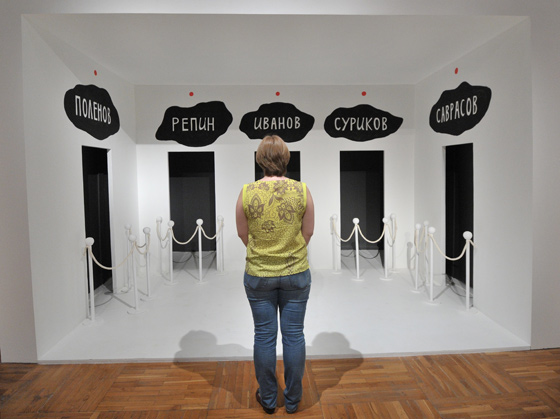 © Sergey Kiselev/Kommersant at the exhibition "From Renaissance to Postmodernism and further"
Russian art for a number of reasons - including those associated with the past merits of the time of the avant -garde - at first glance, is in a much more favorable position. Separate names are the stars at all, as they say, of the world level. But if you try to figure out the success of the success of each of them, it turns out that this success is connected with the policies of the art market, which turns into goods the work of the once most important artists who have lost their place at the helm of the ship of art, but became the property of the mass viewer. Those modern Russian artists who are usually included in the pantheon of world art today have a very indirect attitude to its advanced and current part. Approximately the same thing happens with the figure of Prigov, the artistic part of the heritage of which for the most part gives, paradoxically, the same spirituality and metaphysicality as Russian philosophy, which has not yet found its place. The way the fashionable and relevant artistic “metaphysics” and irrationality looks like Massimiliano Johni showed at the last Venetian Biennale . It is obvious that the prison with the obsolete irony inherent in his poetic method and sometimes very subtly manifested and in some artistic works, Johni does not fit into the concept of naive and simple -minded metaphysics. But to isolate this irony in Prigov-artist, it turns out, is not so simple. And if this is not done, then his work is filled with images - in his own expression - “oven”, “sacred”, etc.
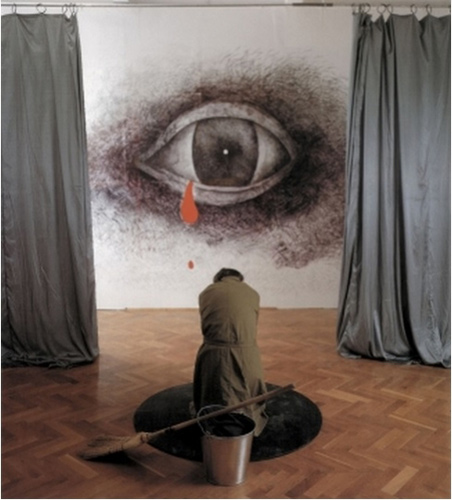 © Tretyakov Gallery Prigov Dmitry Alexandrovich. Crying eye (for poor cleaning lady). 1991
With the artistic legacy of Prigov, it is not easy to work at all, which arose on the basis of his literary creativity, it is essentially - like the whole Russian culture - completely log -centric. And Prigov cannot be divided in half - the poet and the artist, especially since these half can be unequal. We generally have been accepted by a person who at once with several types of creative activity at once, immediately christen the “Russian Leonardo”, crush him into several components - according to the number of activities - and take each of them separately. The figure of Prigov, like no other, is contraindicated. However, the exhibition in the Tretyakov Gallery protrudes precisely the artistic side of his work. The presented literary heritage is exhausted by his artistic experiments with rejected poems and video survey - reading poetic works. Perhaps the matter is exclusively in the conservatism of the exposure methods of the teakovka, which did not allow experiments with the inclusion of his literary heritage in the retrospective, which could say much more about the place of Prigov in the European context than the reproductions of the Bosch, Raphael and Magritte reproductions. (A natural question arises: why could not increase the level of complexity and seriousness of the exhibition, combining Prigov with the originals of some of these works?)
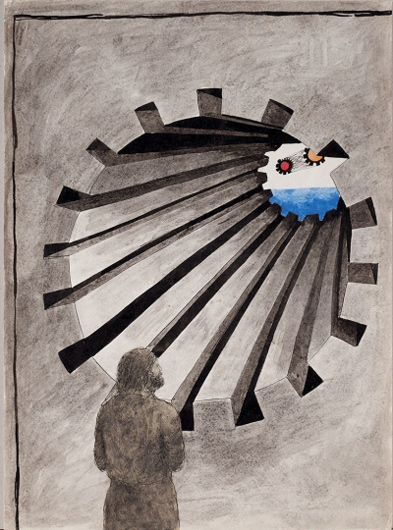 © Tretyakov Gallery Prigov Dmitry Alexandrovich. The composition from the series "wells". 1974
It is interesting that the catalog of the exhibition also pedals the division of Prigov’s figure into a poet and artist, placing a deliberately high -button text by Svetlyakov, telling exclusively about the negative theology and policy of the images, and Sorokinsky is much more lively, personal text (but so unexpected for Sorokin with all these “geniuses”, “creators” and “gift”, which seems to be the Sorokin parody the style of modern Russian conservative art critic), which, of course, is primarily about literature. Sorokin distinguishes important: “The poet (Prigov. - r unit ) writes on behalf of Homo Soveticus ' A, who has come down from the Soviet propaganda posters of that time, completely identified with him, leaving no evaluative distance.” That is, Prigov always managed to occupy a detached meteration, while not falling into the anti -Soviet hysteria, characteristic of many writers before and after. Prigov approached his artistic work as well-understanding it as a conceptual-analytical project, reflecting over the artist’s role in the Soviet world. At least, this is how its serial production method can be perceived - poems and sketches of installations. This whole and conceptual project is more important than the allocation and implementation of individual fragments (installations) - as in the case of poetry: the highlighting of one poem - without placing it in the context of Prigovo poetics - can imagine it, for example, a glorifying police (the cycle “Apofeosis of a militer”). This is the most important feature of Prigov’s literary method, transferred to his artistic activity, but not at all read from the walls of the metaphysical labyrinth of meanings and images, in which many spectators of the exhibition can forever be lost.