
Translated material
"Freedom is my opportunity"
The 90s are considered to be a time of the emergence of freedom of political choice, the emergence of Russian parliamentarism and the end of the Soviet economy of deficiency, which replaced with consumer abundance. The head of the department of sociocultural studies of the Levada Center Alexei Levinson specifically for the project “The Museum of the 90s” talked about whether the 90s of free choice could be considered as a generation that formed at that time, ordered its freedom.
The illusion of choice
-The 90s brought us what is often called freedom of choice-domestic, social, political. Is the appearance of an alternative in the life of a Soviet man somehow the sociologically recorded?
- In fact, this is a rather difficult question. Because if we talk about mass opinions, then you can easily hear the reasoning that there was no freedom of choice, but it appeared, and the reasoning that no freedom of choice appeared, but only her illusion appeared. Although it seems to me an interesting situation when both in the mass consciousness are present both.
If we consider real life, much has changed. First of all, large enterprises were fragmented, and in this sense the life of the masses of people in the same forms and formats ceased to exist: in the morning they got up, went along the bundle at the factory, at lunchtime for a break to the dining room and so on. Previously, the number of people living synchronously and monotonously, even in a small town could reach tens of thousands - and there is no more such device, which means that its mental support is also changing. This separation involves a small, but complication of temporary schedules, coordination, routes, and finally, roles. And a choice appears. Let this be a choice between two stalls selling the same thing, but still this stall owns this one, and the other can be chosen, firstly, where to buy, and secondly, who to work. In addition, of course, consumer choice has increased sharply. The Soviet system was built on the fact that each consumer good existed in one or two or three price versions-two varieties of beer, three varieties of vodka, two varieties of sausage, etc., and the variety of assortment increased in some five years, when the same beer is already three to four dozen, made a choice in the consumer sphere wider. True, according to the research that was carried out by our center, it turns out that this choice grew mainly extensively. The difference in the consumption of different social and profitable groups was mainly quantitative or cost.
Everyone wants to be uniform inside themselves-and LGBT communities, and fascists, and democrats, and respectable United Russia. But what does “one” mean? So - indistinguishable, and hence the direct road to the undergrowth.
- But if this is a quantitative choice, then what does the choice of high -quality mean?
- Now I will explain. In fact, recognize the whole choice that I said about, somehow the language does not turn essential. This is the choice of the same type, and the difference between types of cars, clothes, some benefits are mainly formed due to brands and advertising, which ascribes different value characteristics to the same type of goods. That is, relative symbolic diversity was achieved. But from the point of view of the variety of lifestyle images, images of thought, value justification and norms that a person is guided by, Russian society remains extremely poor. In this sense, we still live in a very large extent the same. The 90s, of course, provided us with some kind of diversity, and there were more choice than in a standard Soviet existence. But the freedom of choice as the value of a certain socio-political system was not realized or realized not completely, but in the form of individual elements within a completely different organization.
- Often in your polls on political topics, respondents are ranked by age, education, place of residence, including income. That is, the possibility of choosing a household is somehow connected with the possibility of choosing a political?
-In the early 90s, we really saw that the main socio-demographic parameters according to which we conduct measurements of our audience affect its political, moral and even aesthetic orientation. At the same time, everything was stacked in a fairly clear picture: young, educated city residents - primarily male - occupy positions as liberal and distant from the Soviet (or at that time - communist) prospects. And vice versa: rural, elderly, uneducated, poor inhabitants, mostly female, occupy the most conservative, pro -Soviet, anti -democratic positions. And it seems that it was even clear why this is this: the former benefited from the fact that they brought the transition to the market and democratization to society, and for the latter they turned into negative influences, destroying the usual way of life and often leading to implements.
It can be assumed that the 90s is not that the ideal behind, but the moment when we at least somehow moved to the ideal, and now we stopped moving to it and, most likely, go in the opposite direction.
But approximately in the mid-90s, Yuri Alexandrovich Levada was the first to draw our attention to the fact that these differences in social capital ceased to play a differentiating role. At first, we noticed this on political plots. For example, when the bombing of Yugoslavia began, anti -Americanism rose in society was exactly the same for everyone and did not depend on these parameters. And almost all reactions were gradually equalized. Then Levada spoke very sharply: he believed that we received such a post -Soviet and in this sense a bastard version of the mass society, in which individuals do not differ in their reactions and behavioral attitudes and society acts as a single mass. What is important, we received this option not as a result of the processes that led to it in the West, primarily mass production and mass consumption. In general, a lot came through those doors.
- What was such a change connected with?
-Obviously, with the fact that at the first moment all these neglected mechanisms of crushing of large public massifs and the appearance of various prospects, different politically, morally and aesthetically colored, worked for this diversity. If you want, it was a choice. In accordance with their ideas about these prospects, people occupied one or another position in political and moral issues. But since the mid-90s, our political elite, as the Soviet government did at one time, began to try to simplify the social organization. This was done then without violence, but even purely economic mechanisms were visible - say, the absorption of small businesses large, the growth of the raw material sector, very small in terms of the number of working in it, but occupies a huge place in the economy and, accordingly, politics. This is a narrowing of the prospects of the country's movement, the feeling that they reached some single possible road, was also associated with the change of political pluralism to political monism. I remember very well how this happened: at first, the ratings of various politicians, one might say, were like a forest where trees of different heights. After some time, even under Yeltsin, a picture was reached, as if a tree was growing on the grass, and this tree is a number one person. Next to him in the form of a backup there is a person number two, vice president or prime minister, and that’s all. The rest is small shoots. And this picture is still preserved. All this narrows the field of view and sets up optics so that it does not seek diversity and, accordingly, reacts to everything uniformly. Moreover, uniformity is also politically encouraged. All our parties and political organization unites the slogan of unity. Everyone wants to be uniform inside themselves-and LGBT communities, and fascists, and democrats, and respectable United Russia, and anyone. If we are one, we are invincible - this is a slogan that everyone accepts. But what does “one” mean? So - indistinguishable, but from here the direct road to the undergrowth.
Reconstruction of the Soviet
-There is such an opinion that, in spite of any freedoms, in people it is still strongly the Soviet worldview. Did the 90s change something high-quality in this regard?
- I am not a supporter of either the words that nothing has changed at all, nor the words that now there is a complete return to the “scoop”. Completely different basic processes occur, but in politics, for lack of the best, a return to certain symbolic forms, so to speak, to the old, “pre -perestroika” ways of placing people in political space, are made. Of course, in relation to today, the 90s act, if not the time of really greater variety, then for sure, when the potency of the variety was much higher. And we can assume that the 90s is not that the ideal behind, but the moment when we at least somehow moved to the ideal, and now we stopped moving to it and, most likely, go in the opposite direction.
“But there is something that has definitely changed?”
- Yes. A very important role was played by the freedom of communication with the outside world, first of all, with the Western world with which Russian society has traditionally correlated itself. This happened thanks to the numerically grown trips of our people abroad, due to any visual and literary products, imported in large quantities. This, of course, artificially expanded the possibilities of choosing; Plus, the real choice that was in the country was added either the virtual choice created by the media, or an additional choice in the form of the possibility of staying in other countries, in other cultures, in other spatio-temporal structures. This, of course, is an extremely important thing, and the possibility of additional choice for part of our society, perhaps even more important than that life that you can just live here.
If you are in a certain social group, then there is already no choice for you. If you are a truly Jew, you must leave if you are truly Russian, you must be baptized.
- Or maybe freedom of choice is related to the problem of generations? Say, those who spent part of the conscious life in Soviet times are easier to come to terms with the lack of choice, for example, the possibility of going abroad than those who started a conscious life in the 90s.
- In general, of course, there is such a pattern, and young people appreciate the freedom of choice and the possibility of going abroad. But the power of this difference is not as great as you might think, not at times. Because emigration is, of course, a choice. But how free he is is a question. And, frankly, this is not a political question. If we recall, say, a Jewish or German emigration of Soviet times, each leaving the USSR to Germany or Israel, probably, could say that he chose freedom and realized his right to freedom of choice in this sense, but in the eyes of a sociologist a completely different process took place. And it is important that the mass process took place. When a social process takes place, which took the demographic form of migration, it seems to us that participation in this migration in each individual case is, as it were, the result of the choice. But this is not entirely true. For example, lemmings migrate with the whole flock - there are no lemmings that remain in place if they are not sick. In the case of people, there is a movement that does not cover the entire flock, but a certain social group. And if you are in this social group, then for you there is already no choice. If you are a truly Jew, you must leave if you are truly Russian, you must be baptized if you are truly Orthodox, you must go to Easter service. And besides, in the mid-90s, to our horror, we noticed that young people, who differ from their parents in attitudes regarding freedom of departure, absolutely coincide with them in attitudes about censorship. The explanation that Lev Dmitrievich Gudkov gives is that the youngest members of society, so to speak, are not armed with their own worldview and their own position, but tend to take the position of a substantially older generation, live not fathers, but grandfathers, not yet gaining their own. Therefore, the youngest respondents of our polls in very many cases occupy the most conservative or most pro -government positions.
-That is, even the younger generation, which grew up in the 90s, is still focused on Soviet as a totalitarian system?
- Yes. But here the fact is that there is a kind of transmission of the relay - Sovetsky as good from some elders to another. There is a famous British proverb: who was not left in his youth or liberal, he has no heart, who did not become a conservative by old age, he has no intelligence. And we have the opposite pattern. I will not say anything about the mind. But to become left with age and support Zyuganov - this is still a really acting pattern. Although again, the point is that the choice, including the choice of political platforms, is extremely miserable, and then let you have an attitude to freedom of choice, but with it you can choose very little from it.
Protest as a choice
-Why in the 90s there was such a high protest activity? If something happened, about a third, according to surveys, they were always ready to reach a rally.
-Even if you do not take into account the completely unexplored history of the labor movement and protest, then this activity began not in the 90s, but in the 80s from the strikes of miners, who seemed to show that people and people have such a weapon in their hands. And the half -million Moscow rallies also proved that the public may be unconditional force. I think the train of this impression was reflected in polls about the protest movement: if anything, then we - yes.
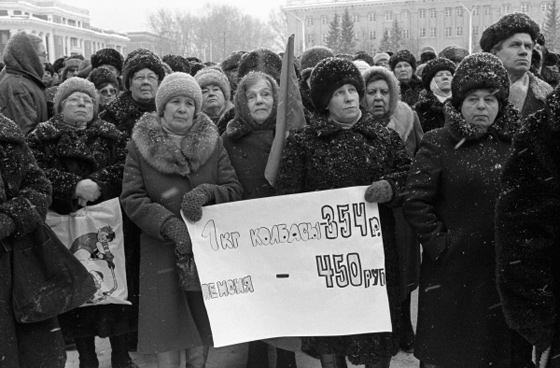 © RIA Novosti Protest Protest against prices in Kemerovo, 1992
- Is the protest activity generally related to the choice? That is, a person seems to choose to go to the rally, join a certain community to declare something.
-Well, again, if you belong to some active group, then it would rather not go with the choice and in this sense to be distinguished from everyone. It will be necessary to somehow explain it to yourself and others. And the real choice - to go or not to go - depends on your position in the public field. In this sense, if you are on the edge of something, if you are a marginal, then you are forced to make this choice, but this is the destiny of the marginal. And then, when eight people went to the square, it was still a choice of one kind, and when 80 thousand came out, there is another social mechanics. They wrote a lot about this, the same Mayakovsky, “drop with the masses” - well, what is the choice. On the contrary, a mass feeling arises: go, otherwise it is impossible. From this the feeling of power: we are one - we are invincible.
-Why then in the 90s there were quite a few resignations when a person left for a post on fundamental personal beliefs?
- This was due to how people found themselves in their posts, with vertical mobility and with elevators who have offered people. The channels through which people became officials in the 90s and now are completely different. In the early 90s, the Soviet nomenclature system broke up. People who were ready to personally take responsibility for the country came to the heights of the authorities. People of this type, recall, generally considered themselves kamikaze. A certain understanding of personal and collective duty made them take up the case of incredible complexity, take responsibility, that is, to answer, including by resignation, or even freedom or life, if you could not do it or all of us could not cope. This first, let’s say, the heroic type of leaders and leaders has already left almost the whole or was absorbed in the device. The second wave appeared. The principles of recruitment and promotion in this environment are completely different. But since the institute of nomenclature has not yet been restored, leading ties are in force. A person falls to the top of a hierarchy because he was in the same system, or worked, or studied with someone, was finally his neighbor in a country cooperative. This is another type of promotion and another idea of responsibility. It would not occur to such people to resign if I could not do it, I was mistaken. It’s not themselves, but the one who raised them will decide their fate: if he considers it necessary, he will punish, fire or, on the contrary, will cover.
The paradox of freedom
- But in general, freedom of choice is good for society? Maybe it would be calm if everyone moved by certain social ways - they received education, worked, moved by the masses.
- There is a significant part of society in which nostalgia in the Soviet situation is very widespread. These people are unhappy that they believe that they do not have a guaranteed future, there is no confidence in the future - such a tracing paper that existed in Soviet propaganda and concerned capitalism, and now transferred here. Yes, for such people a forced choice, the incomplete certainty of the future is a sign of a wrong life. And for them, by the way, all spells do not work about stability, because what is stability if the prices are changing? In Soviet times, the price was stamped on a spoon. The fact that it costs 7 cents was the same attribute as its name as the name of the factory where it was made. Сейчас этого нет, они от этого страдают. Их чувства — это выражение тоски по некой стабильности, которая, кстати, была часто связана с отсутствием выбора или очень узким выбором. По результатам наших опросов подавляющее большинство граждан, которых можно назвать избирателями, стоит за то, чтобы у нас была или одна, или две крупные партии. Иметь три-четыре или много партий — это уже желание незначительного меньшинства.
Когда на площадь выходили восемь человек, это все-таки был выбор одного рода, а когда выходит 80 тысяч, тут другая социальная механика. Возникает массовое чувство: идем, иначе нельзя.
Словом, люди хотят не широкий выбор, а альтернативу. Чтобы одного кандидата или одну партию пугать тем, что выберем другого или другую.
— То есть даже при ностальгии хочется чуть-чуть свободы выбора?
— Да, тут дело в том, что ценность если не выбора, то выборов все-таки присутствует. Ведь вот что очень интересно: российские избиратели ни в грош не ставят демократические институты в виде Государственной думы, а уж тем более законодательных собраний местного уровня. Депутатов просто смешивают с грязью, на вопрос, чем они занимаются, самый распространенный ответ: они занимаются тем, что набивают себе карманы. Накануне выборов люди десятилетиями ожидают, что будут фальсификации, после выборов уверены, что фальсификации были, но сами результаты выборов признают. Казалось бы, если вам безразличны результаты выборов, зачем вам сами выборы. Но публика за них держится. Выборы самоценны. Для одних — как хотя бы потенциальная возможность проявить свою политическую волю, а для других — как традиционная демонстрация лояльности существующему строю. Для таких случаев вместо слова «выбирать» есть советское слово «голосовать».
— И свобода выбора важна не как возможность выбрать, а как потенциальная возможность?
- Yes. Ведь внутри самого понятия свободы заключен тот же парадокс. Свобода — это не обязательно то, что я реализую. Свобода — это моя возможность. А уж я решу, реализовать ее или нет. Это и есть идея свободы.