
Translated material
2 strategies for one president
What geopolitical choice will Putin make in response to the sanctions of the West
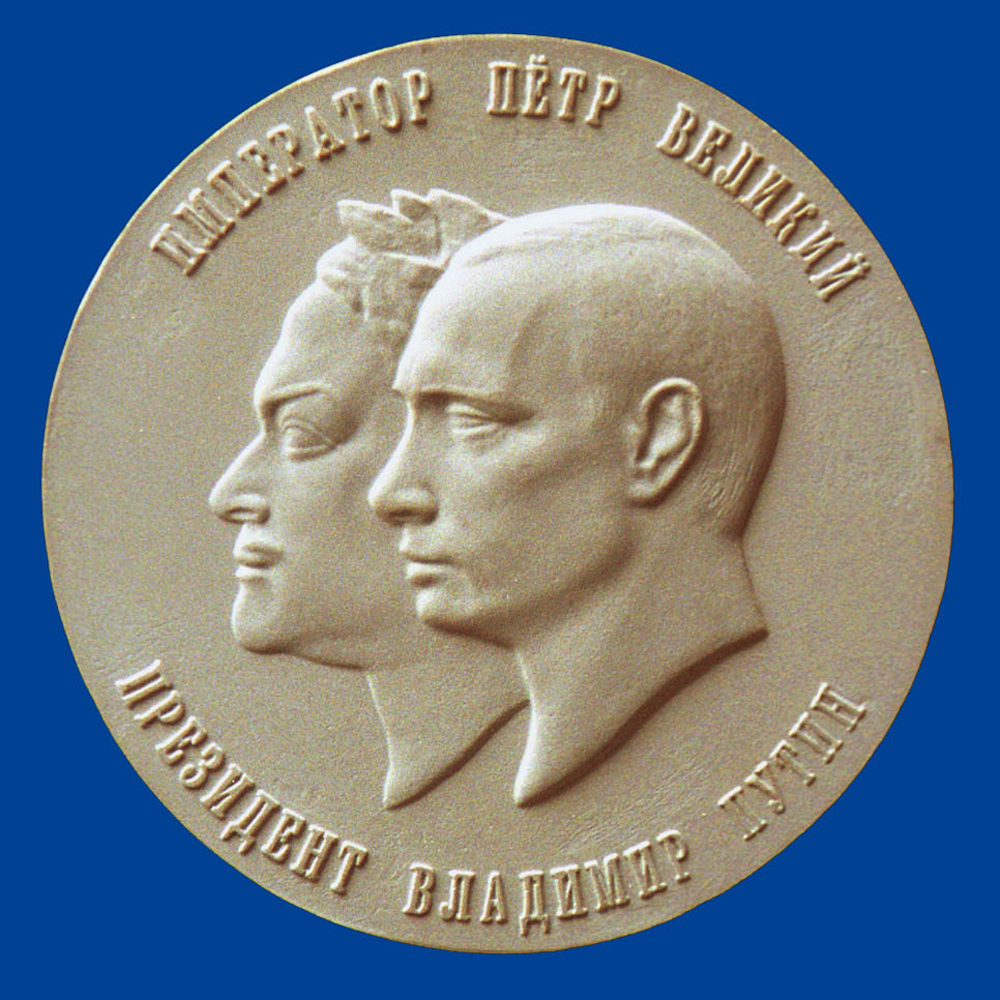
This is how a memorable medal looks like "worshiping the memory of citizen Minin with the first persons of the Russian state." It was released in Nizhny Novgorod /Photo: Nikolai Moshkov /ITAR-TASS
The merit of Vladimir Putin is often charged with activity in the foreign policy arena. In fact, over the past 15 years, the Russian foreign policy has been, so to speak, reactive: friendship with partners in Europe or behind the ocean suddenly broke out, but often it ended just as unexpectedly. Immediately after the attacks on September 11, 2001, Vladimir Putin called George Bush Jr. and the “novel” of Russia with the United States began, which lasted before the Americans’s invasion of Iraq. Then we became friends with the Europeans and, based on the “confrontation of the destruction of the world order”, almost “Moscow -Berlin - Paris Oxes” arose. But the Europeans did not suffer too rough attempt by Moscow to make Viktor Yanukovych to the President of Ukraine in 2004-and the paths dispersed. Well, then Russia began to glance towards China with visible lust and more and more doubt whether it needed the West.
In the middle of the second decade of the century, convincing itself that the West is in a historical decline, Moscow considered it already unnecessary and the very need to reckon with the West - if you can take what is bad, we must take it. So there was an adventure with the annexation of Crimea: a lonely, but imagining great country, decided to act "on the situation."
"
The tactics of Moscow in eastern Ukraine suggests that it does not have a strategic initiative
"
The consequences of this enterprise are fully unclear. That is why the further steps of Moscow are evaluated through the prism of whether Western sanctions will be tightened and how far they will go. The idea of the absence of a strategic initiative in the Kremlin also leads the tactics of Moscow in relation to Eastern Ukraine: “humanitarian” grounds for interference there are much more than in the Crimea, and there was no intervention and not.
However, no matter what the events go, it is clear that Putin in the face of Western sanctions will have to make a strategic choice. Let's try to do it for him.
Political vassalization
Today in front of the owner of the Kremlin, the choice of two strategic lines - “Chinese” and “European”.
The first can conditionally be called the "strategy of Alexander Nevsky." At one time, this Grand Duke, reckoned with the Russian Orthodox Church to the face of the saints, defeated the Teutonic knights who went to Rus' with the Crusade and sought, among other things, to turn it to their Catholic faith. The prince of the Novgorod Republic considered that such “Europeanism” is useless to us - and the parallels with the attitude of the current Kremlin to new European principles are very appropriate here - and decided to give his policy a little “multi -vector”. Not being conquered by the Mongols and in many respects understanding that their campaign in Kyiv in 1240 and Hungary in 1241–1242 leaves the Severorussian lands safe, the prince began to travel to the Horde (adjusted to distances and logistics of that time) almost more often than the “tsar” Vladimir to Beijing - as a result of Russia, as a result of Rus' was formed as quite “anti -Western” and more than “traditional” and more than “traditional” power. For many centuries, the rejecting European practices. Moreover, it was so successful that Novgorod also seemed to one of its greatest overlair and was indicatively “cleaned” in 1570.
Today, Russia again turns away from Europe and looks to Asia. The logic is the same - we are running from the West not because of its technological weakness or financial failure, but primarily because we consider it not enough conservative and traditional, unrequited ideas of geopolitics of the 19th century and incomprehensible values of life government. All other “claims” of Putin's Russia to united Europe are completely secondary.
China will allow Russia to put forward the most delusional initiatives from which will immediately reject
"
What in this case can be a “Chinese” strategy? Its basis will be the political vassalization of Moscow in relation to Beijing. Over the next decades, Russia will become weaker in relation to China. To break this trend, Russia needs to grow by 12-15% per year, provided that the growth rate in China will fall to 3-3.5%. At the same time, Russia does not even ensure the simple reproduction of the existing potential either in the military sector or in the field of infrastructure, while China is rapidly moving forward. In this situation, the union of an industrial leader and a raw materials vassal does not look like something unusual. Over the past 10 years, the supply of Russian raw materials to China has grown by 5.2 times, and the supply of industrial goods from China to Russia - almost 26 (!) Times. These are typically colonial economic relations: the metropolis buys raw materials from the colony and gives it loans to build pipelines for which this raw materials will supply. At the same time, China is clearly ahead of Russia in the perfection of democratic imitations, and Kremlin political technologists should still learn from him.
In foreign policy, Russia will be a kind of “mine trawl”: China will allow it to put forward the most delusional initiatives, from which it will immediately be rejected in the event of their obvious unrealism or danger.
Such a strategy today is most consistent with the ideas of the Russian leadership about the country and the world, in particular about the “energy superpower”, “healthy conservatism” and spirituality, the “patriotic” elite and a largely hereditary ruling class. With China, as Russian leaders hope, it will be possible to agree on the division of the spheres of influence in Central Asia, “put in place” America, and secure a reliable future. In the West, it will be possible to purchase all sorts of fashionable things: Eka Nevidal, even the Kremlin - and the Italians built it. But Rus' will remain itself, albeit backward - which is not so important, since there is a chance for canonization.
This scenario today is very likely primarily because it is beneficial to all parties (that is, all those who are away from Russia): China will receive the raw materials necessary for it at the right cost (not in vain the agreement on the supply of Russian gas is supplemented by the secret protocol on the price on May 21), the West will gain Russian brains that will flow away from the country even faster than oil and gas (but only in the other direction). The ruling elite will be satisfied with money - she does not expect more from life. After 50–70 years (adjusted for the speed of “historical time”), Russia will think about where it has ended up.
Remain Europe
The second strategy can conditionally be called the "strategy of Peter I." Yes, Tsar Pyotr Alekseevich led politics rather tough, in modern language: he took away the Azov from Turkey, from the Sweden - the Baltic coast, and in modern Ukraine, he also “disagreed” well. However, this person understood that the power of Russia - in its potentially leading role in Europe, and in Europe it is not a tradition that is appreciated, but the ability to create conditions for changes and orchestration.
To repeat such a strategy in our time, it would mean to put a rational goal -setting above ideology, and the interests of the state are higher than the current lusts of the elite. The sanctions are not critical - and not the fact that they will be tightened and that the West will be ready to finally ruin relations with Russia. Crimea, South Ossetia and Transnistria are not the territories for which Europe will demonstrate its principles. Without even returning the Crimea to Ukraine, it is quite possible to agree on the settlement of relations with all interested parties: through a system of discounts, preferences and economic concessions to restore impaired mutual understanding. Ultimately, it is possible to formulate the international charter of humanitarian intervention by bringing the disputed territories under it on Russian borders and recognizing the legality of American operations in Kosovo or the behavior of many European powers in Africa.
Isolate from Europe is to leave the only part of the world space where Russia still matters
"
Such a strategy may be unpleasant and incomprehensible to some Kremlin officials, but it would allow Russia to preserve Russia as a European country. And now this is extremely important - not even because the Russians are so dear to European values, but because Russia has not yet lost the status of one of the largest powers in Europe.
China, to which we are so linos recently, “inscribed” in the Asia-Pacific architecture-and at that “theater” Russia has very weak positions. We are turned to the east with the weakest part of our territory: the GDP of Zauralsky Russia is almost 2.8 times less than the GDP of South Korea, not to mention Japan, China or such a Pacific power as the United States. In Europe, we remain one of the leaders and at the same time have resources - natural, intellectual and cultural - which are in demand by Europeans stronger than anyone else. Europe today is not enthusiastic about military games - which is good, since we are actually no resources for their effective playing. “Our Crimea”, but Donbass, if followed by it, will be on the neck of Russia a real mill mill. Europe, “dying” and “decadent”, has expanded over the past 20 years from 12 to 28 countries - and without any tantrums and violations of international law. Isolated from Europe is to leave the only part of the world space where Russia still matters. Yes, and the “Europeanism” does not harm the patriotism-at one time Russian patriots, who spoke mainly French, the Napoleonic “Great Army” ...
Choice
So in favor of which of the strategies will Putin make a choice? The problem is that in Russia there is no policy today - neither domestic nor external. There is only the will of one person manifested in the actions of the state. Given its life attitudes, we can unequivocally assume that the first option will be chosen. Mythical “Russian values” are important to him - and the Chinese will not try to change them with the proper payment of raw materials “Dani”. He knows how to either order or execute, but not to agree - and he will be more comfortable to become a clerk of the Beijing regional committee than a partner of Brussels. He does not want to control complex systems - and therefore Russia is doomed to remain a raw material country and look east. Finally, he with skepticism refers to democracy and freedom, and this also adds a chance of orientation towards China. Orientations, the true conditions of which will not be set out in detailed agreements scheduled for hundreds of pages, but, like May 21 in Shanghai, in short protocols classified for many years.