
Translated material
The choice of Ukraine
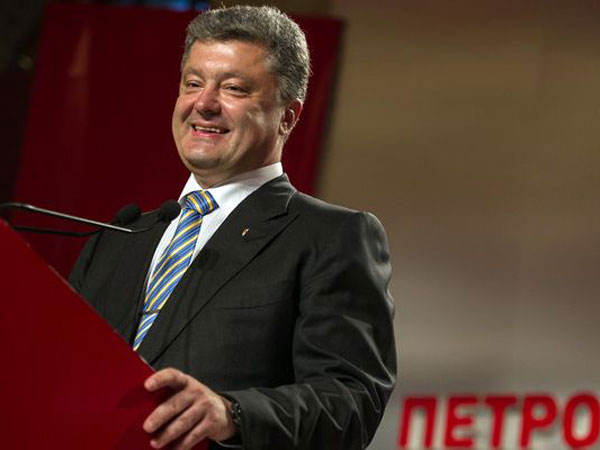
In Ukraine, the presidential election took place. So far, the official result has not been announced, but we can say with confidence: the politician and businessman Petro Poroshenko, as predicted polls before the elections and on the exit from the polling stations, won the first round, gaining more than 53 percent of the vote.
The second result was shown by Yulia Tymoshenko, who scored a little more than 13% of the vote. She did not count on the victory on the first round, hoping only to get into the second round-but even this did not succeed in the ex-Prime Minister.
The third place with the result of 8.5% was taken by the leader of the Radical Party Oleg Lyashko. In principle, it, and not just the Mass Media promoted by the Russian masses in the last months of Oleg Tyagnibok and Dmitry Yarosh, can be considered an exponent of the ideas of Ukrainian nationalists (before that, Lyashko was also loved to scare in Russian television programs). Lyashko is one of the few politicians who offered to start a full -fledged war of Crimea with Russia, he introduced a bill to the Verkhovna Rada, who, if adopted, would declare all participants in “separatist rallies for joining Russia” by traitors of the homeland, and would also allow saboteurs, murderers, marauders, deserters and spies. However, this figure is often compared with Vladimir Zhirinovsky, but put in other conditions. The same tendency to shocking and a loud phrase, backed in this case by personal participation in special operations. Against the backdrop of the actual hostilities in the two eastern regions of the country, as well as a sense of threat of a full -scale war, such a position seems to have support in Ukrainian society, but not too extensive. The specifics of the situation include the high result of another policy associated with the war, but Anatoly Gritsenko, ex-Minister of Defense of Ukraine, is quite moderately pro-European-ex-Minister of Defense of Ukraine.
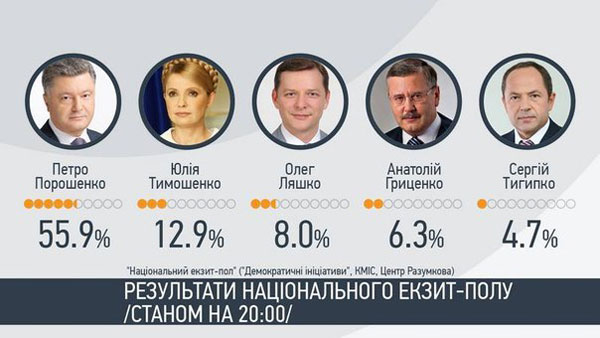
Approximately the same result as Lyashko, only two, scored two candidates associated with the East - Sergey Tigipko and Mikhail Dobkin took 5th and 6th place in the race. Politician and businessman Sergei Tigipko made a serious application in the 2010 presidential election, but began to lose popularity after joining the Yanukovych team. Being the most rating politician of the Party of Regions, he could count on a nomination from it, but was not sure of him, so he moved on his own. The insecurity was justified-the party nominated the ex-governor of the Kharkov region Mikhail Dobkin.
The turnout in the past elections is a difficult question. According to the absolute number of citizens who came to the polling stations, it is difficult to compare the previous vote with the previous ones - the elections, of course, did not pass in the Crimea (some Crimeans voted in other regions), they did not take place on a significant part of the Donetsk and Lugansk regions. The entire elections were not held in 37 out of 225 electoral districts of the country.
However, according to the adopted Verkhovna Rada in March, amendments to the law on the election of the President of Ukraine, if the elections were not held in a certain constituency, then it is not taken into account in statistics and, thus, does not affect the data on the percentage of turnout.
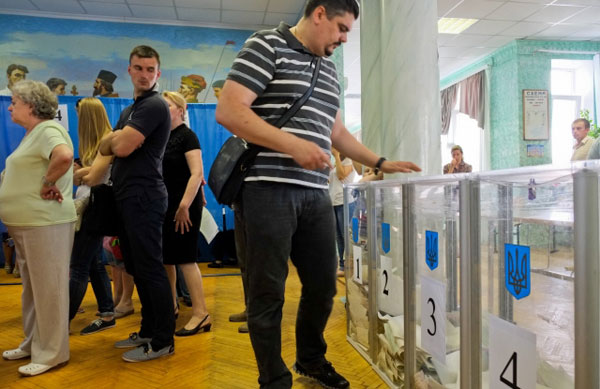 Elections in Ukraine. Photo: 048.ua
Residents of Ukraine traditionally go to polling stations with great pleasure - in 2010, in the last presidential election, the turnout amounted to 69.15%. This time, the turnout with difficulty exceeded 60%, and this is given the mentioned reservations. This is most likely explained by the lack of interest in the elections of a noticeable number of residents of southeast of Ukraine. Less than half of the voters came to sites not only in the Donetsk and Lugansk regions, but also in the relatively peaceful on May 25 of the Kharkov and Odessa regions.
In general, past elections allow us to talk about the end of the country's political division into southeast on the one hand and the center with the West on the other. After 2004, in the political plan, it was customary to divide Ukraine into the “orange” and “blue and white” parts, the electoral forces of which were in the first approximation, which made it possible to constantly change the president and parliamentary majority. Although the thesis about the division of the country into two half arose another ten years before, during the first election of Leonid Kuchma to the post of president of Ukraine in 1994.
Petro Poroshenko won not just in all regions of the country. He was in the first place in all except four constituencies. A little less even, but also surprisingly stable result was received by Yulia Tymoshenko: she took second place in 17 regions out of 25, and lower places gave her voters of the eastern regions and Odessa.
In other words, Poroshenko was not chosen by the inhabitants of Western and Central Ukraine, as it was partly with Viktor Yushchenko, not the population of the south and east of the country, as was with Viktor Yanukovych, but all Ukrainians, let them go to the voting and less willingly.
After the vote, Petro Poroshenko confirmed that he was a supporter of the early parliamentary elections. According to the 2004 Constitution, Ukraine is a parliamentary and presidential republic, but the popularly elected head of state will no doubt have a significant weight in the country's political life.
“When there is a parliamentary crisis, the only way out of this crisis is the election. In the presidential election, we demonstrated this. According to parliamentary elections - I am sure that they should go through this year, ”he said on Sunday evening. The main reason why the country needs to elect a new parliament, according to Poroshenko, is the lack of a coalition in the existing Verkhovna Rada. “Today, there is no coalition, and in the conditions of military occupation and the challenges that Ukraine has encountered today, the country cannot afford to exist with parliament, which blocks decisions that, among other things, are aimed at the country's defense,” Poroshenko said. He also recalled that deputies are still sitting in parliament, who voted on January 16 for laws, sharply limiting freedom of speech and meetings in the country.
It was previously believed that the early elections to the Verkhovna Rada, which was formed only 1.5 years ago, can be avoided - the majority that Viktor Yanukovych’s supporters used to be on the side of the new government. However, on the eve of the presidential election, various politicians spoke about the prospect of parliamentary.
The main foreign policy task of the new Ukrainian authorities, in whatever offices they sit - relations with Russia. Petro Poroshenko, before the election, said that he was ready to negotiate with Moscow, he carefully confirmed the same position in the evening of Sunday.
Poroshenko believes that the current state of bilateral relations is the most difficult over the past two centuries, but the beginning of negotiations has already been laid in Geneva and they should continue - through the mediation of the United States and the European Union. “I think that today we can negotiate with Russia with the participation of the United States, the EU, as well as in other formats,” he said.
The official reaction of Moscow to the past elections has not yet been. According to Foreign Minister Sergei Lavrov, Moscow heard Peter Poroshenko’s statements and is ready for negotiations with him - and preferably without intermediaries. Before the elections, Russian leaders made it clear that under certain conditions, the elections could be recognized.
But no matter what statement on the results of the vote is announced by the Foreign Ministry or even the President of Russia, for many, the plot was indicative, which was shown on Sunday evening in the news of Channel One. According to the presented schedule, which was allegedly published on the website of the CEC of Ukraine, the first place by a noticeable margin is occupied by the candidate from the Right Sector Dmitry Yarosh, while Peter Poroshenko is behind him by as many as 7.5 percentage points.
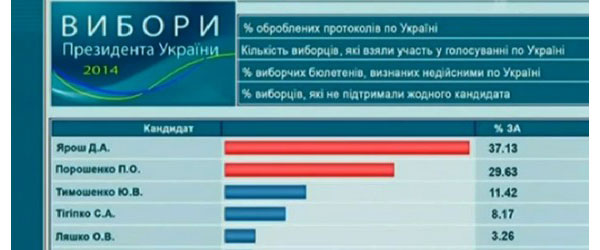
Ukrainian journalists have already found an explanation for the strange schedule of the first channel: according to sources in the SBU, these numbers were really supposed to appear on the CEC website, since the system was infected with a virus, which was “caught” just a few tens of minutes before activation.
Be that as it may, to the good neighborly relations of Russia and Ukraine, it seems, is still far away.