
Translated material
About freedom of assembly in Crimea: New realities
On May 16, the Crimea Council forbidden the conduct of mass events in the territory until June 6, explaining this by “continuing events in many cities of the South-East of Ukraine, which there are victims and victims from the civilian civilian” and the goal of “eliminating possible provocations from extremists who have the opportunity to penetrate the territory of the Republic of Crimea, in order to avoid the breakdown of the resort season in the Republic of Crimea”. Local authorities were proposed to cancel the events already planned for this period. The Governor of Sevastopol Sergey Avayyllo signed a similar order.
The UN report on the territory of Ukraine, which was released a day before, was, in particular, that Russian legislation introduced in the territory of Crimea establishes restrictions on the freedoms of peaceful assemblies. The deputy of the Legislative Assembly of St. Petersburg Boris Vishnevsky sent a statement to the Investigative Committee due to the fact that the decree on the ban on public events in Crimea is a violation of the Russian Constitution, since the heads of regions do not have such powers. In addition, in his opinion, this violates Article 149 of the Criminal Code (preventing the rally, meeting, demonstration, march, picket or participation in them, committed by an official using his official position) and 286 Criminal Code (exceeding official authority).
The resolution was just at the time of the traditional events in the Crimea in memory of the deportation of the peoples of Crimea (in 2014 it turned 65 from the day of the deportation of the Crimean Tatars). The chairman of the Mejlis of the Crimean Tatar people Refat Chubarov called the prohibition of events "inhuman action."
It was planned that on May 17, on Lenin Square in Simferopol, the Crimean Tatar Youth Center will hold the action “lighting fire in their heart”, within the framework of which people had to lay out the national symbol of the Crimean Tarak-Tamba people, the map of Crimea and the words “No Genocide”. However, Lenin's Square was numb, and the organizer of the action, a member of the Mejlis of the Crimean Tatar people, Escender Bariev, announced the abolition of the action.
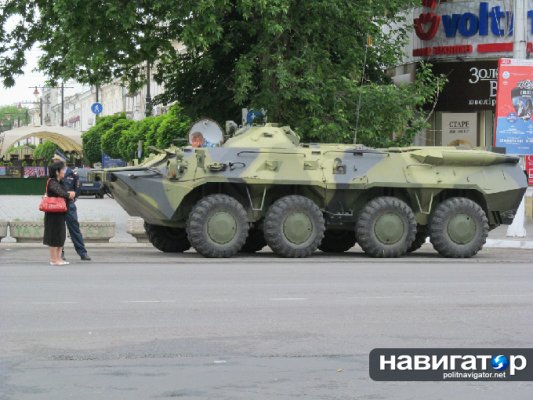
On May 18, a large -scale rally was expected in the center of Simferopol, similar to those that were held in Crimea on the occasion of a sad date for many years. However, in the document signed by the head of the Council of Ministers Sergei Aksenov, it was said that the event in the city center was inappropriate and it should be carried out in the area of the Abdal cemetery on the outskirts. On the central streets of the Crimean capital, the movement was blocked, the police and riot police were used in the cordon, as well as the BTRs , the reinforced outfits were on duty in the area of the railway station and at the entrances to the cities, military helicopters flew in the sky.
At the same time, on May 23, the Crimean Tulumbasi-2014 Cossack culture festival began on the territory of Crimea. According to Radio Liberty, the event is held under the patronage of the Council of Ministers, the press secretary of which Ekaterina Polonchuk said that the holding of the festival does not contradict the ban, since the "festival is held in different cities in closed rooms." (The publication “15 minutes” gives a more detailed explanation of Polnchuk: “It was specially selected so as not to violate the decree. That is, this festival is not one mass event. It was specially divided into various territories.”) However, the awarding ceremony of the scientific award in Turkology “The World of Bekir Choban-Zade”, which was also supposed to be held in a closed room (though not in different cities, but not in different cities, but not in different cities, but not in different cities, but not in different cities, but not in different cities, but not in different cities, but not in different cities, but not in different cities, but not in different cities, but not in different cities, but not in different cities, but not in different cities, but not in different cities, but not in different cities, but not in different cities Only in Simferopol) was prohibited, and Polnchuk could not explain why. “There are probably some specific criteria for mass events,” Radio Liberty quotes her. The rally of the memory of the executed prisoners of war to Kerch due to the ban was decided to transfer to June.
Chubarov noted that the ban on holding events until June 6 is due to the fact that on this day the festival “Great Russian Word” will begin.
Shortly before the adoption of a scandalous ban in Crimea, Article 20.2 of the Administrative Code was first applied. This happened after the inhabitants of the Crimea began to block the tracks on the peninsula due to the fact that the leader of the Crimean Tatars, the People’s Deputy of Ukraine, Mustafa Dzhemilev, was not allowed into the territory of Crimea. The representative of the Crimean Field Mission to Human Rights Andrei Krysko told the OVD-Info that no one was detained on that day, but then a number of persons were charged with violating the rules of mass events, not always presenting a sufficient evidence base. At least 49 administrative protocols were drawn up. According to the head of the Crimean Human Rights Center, Alexandra Paria, the administrative cases were instituted in five regions of Crimea, including 3 cases in Simferopol and 17 in Bakhchisarai. In most cases, the courts sentenced people to fines in the amount of 10 to 40 thousand rubles, two cases were terminated, one was sent to the police department for revision. In three cases, the protocols were not drawn up, everything was limited to issuing warnings. In all cases, appeals have been filed, the butler said.
[{"Type": "Media", "View_Mode": "Media_large", "FID": "4609", "Attributes": {"Alt": " "," Class ":" Media-Image "," Height ":" 480 "," Typeof ":" Foaf: Image "," Width ":" 359 "}}]] [{"Type": "Media", "View_Mode": "Media_large", "FID": "4610", "Attributes": {"Alt": " "," Class ":" Media-Image "," Height ":" 480 "," Typeof ":" Foaf: Image "," Width ":" 359 "}}]]
Typical decision on an administrative case
In addition, when on May 3, Dzhemilev tried to enter the Crimea, his supporters, who arrived to meet him to the border point of Armyansk, broke through the cordon of the Russian military, as a result of which a brawl occurred. On May 4, the Crimean prosecutor’s office sent decisions to the Investigative Committee and the FSB “To organize criminal prosecution in relation to guilty persons” on the fact of “illegal public actions of an extremist nature” in Armenian, “associated with riots, overlapping of the highway, illegal crossing of the state border of the Russian Federation, connected with the obstruction of the legitimate activities of state bodies, as well as the use of the application violence ". The prosecutor's office demanded to initiate criminal cases of riots, the application of violence to representatives of the authorities and the illegal crossing of the border. Crimean prosecutor Natalya Poklonskaya announced a warning to Chubarova about the prevention of extremist activities. So far, there are no data on criminal proceedings.
Meanwhile, the obstruction of mass assemblies in the Crimea was repeatedly noted earlier, including shortly after the adoption of the law of March 21 . Moreover, one of the first to feel the supporters of Crimea to the Russians to Russia: on March 30, Kerch made an attempt to stop the pro-Russian rally in support of the southeast of Ukraine. The local police, referring to Russian legislation, said that those who came did not have the right to hold a rally, since they did not submit notifications about its holding in ten days. True, in response, the rally participants said that they would not go anywhere, since the policeman is putting in the Ukrainian uniform.
However, the events of supporters of the unity of Ukraine were suppressed and accelerated by the forces of the so -called self -defense of Crimea. In Simferopol, only one site was left, in Shevchenko Park, remote from the city center.
Representatives of the local LGBT community planned to hold a gay parade on April 20 and 21 in Simferopol and April 23 of Sevastopol, however, the Executive Committee of the City Council of Simferopol and the Leninsky district state administration of Sevastopol refused to coordinate the parade, referring to the law on the ban on propaganda of non-traditional sexual relations among minors. Activists of the Moscow Gay Pride challenged these decisions in court, but on May 20 the Golovinsky District Court of Moscow recognized the prohibitions legal.
On April 28, representatives of the Russian Ministry of Internal Affairs prevented the holding of a rally in Sevastopol dedicated to the problem of bribery in the city and Crimea. The police demanded permits from the audience and accused of conducting an inconsistent event. The rally participants said in response that in Sevastopol there is an transition period of integration until January 1, which guarantees the right to peaceful meetings.
At the moment, there is no information about any procedural actions in the wake of mass events in the Crimea, not counting the events of May 3, the human rights activists working on the peninsula.