
Translated material
Economics on the foundation of Islam
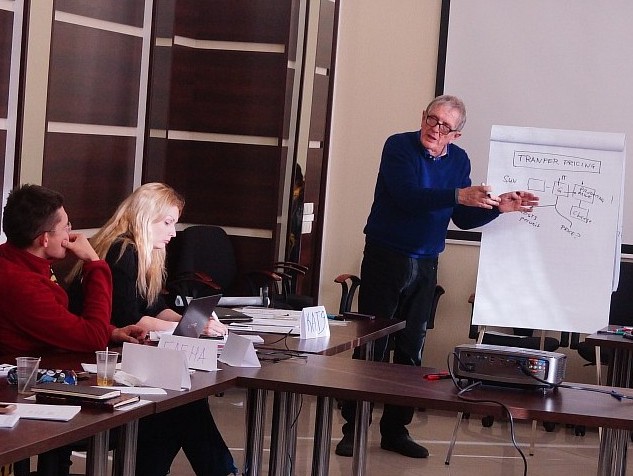
Polit.ru continues to publish materials about the Homo Religio S US lecture cycle, held by the Yegor Gaidar Foundation, the Russian Economic School and the Dmitry Zimin Foundation “Dynasty”. Professor of Kingston University Robin Mettyuz, an Englishman who accepted Islam in the middle of his life, dedicated most of his research to the Islam economy. In his lecture, he spoke about the significance of the Koran for the theory of the economy, the meaning of the zero interest rate and how important it is to die to death.
In the audience, fluff from dandelions flew - he rushed over the heads of the guests, then lay on the floor. Each movement lifted him and forced him to spin again. Professor Mettyuz appeared in the audience, raising another wave of fluff, which scattered in different directions. Putting his hands in the pockets of stitched trousers, he walked along the stage - and turned his head:
-Who speaks English here? He asked in pure British. Almost the entire audience raised her hands. - Most - for Russians this is characteristic of, they know languages, unlike the British - they have more difficult for them. But we all have difficulties with understanding Islam.
I was brought up in a Christian family and until 30 years old was a Christian. Then I decided to go to Islam. I tried to adhere to all the requirements: I prayed, fasted, made pilgrimages and observed Zakat (see below - A.N.). In order to make sure of the truth of my faith, I talked not only with orthodox Muslims, but also with atheists - they ask the most correct questions for approval or discarding faith. But even now I have not reached her understanding that I would like - this is not disappointment, but the awareness of its depth. As a person is not a blindly believer - I don’t know whether it is a privilege or my cross - I sought to get knowledge about Islam.
The value of the Qur'an
-Islam in our view became something alien to Christianity, Judaism and other religions. It is associated with jihad with us - with the zeal of Muslims on the path of comprehension of Allah - people usually narrow this concept to armed struggle and terrorism, ”Professor Matthews is indignant. - No one is interested in the real meaning of the word “jihad”, not the word “Islam”, and no one thinks about the economy of Islam. Meanwhile, my students became interested in this issue, and I followed them.
The Islamic economy is a moral structure that acts on the basis of the five fundamental principles of Islam: evidence of faith, prayer, donations, post and pilgrimage. It does not have a division into spiritual and material, and justice and generosity as the norms of ethics are part of the economy. A variety of interpretations and meanings of the same ideas by one person is allowed. In the traditional economy, the spiritual and material is strictly delimited, and the interpretation of ideas in schools always differ - they do not accept other people's explanations.
For Muslims, the Qur'an is a literary processing of the will of God, not a metaphor - therefore, the Islamic economy must correspond to Him. It has answers to almost all the questions of the economy. In 7 verses of the Koran, the interest rate is mentioned, and 20 verses - charity, generosity - the basic principles of this economy.
Usually they talk about the economy as a science whose schools reduce it to interest rate policy. This is such a policy with the help of which the government affect interest rates, regulating the volume of their debt obligations. Higher interest rates will restrain investments and reduce the demand for money, being a factor in reduction of both employment and prices. All schools talk about the zero interest rate as a state where the bank is not able to further reduce the interest rate to increase the money supply and stimulate borrowing. In my opinion, we exaggerate the importance of this bet and profit.
For example, Zakat - a Muslim tax - requires transferring 2% of its wealth poor during the month of Ramadan. The generosity is “built” in Islam, this feature simply discourages the modern economy with its stimulation of consumer interest and the squandering of individuals.
Exploring society, sociologists note a huge gap between 99% of ordinary citizens and 1% of the rich. The latter, due to their high income, has a very high level of consumption, with their existence they support the capitalist economy and at the same time drive it into a crisis. It so happened with today's Europe with its irrational distribution of income-the professor looked at the audience over his glasses-yes, because of this, the crisis came in it. The Zakat proposes to limit the rich (speaking of the macroeconomic level - a country with a powerful economy), scattering their income between other segments of the population (between the country's weaker countries). The interest rate should be limited to the principle of justice - no one should have excesses, no one should openly demonstrate their wealth.
The spirituality of science
- Earlier, in the Middle Ages, the availability of great profits was considered to be wasteful. In early Islam, interest in profit was zero, most exchanges were in the form of a barter, there was no inflation. That economy was not sensitive to crises. Money existed as a means of a certain account, for convenience. As a result of such a zero growth, the amount of gold did not grow, it did not circulate, nothing arose. This idea of zero income exists in the Qur'an and develops in the Islamic economy.
However, can such a economy that is based on faith and authority be considered a science? After all, each science is based only on facts, and we are talking about some ethical and religious norms-Robin Matthew seemed to have dismissed this idea, but in fact-from the face of the face. - I believe that this is permissible and necessary for every economy.
- Initially, in every science, in every theory there is an axiom - the core that is supposed as obvious and does not require evidence. What if you try to prove this core? This is unlikely to work out, because it is simply accepted by scientists. Consequently, the logic of each science is not complete, it is one -sided and this is the disadvantage of this - the product of religion is more logical because it is based on faith in God. This means that any science can be changed, new principles can be introduced into it - they can be based on Nazism, fascism - can become destructive and make science not at all what it was originally conceived for. In religion, multiple interpretation only more reveals the creative sides.
Accepting axioms for granted, scientists use spiritual, intangible ways to comprehend the world. There are two such paths: the path of faith and the path of striving for knowledge. Going into a blind faith - not my option - I choose the second path. Like any scientist, I believe that in all sciences, in everything, there is its own core, truth - and I want to achieve its very essence. But while I have only assumptions, with my thoughts I move further from the end.
The desire for knowledge leads to the problem of perception - how can I comprehend the interest to me in Islam? Of course, through such a classic direction as Sufism. This is a mystic-ascetic current. The basis of any mysticism - Sufism, shamanism, etc. - lies the postulate that we live in the world of illusions - reality is hidden from us with a veil. They all say that a person is not able to withstand even part of this reality. He prefers to explain it with his terms, to make her accessible to himself, but in this way he moves away from her throughout his existence and comes to her only at the end of his life.
The Tibetan “Book of the Dead” says that the dying person sees reality before he goes into the world of karmic illusions. A similar prophet in the Qur'an is also said - before death, we see the truth and do not believe it - and we do not believe because it does not correlate with what we used to believe in. Most of the Sufis use the term “die to death” - with the help of meditation and the right regime, they come to realization of reality throughout life. Such a “insight”, the removal of the veil of Sufia is called “Tajali” - it allows not only to approach true meaning, but also to look at it from a different angle - because the truth will be true from all sides. Tajali can be false-in unenlightened ones, but everyone probably experienced a “barakat” in life-this is a sense of peace and peace in some state or some kind of thing. Barakat allows us to accidentally feel Tajali at some point. These terms are used in order to explain that the area in which we live is illusory - and behind its frames is not one, but an infinite number of spheres of reality.
Spheres of being
- The paradox of Islam is that for him being is one, indivisible, but in it there are simultaneously spheres of being, which are multifaceted and interconnected. We cannot talk about the unity of being, because we cannot comprehend it in all its integrity, but we are talking about him, ”Professor Matthew shrugs and grins. - If we are talking about the unity of being that everything is one, then we must say that there is no individual consciousness - it is an illusion. It turns out that the consciousness of people, animals, plants, machines is collectively.
For example, I often noticed that modern churches are built in the same places where they used to build their sacred places “primitive” peoples and past generations. Once I went to one city where excavations were carried out-archaeologists claimed that they dug up everything that was filled with sand. After some time, people decided to build a mosque near this place, and when laying the foundation, it turned out that they were going to build it where the old temple was not yet opened.
The Swiss psychiatrist Karl Jung spoke in one of his works about the synchronization of several levels of being - that one can be in another and so on, until you know all the unity as a whole. However, the experiments of the synchronization psychiatrist did not lead to any results, from which we can conclude that reality for a person is in most cases unknowable.
Remember how the disco ball looks -it has a huge number of faces, similar to each other, but differently reflecting various parts of reality. This is how the unity of being and its spheres look. At the same time, it reminds me of the bulb - its layers can be removed one after another, all of them will be equivalent parts of the bow and there will be no final base in them.
The spheres of being are diverse, they have their own grammar and interpret reality in different ways, from them all new meanings can be obtained-all of them will be true, all together will make up the unity of being. Dhat (essence) is another term of Sufism - this is pure data that exist in all areas of being - we do not see them, but we can partially realize with the help of our grammar. However, interpreting the endless spheres of reality, we averaging them, they are incomprehensible through our normal perception. Many religions allow the plurality of interpretations - this is their logic and wisdom.
But we cannot go along different paths at the same time - we must choose one path and it will be true for us. All other interpretations will exist, but we can only understand them with Tajali. An important economic principle of risk separation is associated with this idea. The Qur'an says that the risk should share between the investor and the borrower. One of the partners should not take on all the risks, otherwise it scares and limits it, the sharia - Islamic jurisprudence forbids to do this. The modern Islamic economy has been preserved in the form of payment for capital management.
The inferiority of the economic system is becoming more and more obvious, ”Matthew believes. -The whole system of regulation of the Islamic economy is built on the basis of the Qur'an-this is not that the 300-page regulations that adopted the US Parliament. Who will read and comply with such a set of rules? Religious books, meanwhile, read the vast majority of people. Having summarized all these facts, is it time to unite religion and science? - the professor finished his apology.