
Translated material
Goat instead of a pharmaceutical factory
There is an old joke about a girl of an abstract who, in a ticket on an exam in biology, came across the question: "What do proteins do in the cage?" She wrote: "Squirrels in a cage drink water from a drinker, eat nuts, spin in the wheel." Although the examiners argued that in the issue it was about the functions of proteins in a living cage, and not about the classes of protein in captivity, after the appeal the answer was estimated, since the formulation of the question also admitted another understanding.
It is not known whether such a story happened in some university or all this is an invention, but it should be noted that even if the compilers of questions had stressed and wrote: “What do they do in a cage?”, Their question would still look very strange. Because in this case, the applicant could write one word: “everything” - and claim, if not excellent, then a good assessment.
Squirrels are building materials from whichthe cytoskeleton consists of a “frame” of a living cell. Squirrels are body engines, because the contracting fibers of our muscles and tendons consist of proteins (myosin, collagen and others). Proteins-catalyst enzymes that control numerous chemical reactions that provide digestion, breathing, work of the nervous system and much more. Squirrels are transport that transfers molecules of different substances through the cell membrane and delivers them to the right place. Squirrels are protection, because immunoglobulins are also proteins. The storage of genetic information and its delivery to ribosomes, however, fell to the share of not proteins, but nucleic acids of DNA and RNA. But the operation of DNA and RNA is provided with a dozen specialized proteins: DNA doubling provides DNA-polymerase protein, RNA polymerase proteins synthesize RNA based on DNA, ribonuclease proteins break down unnecessary RNA molecules, and so on.
With so many important protein functions, it is not surprising that many drugs are also proteins. Often the cause of the disease is the absence of a certain protein in the body. Then it needs to be added to the body artificially. So, the task of the pharmacist is to synthesize the desired protein.
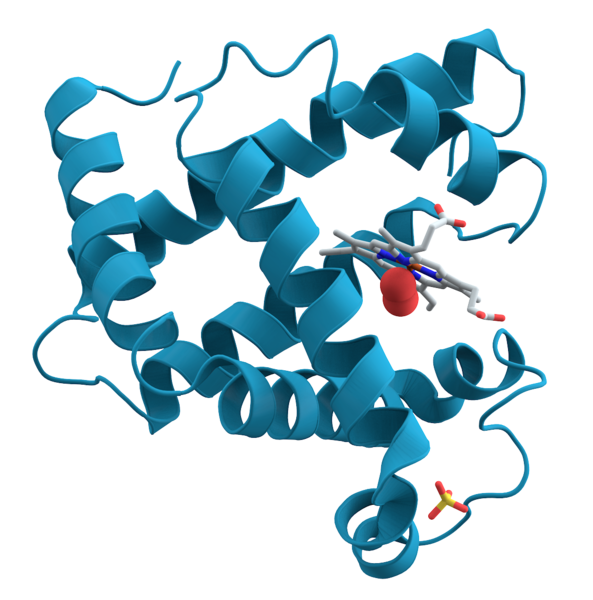
If the cause of the disease is the lack of a certain protein in the body, the task of the pharmacist is to synthesize it for artificial administration into the body.Here difficulties begin. The fact is that protein is a rather complicated thing. From school, we remember that proteins are polymers, chains of amino acids located in a certain sequence of amino acids. It would seem that connect the amino acids in the right order - that’s the whole synthesis. But the amino acid sequence is only the so -called primary protein structure. Due to the hydrogen chemical ties or forces of Van-der-vals, acting between the “links” of the amino acid chain, this chain acquires a certain shape, for example, spirals, loops or a number of zigzag folds. This is a secondary structure. Then the chain according to a certain scheme is folded into a “ball”, forming a tertiary structure. And some proteins also have a quarter structure - the unification of several "balls". How complex protein structures are, you can admire the example of hemoglobin , myoglobin and insulin .


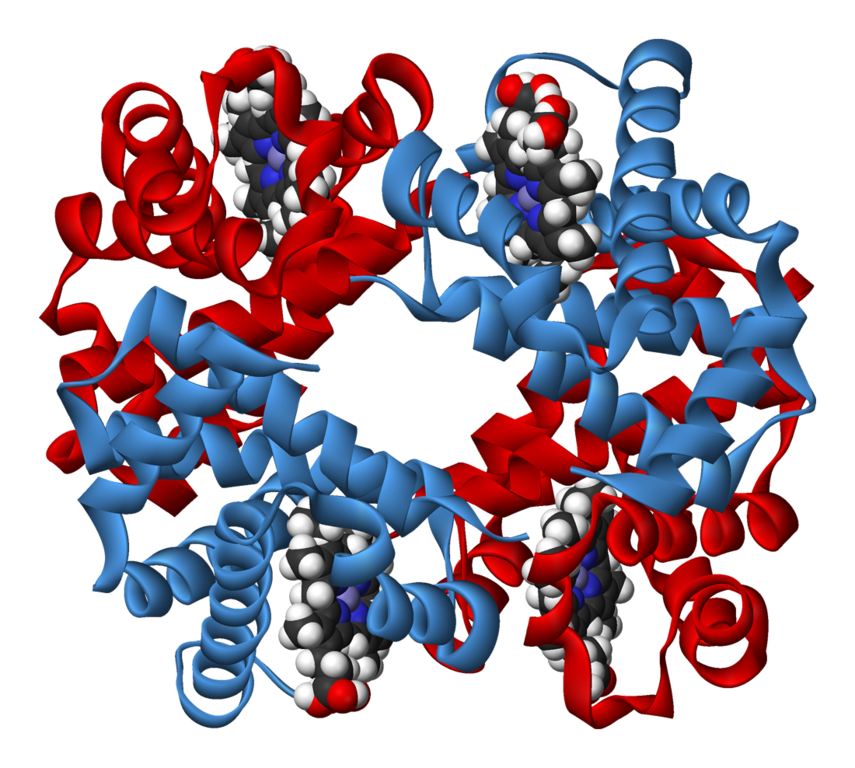 The structure of the hemoglobin molecule
And this is by no means randomly crumpled amino acid chains, but strictly defined, their own for each protein of the structure. If in the process of synthesis the "ball" begins to curl up incorrectly, we need to get the protein, our medicine will not work. Therefore, it is difficult to synthesize many proteins in the laboratory, what can we say about obtaining them on an industrial scale. Although living organisms cope with this.
Maybe then a living organism will become our pharmaceutical factory? This idea has arisen for a long time and has been successfully embodied. By methods of genetic engineering, scientists introduce the desired gene into the genome, and as a result, a certain protein begins to synthesize in the body. In 1982, insulin was the first such protein, which was “taught” by bacteria to produce. In 2009, Atryn was approved in the United States, saving from excessive blood clots in blood vessels (due to deficiency of antitrombin protein in patients). The drug was allocated from the milk of goats, in the genome of which the human gene was introduced.
Such work is carried out in our country. For example, they are engaged in Transgenfarm LLC, a resident of the Skolkovo Foundation. We will talk about the work of scientists from Transgarm to receive Lacterrin.
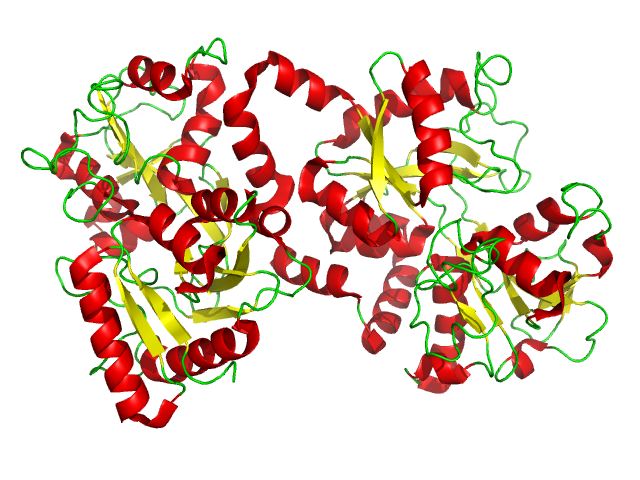 The structure of the Lacterrin molecule
Lacterrin - protein with various functions. Firstly, it belongs to a group of proteins that provide the delivery of iron ions to the cage. But the main thing is that Lactorerin plays a very important role in the work of the human immune system. It is called a natural antibiotic. This protein binds the iron necessary for bacteria, and they die. If stability can be developed for artificial antibiotics in bacteria over time, then this does not happen with lactoerrin. Lacterrin’s action on viruses was also found, there are studies that revealed the antitumor activity of this protein. In the body of the child, whose own immune system has not yet earned at full capacity, lactoperrin enters the mother’s milk, where it is especially a lot of it.
But if the child is fed artificially, then he does not receive the necessary lactoerrin. So you need to provide it with this protein. Lacterrin especially needs premature children. Also, lactoferrin can be supported by an immune system and an adult at moments when it experiences special loads.
Transgarma scientists have developed a technology for obtaining a natural antibiotic - lactoerrin milk protein.Scientists began with experiments on mice. This protein appeared in milk laboratory mice who received the lactoerrin gene. But mice are poorly suitable for the production of medicine. Therefore, in 2007, Transgarma experts working at the Institute of Biology of the Gena RAS and the scientific-practical center of the NAS of Belarus in animal husbandry introduced the gene responsible for the synthesis of human lactoerrin in the goat genome. As a result, kids were obtained transgeny according to the gene. They were called Lak-1 and Lak-2. When they grew up, they handed this gene to his descendants. In the end, a herd of goats was obtained, which gave Lacterrin milk. On average, their milk contains about 3.5 grams of this protein per liter.


You can give patients milk of such goats, it will have a useful action due to the presence of lactoerrin in it. Goat milk, enriched with lactoperrin, has already passed certification. But you can distinguish from milk and the protein itself in its pure form, which then used for therapy. In 2011, the Lacterrin of the person obtained thanks to the transgenic goats was called “Neolactorrin” (“Neolakt”).
It is worth noting that the technology created by Transgarma scientists can also be used in the future to obtain other necessary proteins from the milk of transgenic goats. It will be possible to get acquainted with the development of the company in the near future on June 2-3 at the startup bazaar, as part of the conference of innovative startups Startup Village , held on the basis of Skolkovo.