
Translated material
President at the uniform
On May 26–29, the presidential election was held in Egypt: the victory was won by the former Minister of Defense Marshal al-Sisi.
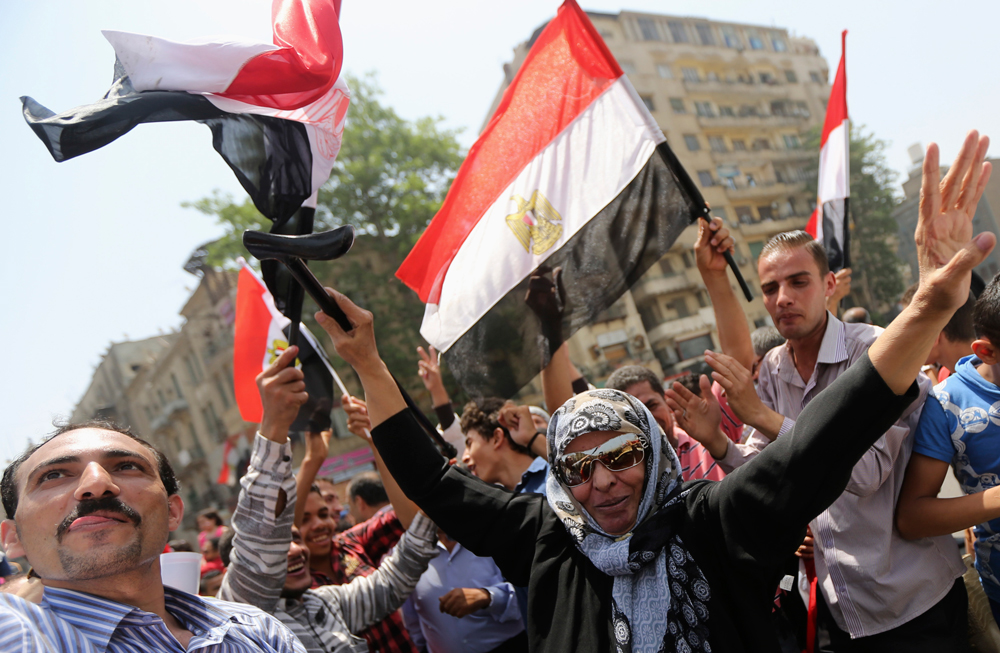
May 29 on Tahrir Square in Cairo celebrated the victory of Marshal al-Sisi in the presidential election /Photo: Amr Dalsh /Reuters
According to preliminary voting results, as-Sisi scored 95.3% of the vote, leaving far behind his only rival, representative of the left Hamdin Sabahi (4.7%). The military government extended the elections for the day, trying to attract voters to sites, but these efforts failed: the turnout was only 48%. The victory of As-Sisi (an essay about him-in the nearest issue of The New Times) marked the final defeat of the Egyptian revolution and return during the time of Hosni Mubarak-at least this is the ruling regime. The slogans about the restoration of order and the paternalistic rhetoric found a response among many Egyptians. The West, it seems, the military also impress more than the Muslim Brothers they had overthrown a year ago.
In fact, the situation in the country is not at all as stable as the AS-Sisi regime would like. The authorities poorly control the situation even in the suburbs of Cairo, where the “brothers” demonstrations are still undergoing, brutally dispersed with the use of weapons. Cities and villages in the provinces turned into feudal estates of local oligarchs. Invability in its own way illustrates the decision of the authorities to close universities during elections-from fears of student protests.
At the same time, the economy is in a free fall, torn between bread and gasoline subsidies and a decrease in export income. Stabilization loans from Saudi Arabia are coming to an end, and in order to get money from the IMF, it is necessary to reduce subsidies. The energy supply crisis reached such a scale that the fan shutdown of electricity began already in Cairo itself immediately before the elections, despite all the attempts by the authorities to create a favorable background. But instead of specific steps to stabilize the economy and mobilization of the AS-Sisi society, in his appeals, prefers to pour out love for voters: “You are in my heart, and I love all of you.”
There are, however, other ideas, for example, a small victorious war against one of the neighbors of Egypt. According to sources close to the Egyptian military, the possibility of “taking control” of the border regions of Libya, namely, oil -bearing Kirenaica, which, after the overthrow of the Gaddafi regime, is under the rule of Islamists and tribal clans is considered. In addition to obtaining oil rents, such a step would help to establish oil supplies to Europe from troubled Libya. So far, the invasion is discussed at the level of rumors, but in Egypt there is rarely smoke without fire. So the high -ranking Ministry of Defense officer a few days ago suddenly made a refutation of such plans on the pages of one of the largest Egyptian newspapers, and this rather confirms the opposite in the eyes of experts.
One way or another, it will not be possible to scroll the arrows ago, in the good old days of Mubarak, as-Sisi will not be able to-Egypt received only a temporary respite.