
Translated material
Old time epic
The traditional Russian culture, which in our time is considered the only source, if not truth, then at least the norm, really has answers to many questions. From ancient legends we learn a lot - why the wheat of grain has only at the top of the stem, where the Russian land “eat” and who was the first to reign in it, as the heroes and the like were transferred in Rus'. However, even the most enthusiastic soil, in contact with these texts, will often be at a dead end. The ancient texts are multi -layered, ambiguous and sometimes deceptively understandable, and this direct and literal understanding for verification turns out to be false. Fortunately, in our time there is a lot of special literature devoted to both the principles of the formation and functioning of folklore consciousness as a whole, and by a separate traditional genres of Russian literature.
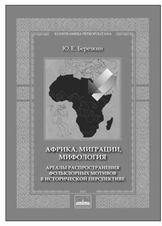 Berezkin Yu. E. Africa, migration, mythology. Areas of the spread of folklore motifs in the historical perspective. - St. Petersburg: Science, 2013. - 320 p.
This modest book is the best confirmation of the thesis that science is primarily collective work. The point is not only in an impressive bibliography on the last pages. The author of this book is a specialist in the history and archeology of pre -Columbian America. The absence of written sources of the history of most of the peoples of the New World predetermined the appeal of the researcher to a wide range of auxiliary historical disciplines, his participation in the project “Myths and Genes” and, as a result, the use of folklore data, population genetics, physical anthropology, pale -relief, climate history and many other diverse sciences to create a unified reconstruction of the pre -schedule history of humanity. You can get acquainted with her in this book.
Yuri Berezkin proceeds from the fact that the overwhelming majority people are the descendants of the same population that came out of Africa and absorbed other more ancient anthropoids (Neanderthals and Denisievians), dissolved in it almost without a trace. The first wave (75-62 thousand liters) through the Sinai and Bab-El-Mandebsky Strait went to Southeast Asia, Indonesia and Australia, the second (38-24 thousand liters) in the same way-to Northern Eurasia, and from there to the New World. At the same time, Africa south of Sahara (from 60 thousand liters of 14 thousand ppn.) Was wasolated from the rest of the world due to adverse climatic conditions.
The author of the parties folklore narratives on elements repeated in texts from different traditions, calling these elements motives. For his reconstructions, he turns primarily to those that are often found, but not in all peoples, that is, to motives that allow you to compare different folklore traditions in the degree of similarity of the motive fund. Since studies conducted as part of the Myths and Genes project showed the presence of correlations between some folklore motifs and some genetic markers, Berezkin proceeds from the assumption that myths were mainly transmitted from parents to children. True, the researcher does not deny other ways of spreading folklore motifs, for example, with merchants and captives in those territories of Eurasia, who, being connected by trade routes and entering into huge empires, have since ancient times constituted a single world -system.
The most important for Berezkin’s concept is the folklore of those ethnic groups, whose ancestors due to changes in the earth's climate or relief for millennia have been in isolation from the rest of the world. This is Africa south of Sahara, Central and South Australia and New Light. According to Berezkin, the complexes of motives, bringing the individual traditions of the peoples, which, by the time of the arrival of Europeans, lived on different sides of the Indian and Pacific Ocean are the most ancient.
It would seem that such a study of the myth does not imply attempts to break through to the meaning of specific narratives, nor progress in the study of specific traditions.
As in the previous works of the researcher, the myth is studied not by itself, but as a kind of marker that allows you to track the most ancient migrations and contacts, and the motives distinguished by Berezkin are present in the folklore traditions considered by him as a certain carrier, which is not recognized by its carriers, similar to a pattern of teeth or ancient linguistic borrowing. This is nothing more than another classifying feature for ethnologists.
Nevertheless, the fact that a variety of myths about the origin of death falls into a group of motives allocated as the most ancients and, in principle, can be interpreted by specialists from other areas - social anthropologists, psychologists, religious scholars, etc.
The appearance of death is associated in these myths with an unlucky test (incorrect answer to the question, violation of the ban, refusal to complete the task of the demiurge, etc.) or the reluctance of a certain character (zoomorphic or even anthropomorphic) to take into account other people's interests. By the way, various versions of history about the forbidden fruit are known in Africa south of Sahara, and in Melanesia, and in Amazon. We can assume that the antiquity of this motive speaks of its semantic and existential priority. Say, myths about the origin of the stars, according to Berezkin, arose later.
The earlier works of Berezkin contain a refutation of concepts that proclaim any particular mythological image, for example, a world tree, a universal stage in the development of culture or even the human spirit. To do this, it is enough to show that this or that motive is not recorded in all possible areas.
However, this work begins with the statement that only those motives are considered in it that allows you to distinguish between folklore traditions of different populations, to identify the degree of their discrepancy. Thus, the existence and motives of universal, for example, on the acquisition by people of fire using its abduction are recognized. It's just that these are not the motives that Berezkin’s predecessors wrote about.
What are such "common places"? Some similarities of unions and auxiliary verbs in natural language, which have mainly syntactic functions, but separately deprived of meaning? Or, like to lexemes, have their own meaning, that is, as soon as we are talking about mythology, answer some fundamental questions about the origin of the universe, the place of man, the basics of the hostel, etc.?
Even if the universals are extremely poor in meaning, there is reason to interpret some of the Frichers (motives found in most traditions) considered by Berezkin, roughly speaking, as different ways of expressing the same idea, which in turn will be universal. In a word, there is no doubt that the Berezkin project promises no less stunning discoveries in the future than those that have already been made.
At the source of the world: Russian etiological tales and legends. Compilation and comments by O. V. Belova, G.I. Kabakova. - M.: Forum; Neolite, 2014. - 538 p.
As noted by E. M. Meletinsky, the status of the same folklore plot in different traditions may not be the same. For example, it can serve as the basis for a certain story, which is considered reliable, is associated with the realities of the life and customs of a particular people and has an etiological finale (tells about the origin of something). Or be considered fiction and serve for entertainment. In the first case, the narrative is called a myth, in the second - a fairy tale.
Accordingly, we have a unique collection of a special kind of Russian prosaic folklore texts, which can be called Russian myths. Their novelty for science is relative - some of them are recorded in the 19th century. However, as a special genre, they attracted the attention of researchers relatively recently.
All folklore texts included in the collection have an etiological final. They talk about the origin of land, people, certain plants, animals and birds, food prohibitions, customs of different peoples, etc. Of them we learn how illnesses came from, where a person has a kadyk, which determined the duration of human life, why the violet has a pleasant smell, and Aconite has narrow leaves, which rides on one leg, which explains the power of a man over a woman and the absence of a woman and the lack of lack free time.
Most of the texts included in the collection can be divided into two groups: “People’s Bible” and, let’s say, texts with the plot that we have well known to us from childhood from fairy tales. An extremely widespread story is a story reminiscent of a fairy tale of a goldfish. A magical tree acts in her role, eventually turning the greedy and power -loving married couple into bears. The fairy tale of the bridegroom, who forced the girl to marry him, settled on her clothes after bathing, ends with her turning into a cuckoo or into a spruce, and her children into other trees, etc.
In the stories about the creation of the world and certain things and animals, God (Christ) and Satan appear. Despite the presence of such characters, these texts have features that do not allow them to reduce them either to Orthodoxy, or even to Christianity as a whole. The point is not only that the Russian tradition links with the gospel events the origin of plants. We see traces of a fundamentally different worldview.
In some versions, God and the devil create the world together. Satan, on the instructions of God, takes the earth from the bottom of the ocean, from which God creates land. In one of the texts, they are even called brothers living "in the same hut."
And one of them creates good things: I am drying in the middle of the ocean, cattle, birds, etc., the second - bad ones: diseases, swamps, mountains and ravines, snakes, mosquitoes and - yes, such a text is also recorded! - Women.
Such a picture of the world resembles the Bogomil heresy or even Manichaeism, but in Russian stories about the creation of the world we find elements, much more ancient than these doctrines. For example, there are stories in which the younger demiurge helps God by the fact that in the appearance of a waterfowl dive to the bottom of the pristine ocean behind the Earth.
As the studies of Yuri Berezkin show, these motives (the creation of the world with two demiurges and the creation of land from the ground raised by the diver from the bottom of the ocean) are widespread not only in Eurasia (in Africa and Australia there are no them, so it does not belong to Berezkin), but also among the indigenous inhabitants of the New World. So if it is divided by his approach, it turns out that the age of Russian legends about the creation of the world can be estimated at 10-15 thousand years, they existed long before the Russian people themselves formed before Manichaeism appeared.
On the example of domestic legends and legends, we once again become convinced that no culture can be considered unique and consists of elements, firstly inherent in other cultures, secondly, separately more ancients than their combination that determines the originality of this culture.
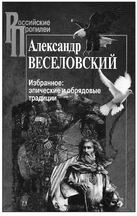
Veselovsky A.N. Chosen: Ritual and epic traditions. - M.: Political Encyclopedia, 2013. - 637 p.
Before us is the reprint of the works of the classic of Russian philology and folklorism Alexander Veselovsky (1838-1906). Most of them are devoted to the plots of epics, the Russian historical epic.
Alexander Veselovsky is an amazing figure. The wide range of scientific interests and the significance of its contribution to science are striking. Veselovsky is the creator of historical poetics. The first theory of motive in Russian science belongs to him. He introduced the concept of "wandering plots." Without Veselovsky’s research in Russia, the “morphology of the fairy tale” Vladimir Propp and even, ultimately, the analytical catalog of folklore-mythological motives of Yuri Berezkin would hardly be possible.
The fact that Veselovsky’s works do not belong to our time, unfortunately, is very noticeable. The classic of Russian science gives quotes from the texts of medieval European literary monuments without translation. He is confident in his reader-polyglot. The modern publisher had to turn to several translators.
Most of the collection is devoted to epics. Their heroes are familiar to the reader in popular adaptations of epic plots (Ilya Muromets, Dobrynya Nikitich, Alyosha Popovich, Sadko) or in standard courses of Russian folklore, which are read in our time at humanities (Duke Stepanovich, Churila Plekhovich, etc.).
Considering the relevant epics, Veselovsky finds parallels to their plots in medieval European literature, mainly in the book epic.
For example, the battle of Ilya Muromets with his son Sokolnik, ending in the death of the latter, reminds the researcher the ancient Eminth poem about guildbrand and fortifications. The attempts of Alyosha Popovich to slander the wives or sisters of other heroes Veselovsky compares with the actions of unsuccessful and insidious seducers from medieval Greek and Italian songs, the plot of which is known to us according to one of the stories of “Decameron” (the ninth novels of the second). Of course, it is rare to talk about direct influence.
The most convincing case is the analysis of the epic about Sadko. Veselovsky indicates her resemblance to the Old French novel about Tristan Leon. It appears in the nephew of Joseph of the Arimaphaean cage, who, like Sadko, is forced to rush from the ship into the water to stop the storm. Thus, this epic motive ultimately discovers the biblical origin and represents (the name of Sadok - Jewish origin) the modified story of the prophet of Jonah, which has imbued with medieval literature and Russian folklore from the literature of the ancient Hebrew.
 Veselovsky has no doubt that "the folk epic of any historical people if necessary is international." The folklore texts considered by the researcher are really striking in cosmopolitanism. Duke Stepanovich, the hero of the most popular, according to the estimates of Vladimir Propp, Russian Ep, a clear foreigner. He boasts of his wealth, the horse and the cooking of his mother, with whom nothing can be compared in Rus'. When the envoys of the Kyiv prince go to Dyuk’s homeland to India, his words are fully confirmed. Moreover, Dobrynya Nikitich falls into an awkward position, taking richly dressed women in Duke's wards for his mother, but they turn out to be only her maids.
Veselovsky sees in this story an echo of medieval European legends about the presbyter of John (pious and powerful Christian rulers of India) and old French legends about Karl the Great Walking to Jerusalem and Constantinople. Along the way, the Franks meet richly decorated tents that could belong to the Byzantine emperor Hugon, but richly dressed people in them are his shepherds. The monarch himself is busy with plowing, but not out of necessity, but because he remembers the words that the Lord said to Adam, expelling him from paradise. Alexander Veselovsky reasonably indicates the similarity of this character with another widely-known epic hero, the focus-sled Mikula Selyaninovich.
Modern eposyers reproach Veselovsky for unreasonably considering the Russian epic epic and medieval European literature as the phenomena of the same order. Nevertheless, modern folklorism is known for many cases when a folklore plot eventually discovers its book origin. The intermediary between European literature and the Russian epic could be the literature of the Byzantine, to which Veselovsky often turns on the pages of this book.
In any case, thanks to Veselovsky, we get a convenient catalog of motives and formulas, from which it is clear that the medieval European book epic and Russian epics are more similar to each other in many details than, permissible, Old Russian literature and the works of Count Tolstoy. And, of course, not knowing how to recognize stray plots, we will never be able to successfully use the Russian epic as a historical source.
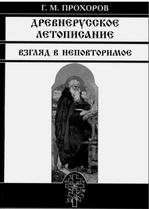
Prokhorov G. M. Old Russian chronicle. A look at the unique. - M.: Institute of Russian Civilization; St. Petersburg: Oleg Abyshko Publishing House, 2014. - 416 p.
The book of the outstanding Russian philologist Medievist-Textologist Gelian Prokhorov was published in a series with the promising name “Research of Russian Civilization”. Among the topics, scheduled by the Institute of Russian Civilization for Lighting, are pearls such as “Third Rome against the new world order” and “Antichrist’s monetary power”.
Nevertheless, you completely forget about all these signs of time. After all, before us is the set of work of Prokhorov in almost half a century. Almost half of the chapters are published in the form of articles back in Soviet times. The rest appeared in the 1990s and zero, but in terms of scientific severity they are not inferior to pre-perestroika. The subject of the study of Prokhorov is the most ancient of the Russian chronicles that have reached us. The scientist is trying to figure out which of them are primary, in what conditions and for what purpose they were created.
For the most part, the book consists of special textual calculations. Prokhorov restores the wiped letters, returns the confused pages to the original position, compares the oldest of the Russian chronicles that have reached us, determining borrowings, additions, gaps and editing. Единственное, чего он стремится по возможности избежать, это оперирование гипотетическими протографами, в частности «Новгородской Карамзинской летописью», реконструированной основоположником российской науки о летописании А. А. Шахматовым. Выводы, к которым приходит исследователь, состоят в том, что древнейшие из дошедших до нас летописей (Лаврентьевская, Ипатьевская, Радзивиловская, Рогожский летописец) уже отражают владимирскую, а затем и московскую точку зрения на историю Руси.
Еще во второй половине XII века при Всеволоде Большое Гнездо во Владимире начинается сведение киевских, новгородских, полоцких и других материалов в общероссийский свод, для того чтобы обосновать право этого князя на верховенство во всей Руси. Другой свод с подобной же целью, как считает Прохоров, был создан при великом князе Дмитрии Ивановиче в 1377 году.
Исследователь не ставит перед собой цель описать картину мира и систему ценностей древнерусского летописца, однако по мере чтения его книги у читателя складывается четкое представление о методе написания древних хроник и целях их создателей. Как замечает Прохоров, летописи как жанр подобны фольклору («канцелярский эпос Древней Руси») в том смысле, что их авторы, как правило, не представлялись читателю. Пергамент и бумага были ресурсом ограниченным. Адресатами хроник были князья, люди занятые и зачастую неграмотные, то есть нуждающиеся в том, чтобы им читали вслух, поэтому от себя летописец мог добавить крайне мало.
 Более того, как показывает Прохоров в главе «Повесть о Батыевом нашествии в Лаврентьевской летописи», зачастую летописцы оперировали неким набором общих мест, то есть стереотипных способов выражения определенных идей. К примеру, автор вышеназванного памятника, описывая зверства напавших на Русь татар на территории Рязанского княжества, дословно воспроизводит взятую из «Повести временных лет» картину разгрома византийских побережий, учиненного в 942 году дружиной князя Игоря, то есть в большинстве своем язычниками. Когда же речь идет о разорении Владимира, то опять-таки дословно повторяется рассказ о том, что делали в 1203 году половцы в захваченном ими Киеве. Можно ли считать летописца лжецом? Археологические раскопки на территории древнего Киева и Старой Рязани не позволяют усомниться в реальности монгольского нашествия и катастрофичности его последствий. И летописец вполне мог верить в то, что при нападении язычников на христиан всегда происходит одно и то же.
Другое дело, что, как доказывает Гелиан Прохоров, автор «Повести о Батыевом нашествии», используя эти традиционные приемы, стремился изменить настоящее и будущее, то есть толкнуть князя Дмитрия Ивановича на открытую борьбу с татарами.
Проведенный исследователем анализ летописей показывает, что парадоксальным образом именно те их особенности, которые с нашей точки зрения являются недостатками, сообщают многое о намерениях авторов и ситуации создания конкретных памятников. И наблюдения эти, безусловно, можно распространить на другие разновидности традиционных русских повествований о прошлом: их жанровая условность, непоследовательность и противоречивость оказываются для историка источником бесценной информации. Конечно, они не научат нас, как жить в настоящем, но, безусловно, обогатят знания отечественного читателя о прошлом его страны и его народа, обычаях и верованиях, ушедших навсегда вместе с аутентичным русским летописанием, эпосом и мифом.