
Translated material
How Crimea was rewritten
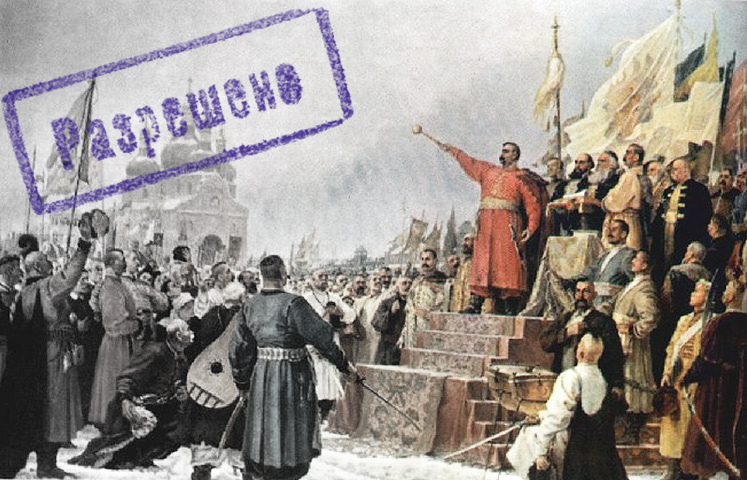
According to RIA Novosti, on June 2, President Vladimir Putin instructed the Cabinet of Ministers together with the Russian Historical Society until August 15 to supplement the concept of a new textbook of Russian history information on the role of Crimea and Sevastopol in the fate of the Russian state. The dean of the Faculty of History of the Tauride National University named after Vernadsky Alexander Germanovich Herzen told Inna Denisova, how, under the pressure of power over the past 100 years, they revised the history of Crimea and the origin of the East Slavic peoples.
-At different times, the history of Crimea was told differently. How did the views change?
- You need to start since 1952. From the conference at the Institute of General History of the Russian Academy of Sciences, where the issues of studying and teaching the history of Crimea were discussed.
Academician Boris Dmitrievich Grekov and archaeologist Boris Aleksandrovich Rybakov, Academician. They brought leading historians: antichists, medievists, specialists in new and recent history. And they gave them hard attitudes.
It was decided to consider the history of Crimea from the perspective of not external influences, but its own development. The role of Byzantium was declared exaggerated. The role of the Crimean Khanate and the level of Crimean Tatar culture in Crimea are leveled. They especially criticized Sergei Alexandrovich Bakhrushin, the largest specialist in the history of Siberia, for his article “The main points of the history of the Crimean Khanate”, published in 1936. Only seven years after the eviction of the Tatars passed, it was necessary to introduce this fact into the general ideological and theoretical channel.
The trouble is that Hitler in Mine Kampf wrote: "Goths are we."
From now on, the Crimean Khanate was presented as an aggressive, retarded state with an extensive economy, which depends primarily on military booty, solving economic problems due to the forcible assignment of the product. Themes for museum expositions at that time could be, for example, the following: "The aggressive policy of the Ottoman Empire and the Crimean Khanate and the heroic struggle of the Russian and Ukrainian people with Tatar-Turkish aggression."
It came out even better with the Gothic theory. A lot was written about the Goths in the Crimea; Their presence on the peninsula until the 16th century is a reality in the ethnic history of Crimea. The trouble is that Hitler in Mine Kampf wrote: "Goths are we." He wanted to make the Crimea of the Grivikhovska, the wounded soldiers and officers were supposed to come here. All others - both the Slavs and the Tatars - were expelled. The peninsula was supposed to be called Gotland, Simferopol to Gottenburg, and Sevastopol - Friedrichshaffen. The plans were made public, but never implemented.
As a result, since 1952, the recognition of the very fact of the existence of the Goths on the territory of Crimea was declared aiding fascist ideology. Many conscientious researchers were repressed.
In fact, the Crimean Goths did not participate in the Ethnogenesis of the Germans. They generally died out: a handful miraculously survived and lived until the 16th century.
The ancient period - the ancient Greeks appeared on the peninsula in the VI century BC - it was customary to be considered a colonization. Colonization is bad. Local peoples - Taurus, Scythians, Sarmatians - went their own way, and then the Greeks set up cities to them. They planted a slave system!
Textbooks wrote about the uprising of slaves under the leadership of Savmak. It really happened in the Bosporus kingdom in about 110-109 BC: only it was not the uprising of the slaves-sissy against the Greeks-Ugetters, but the palace coup.
Muscovy and Ukraine, according to the provisions adopted in the Pereyaslav Rada, were considered as equal powers; Then Moscow violated one position after another and ultimately usurped power.
In the 56th year, after the XX Congress, the course of the course began. Attempts to reconsider the history of the Crimean Khanate until the beginning of the 90s were practically not made. But there were progress with the Goths: in the late 60s, articles appeared, experts pointed to archaeological complexes, calling their inhabitants exclusively “the so-called Goths”, since they were still afraid of accusations of fascism.
All these turns are perfectly described in Orwell’s novel “1984”, a brilliant satire on a labile story that changes accents and poles.
- After the collapse of the USSR, how did they tell the same story in Russia and Ukraine?
- Here, since Lomonosov, there were different views on the origin of the East Slavic peoples since Lomonosov.
The point of view adopted in Soviet historical science was formulated in the post -war years in the book of Vladimir Mavrodin “The Origin of the Russian People”. Three East Slavic people, Great Russians, Ukrainians and Belarusians, ascended to a single ethnocultural community, which was called the ancient Russian nationality. This community formed in the 9th -10th centuries from the East Slavic tribes described in the "Tale of Bygone Years." At the same time, it was hardly taken into account that Nestor wrote his work for a long time after these processes and his description was edited from the standpoint of the winning clan of the Rurikovich, that is, acquired an ideological coloring.
The point of view on the independent path of Ukraine in the 19th century was set out by historian Nikolai Ivanovich Kostomarov. In his “History of Rus” “Rus” were called Ukrainians.
The official Russian historiography, which would be more correct not even with Karamzin, but with Tatishchev, who made an attempt to create a viewing Russian history in the first half of the 18th century, set out this idea. The tribes were united. The power of the dynasty is established. Starting with Igor, who became the All -Russian prince, and until the death of Yaroslav the Wise in 1054 there was a single state - Kievan Rus. The idea of the "Brotherhood of the Peoples" was laid down in the consideration of the process of unification of land as coming from Moscow, from the Moscow principality. The reason for the unification is to return your own.
The core of the future territory of Ukraine was the Galician-Volyn principality. Since the end of the 15th century, a contingent called the Cossacks has been formed in the right bank, which was then part of Poland: it begins to determine the tendency of the territory to self -identification.
In 1650, the work of the French engineer GIIIOM Levasser de Boplan “Description of Ukraine” was released in Ruan. On behalf of the Polish government, Boplan was engaged in the strengthening of fortresses in Ukraine and wrote a very good book, paying a lot of attention to the Crimea. He was a very educated person. I attached a map with the territories of Volyn, Dniester and Podillia to the description, described precisely as Ukraine. The book was published in 1650, during the liberation war under the leadership of Khmelnitsky: this war contributed to the awareness of themselves by Ukrainians most of the population.
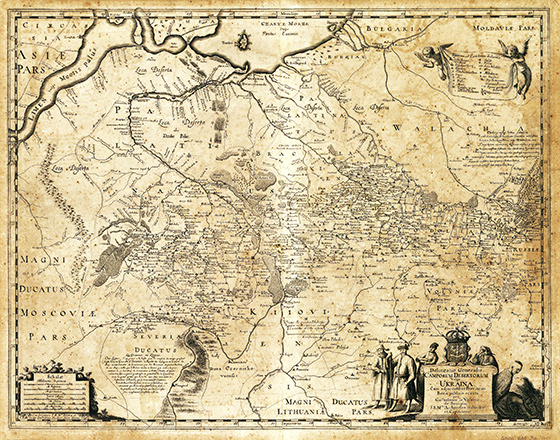 General map of Ukraine on the descriptions of de Boplan, 1648
In Ukraine, there was its own view of the history of the formation of three fraternal nationalities. Discussions have been going on since the 60s. Some historians, for example, Mikhail Bryachevsky and Vladimir Shevkoplyas, even then refuted the theory of land unification around Moscow. They put the question: what happened to the Pereyaslav Rada? Was it a reunion or joining?
The very formulation of the question caused oblique glances. In the 60s, historians were no longer planted, but-completely ignored. Although Peter Sherast - there was such a leader of Ukraine - was accused of making nationalist views. Despite the fact that in his book “Ukraine is my Radyansk” - about his own path of Ukraine and its ancient roots - the formulations were very soft. But nationalism was seen in it.
After the 91st year, when Ukraine became independent, the formation of a view of Ukrainian history as isolated from trinity begins. Instead of the theory of “fraternal peoples”, another vision was proposed: Kievan Rus is a state whose heirs are the Ukrainian people. Textbooks began to write from this position.
The point of view on the independent path of Ukraine in the 19th century was set out by historian Nikolai Ivanovich Kostomarov. In his “History of Rus” “Rus” were called Ukrainians. The Poles, by the way, still call Ukrainians “Rus”. The Russians in this concept were representatives of the northern tribes. Belarusians had his own path of evolution - from the East Slavic tribe of Krivichi.
Muscovy and Ukraine, according to the provisions adopted in the Pereyaslav Rada, were considered as equal powers; Then Moscow violated one position after another and ultimately usurped power.
I personally responded only to the first volume, the history of Crimea from ancient times before the inclusion in Russia. I don't have to rewrite much.
Significant was a revision of the role of Ivan Mazepa. He was declared a fighter for creating a Ukrainian state. And not a traitor, which we are used to seeing in the assessment of Pushkin and the Holy Synod. The formula "Mazepa-Office" is clogged in the mentality and public consciousness of Russians. The same with Petlyura, Vladimir Vinnichenko, Una-UNSO. For some, enemies, for others - fighters for gaining statehood by the people.
In 2003, Leonid Kuchma wrote an important book “Ukraine NOT Russia”: it set forth the view necessary for building the state and consolidating the nation.
Today we are here, in the Crimea, again we are returning to the views of the story that existed until 1991.
- Are there any common works on the history of Crimea? Whose position do they reflect?
- There was such a historian Pavel Nadinsky, we even have a street named in his honor. He wrote "Essays on the History of Crimea" in several volumes. The views are stated taking into account directives of the 52nd year. After that, there were no generalizing works on the history of Crimea.
Shortly before the last events, Prime Minister Mogilev decided to write the story of Crimea. And even allocated funds. I suggested writing a three -volume again. What will happen to the idea today is a question. As an editor-compiler, I personally answered only the first volume, the history of Crimea from ancient times to the inclusion in Russia. I don't have to rewrite much.
But those who worked on the second and third volumes, on the history of Crimea of the XIX -XX centuries, will be more difficult. Since they were looking for moments uniting Ukraine and Crimea. They described the persecution of Ukrainians and the Ukrainian language, events like the Emsk decree Alexander II of 1876 . They focused on the liberation movement of Ukraine starting with the Cyril-Methodius Brotherhood. These events will now have to be presented differently.
- Is it possible, relying on historical experience, to present political consequences?
- In the Crimea - I say precisely taking into account the entire previous history - nothing has never been solved. Crimea has never been independent since primitive times. Even the Crimean Khanate never possessed the entire territory of the peninsula. All the events that took place here, and the impulses, pushing them - were all outside the Crimea. Well, we are not a subject of history. And only the object, unfortunately. So not here everything will be decided.
Now no one wants to talk about the consequences. Then they will say: "Why didn’t you warn us?" This is a very serious step, primarily for Russia. I am a patriot of Russia, and I am very afraid for Russia. Did she pay too much price for this piece of land, 26,000 square kilometers? It is not known how things will go further. So far they are not in the best way. And Russia is now in isolation. Personally, I am impressed by the applied sanctions. In the West, a lot is considered and counted.
Russia and for the first time, during the Russo-Turkish war, acquired Crimea easily. But she held it - always with great difficulty.
I think about the board all the time. Here Russia received this territory, but acquired a hostile state on the southern border. Crimea becomes an enclave. Was there little Kaliningrad? To keep this territory will cost more than the Olympics in Sochi. Water, electricity. Tatar factor. They thought that it would be possible to easily solve it. It turns out that no. Tatars are now very actively entering Turkey.
In 1783, Russia grew Crimea. And now she will lose a lot. Already lost Ukraine.
Russia and for the first time, during the Russo-Turkish war, acquired Crimea easily. But she held it - always with great difficulty. Each time it had to be returned. Or colossal diplomatic efforts, as Prince Gorchakov did in 1855. Or huge human victims. As in the 20th year, when the Bolsheviks were made by mass terror, which suppresses various kinds of resistance, which there were many, including the Tatar.
Today, Russia has a hostile state in the south, which receives general international support. I am not a political scientist. I have my own vision, based on what I can have - a retrospective story. Euphoria will pass. There will be many problems. I repeat: I am a patriot of Russia. I treat these problems with compassion.
- And the economic situation? There is, for example, the opinion that in the Crimea deposits of minerals, Ukraine simply did not dig them.
- Yeah, and gold! How Ukraine was looking for him in due time! I am not a specialist here, but I am sure that these issues are very politicized. Crimea is not a gift geologically. Sorry, what are the minerals? Limestone plateau. There is almost no iron here-a little bit on the Kerch Peninsula, the Kamysh-Burun plant works. Gas really is on the shelf. But: as far as I know - and my son works in Chernomorneftegaz - huge costs are needed not only for prey, but also for reconnaissance. Drilling at the depths of a kilometer and more - this is tremendous costs, it is not known whether they will pay off or not if you start prey.
Now everyone is regretting the project that the public overwhelmed - the Schelkovo nuclear power plant. I myself opposed in the 88th. She was really put on the site of a geological fault. Today she would be very helpful. However, it makes no sense to regret: with our construction culture, we could fly up higher than Chernobyl.
- Will there be a teaching of such discipline as the history of Ukraine? And what will happen to the teachers?
- Discipline will remain, although the number of hours of teaching will be reduced. These watches will be given to the history of Russia.
No one is going to dismiss people. We have teachers who have already experienced a transformation. Someone taught the history of the USSR, for example. Or the history of the CPSU, instead of which sociology and philosophy appeared.
Until September last year, there was a department of history of Russia at our university, which was abolished, but not for political reasons, but due to a reduction in the number of hours. Now she appears again. Even two. The Department of History of Russia and New and Contemporary History and the Department of Russian History. Along with the Department of History of Ukraine and special disciplines.