
Translated material
Rubbing in the Birnamo forest
The arrival of Luke Persevaly in St. Petersburg and his production "Macbeta" in the Baltic House Theater is certainly one of the most important events in the local theater season. It doesn’t matter at all what exactly was expected from this performance, based on the experience of acquaintance with the previous works of the director (among them “Othello”, “Cherry Garden”, “Children of the Sun” , “The Death of the Communications” and the simple -minded, and therefore, probably, who was especially loved in St. Petersburg, “Everyone Dies alone” by Hans Fallada). In any case, they received something if not the opposite, then unexpected and much more radical than what was seen before. They did not contribute to the faithful “to prevent the whole” and rare hints in an interview with Perseval: he simultaneously spoke about the characters of the play as “archetypes”, as well as about “neighbors and acquaintances” recognized by each viewer. And it did not seem such irreparable eclecticism by someone's incendiary announcement: “Petersburg spectators will see“ Macbeta ”in the production of yoga” (all the more so since Luke Perseval during rehearsals was really engaged in yoga with everyone).
The scenographer Annett Kurtz drawed a huge sceno sceno scenes from the edge to the edge with broken lines of metal beams. The dark space in a scattered control light at the beginning of the performance gradually begins to be filled with witches. That is, perhaps they are more guessed than visible, female figures slowly, very slowly appear in the doorway and, taking a barely noticeable step to the side, dissolve in the fog. There are much more than three of them (actually eight), only then it turns out that all of them are completely naked and covered only with long-prefabricated tangled hair. During the performance, the witch will not say a word.
 © Vladimir Lupovskaya / Baltic House
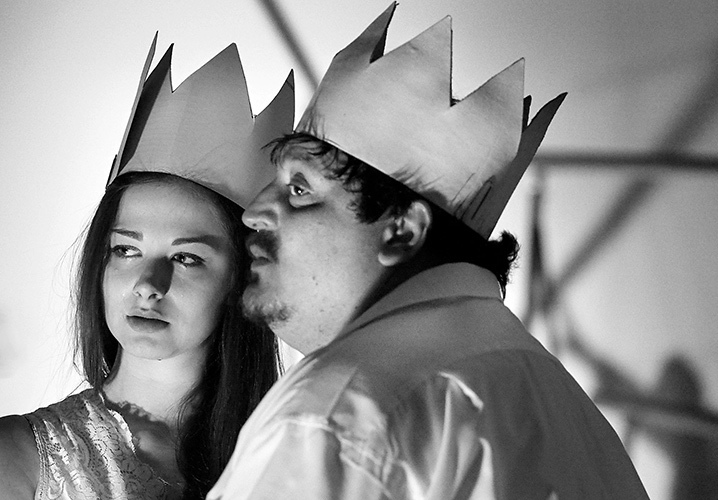
In the same way, other figures are materialized in the only light spot, only by the nature of plasticity and individual details, giving the opportunity to guess who they are. Not people, just shadows: the king (then we will see that the crown is paper), the man and his little girl (Banko and Flins), the woman, in love (MacDuf and his lady, but not necessary), two princes (little boys in the crowns) ... Heavy, very well-fed, somewhat awkward and devoid of any external significance, which would probably be worth it. Calling “just a person” is Macbeth. According to the “death of the salesman”, we remember: in the world of Persianel there is no place for charisma, there are no “princes”, but there are only heavy uncles, and even if they reach the bestial state (and they come, they have nowhere to go)-then modern humanism lies.
The whole next scene - and the performance begins straight with a foreboding and preparation for the murder of Duncan - is in a whisper. Night, everyone is sleeping. The sparkling de Quincy “A knock on the gate of Shakespeare” is simply impossible here. There is no one to knock here and nowhere - there is no external world. This is someone's "darkness behind closed eyes." Meditative promenade of shadows, silhouettes of kings and princes, a scene, as a sentence to Cincinnat C., pronounced by a whisper; The torn logic of a poetic text, which begins to seem darker and more mysterious than it really is - all this is too reminiscent of the plays of Meterlink (both the blind, and the "uninvited guest", in one of the translations of a perspicaciously called "rubbing", and especially the "death of tentazhil"). This exciting quasi -follyist uncertainty of a prolonged prologue is perhaps the best part of the performance.
And then the intonation will begin to imperceptibly, but steadily increased, the sound, color, words, words will increase: Macbeth is attacked by her lady - no witches need such a lady, the heroine of Maria Schulgi (the new actress in Balto, young and bright) suddenly and fiercely spilles all bitterness and contempt, copying infinitely long time in disbelief. For a long time, it seems, Lady Macbeth did not play such an outright villain. She demands from her husband power, pointing to the line of the fate of her own palm. She needs a crown here.
There is no place for charisma in the world of Perseval, there are no “princes”, but there are only heavy uncles, and even if they reach the bestial state, then this is modern humanism.
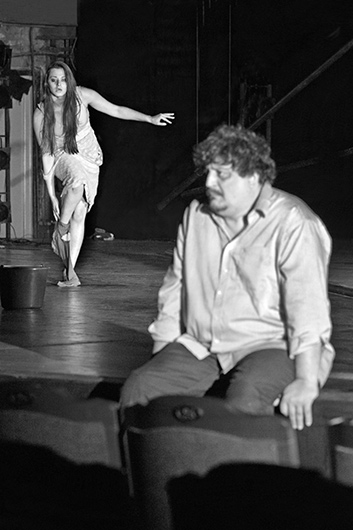
But the first onslaught is crushed, the lady disappears - and again appears in an exceptionally woeful form, dismantled, torn to be torn apart, tanned, with tangled on the feet lowered tights. While Macbeth was talking to himself (an invisible dagger, the prophecies of the witches - everything is mixed) and tried to wake up from an unknown nightmare, almost drowning in a bucket of water, Lady Macbeth managed to rape King Duncan. What Banko reported with the help of the Shakespearean text (where about the hospitable mistress who gave (!) Everything that the king needed). In this place, traffic jams are burned out at the tragedy - because, in fact, the problem has been removed, the wrong thing in his struggle for power Macbeth receives the right to kill. The lady, having dealt with pantyhose, in perfect despair slows down her husband, he still mumbles about fidelity to the good ruler in apathy, and then the woman resorts to an irresistible argument, sitting on McBet from above and, as it were, in a rush of passion, pouring herself out of the bottle. The erotic stamp of the modern theater acts flawlessly: I really want to kill someone. So Macbeth, armed with a bottle (and maybe a “rose”), goes to a crime. For some reason, the lady is still babbling about how she is not able to kill the king herself, because he looks like her father (who looks like? The rapist? And very similar?), But no one pays much attention to these nonsense.
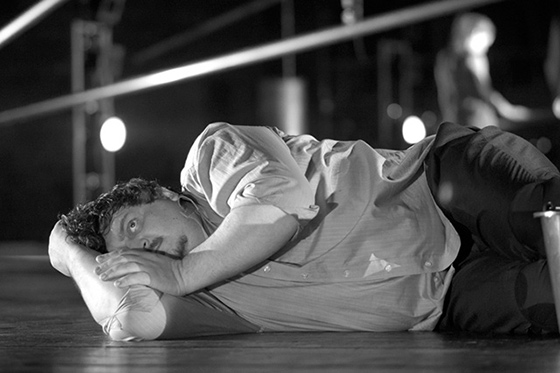
After the first murder, fears, outbreaks of rage, monologues, nightmares, new orders to kill (McBet should be an unflappable, correct and indifferent servant called Lennox - Yuri Elagin), a ghost of Bankko, a fan, new prophecies of witches (of course, they will have to voiced themselves) - it all happens at the same time. Leonid Alimov in the role of Macbeta performs a modest acting feat, managing to justify every spoken word, not at all anger than the every minute cliffs of logical connections. His Macbeth “flows” into the text - even into several lines. The only worthy interlocutor is his own shadow - on the wall in front of the rested and not hopping macbet dance the silhouette in the crown, "shadow, comedian, who kindened for half an hour on stage."
A separate and luxurious joke turns out to be a McBet’s attempt to blame the sons of Duncan, who "in Ireland and England hiding, they deny ceremonial." And the king reinforces the words with a gesture, measuring shortly from the floor, they say, well, remember, villains: Malcolm (from the pot of two tops) and Donalbine (even less). The fantastic shamelessness of bloody tyrants has never looked so murderous. Meanwhile, witches and ghosts are imperceptibly, but persistently fill the scene. In the choreography of Ted Stoffer, they do not dance, rather flow from the pose in the pose, simply increasing the effect of presence, pressing McBet to the advance.
 © Vladimir Lupovskaya / Baltic House
By the time we are announced that the Birnamo forest still moved to the Dunesinsky hill, all this will completely cease to have any meaning. What hill, what forest?! The dying lady Macbeth will not appear on the stage not to complain about the “aromas of Arabia” unsuitable for her hands (what, to hell, Arabia?!), And with a monologue from the Bekketovsky “happy days”. The winding and unreliable path that Persianal went in this performance ultimately led to the fact that Mcubtovo “Tomorrow, Tomorrow” turned out to be an echo of “Enterprise expectations”, and the famous “Life is a story that the fool retold, there is a lot of words and passion, there is only meaning” - the foreshadow of “endgotes”. This happened in completely traditional productions. It is interesting that in the flagship of European directing, this philological idea was able to be realized only through the text.
The Macbeth is absorbed in the non -aggressive, but relentless witch circle, and the spectacle begins to finally formalize the visual analogue of the famous hit: “What is the point of being yourself, not behaving shame, / when fifteen women frolic by the pond, / Naked trains, empty cities, alas, to decline forever.”
Exhausted by the question of the level of “what is the point of being yourself” (with all the variations, including “what is the point of just to be”), the Persian “Macbeth” turned out to be the experience of the current theater of that literal sense where the length of the time is transmitted through the length of the performance, the pressure tightness of the locked space - by the locking of the viewer in the hall, and the incomprehensibility of being is carefully constructed by meaninglessness. Well, this is the theatrical art that has come today, alas. Coming, alas.