
Translated material
Music under the brand
Julia Strakovich is the author of the book “Digital. What happened to music in the XXI century ”, which has stated a chronicle of changes that have occurred over the past couple of decades with an industrial recording industry, the musician shop, a community of consumers of their product and journalists. The book was nominated for the award of A.K. The Trinity “Steppe Wolf” 2014 in his regular column on Colta.ru Julia Strakovich will continue to analyze the most important events of the digital revolution.
In recent years, in the agonizing musical industry, eagerly eager for the Messiah, capable of fixing everything, a new faith has been outlined: salvation will come from brands. Try yourself in advertising - they advise that eminent, that new artists who have fallen into a financial dead end. The farther, the less we are talking about the simple composition of advertising songs-unlike the record-commander-in-commissaries who are in the ideological stupor, non-recycled companies find more and more ways to take music into circulation. Here p . Diddy becomes the face of CIROC Vodka . But friendly chatting in bushmills whiskey rollers Chromeo duet, rapper Theophylus London and Bon Folk star Iver . However, all this, although in its own way, is inventive and claiming the personal involvement of heroes, but still traditional advertising with a glass of advanced drink in the hand. And in this sense, she seems to be yesterday.
Sincere loyalty as a new classic
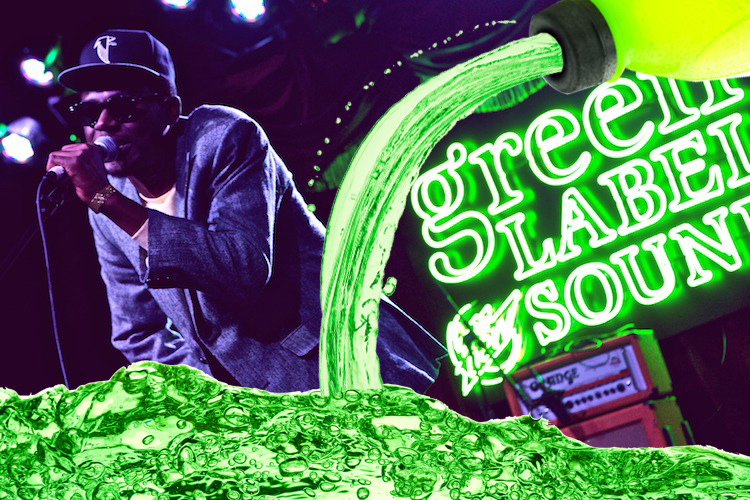
The current approach of large business to interact with artists becomes much thinner. “Buyers are smarter,” comments his brand manager of another, this time non-alcoholic, drink- Mountain Dew , the last thing they would like to see is how we pay someone for drinking our product in front of the camera. We intend to create something else - sincere loyalty . ” The reality behind this intention is not at all the same that you expect from the creators of chemical soda: instead of simply engaging the teenage idol from the top 50, MD open their own recording company- Green Label Sound , gain an oka of independent authors in the range from Holy Ghost ! Before MNDR and Neon Indian , they work with them in a complete cycle: they record albums, invest in tours-in general, they do everything that traditional music labels once did. With only one difference - their investments in music do not claim to payback, no one requires profit from artists, the return in the other - in the very loyalty of the public, in the fact that managers responsible for the program define as Brand Mounta I N Dew as HIP .
We intend to create something else - sincere loyalty.
This approach, of course, cannot be called innovative - at least Starbucks has been doing something similar for a long time With his Hear Music . What is changing today is the scale. Musical projects working for the image of a commercial brand become a common place, almost a prerequisite for successful competition. And now V Ans launches its own concert venues ( The House of Vans ) in New York and Berlin, and Converse represents a series of videos with unexpected trio of stars (like Paloma Faith, Gram Coxson and Bill Ryder-Jones ) and opens in Boston and San Francisco Rubber Tracks studio, where It is completely free to record young musicians. In general, its own label and a studio are a towing that becomes more and more popular. Where there used to be a peak of marketing fashion festivals like red Bull Music Academy , now almost inevitably arise Red Bull Records and Red Bull Music Publinging .
Patronie or corporate orgy?
As for the festivals, many of them, who did not even carry the initially advertising load, are almost entirely in the power of brands today. A particularly vivid example of recent is the famous American South by Southwest ( SXSW ) , once elitist-Gikovsky, and in recent years, almost completely consisted of music scenes belonging to brands. Doritos chips (I must say, by no means awakening your appetite ) with a performance is advertised by Lady here GAGA . Samsung scene Represent to Kanye West and Jay-Z . However, just speaking on the stage of the sponsor for a fee is an option that is no longer the most attractive for current stars, the corporate world is configured for closer cooperation. The same Jay -Z received from Samsung a check of $ 5 million for the release of his new album through the Galaxy device, and this type of transaction seems to be a new classic soon. This, however, is not so much sponsorship as another musical business model. But Pepsi Corporation, leaving its subsidiary Mountain DEW Indie Artists Green Label , took Beyonce under the wing and now in every possible way supports it, investing, in particular, in the record-without any certain business deaths.
In fact, the last story is already almost pure philanthropy, but patronage for show. Most of all, it resembles the times when the highest aristocrats competed, who will be able to assemble the best court orchestra, thereby affirming their status. It seems that the corporations in the consumer society are new yards, and today they are conducting a gambling struggle for who will be able to attract the artist more interesting. Much here begins to depend on the ambitions of a particular company. Not everyone is impressed by the format of popular rappers and their wives, and some even claim to create artistic values. Like an american Express , launched an unprecedented project in which the exclusive concert of The Killers removes Werner Herzog, Coldplay - Anton Corbine, The Arcade Fire - Terry Gilliam, Jack White - Gary Oldman, and Vampire Weekend - Steve Buscami. Someone, in turn, prefers the role of a culturalist-like Burberry , in his series Acoustic, representing not recognized masters from music and arthouse, but young British artists, not forgetting to dress them up under their label. The support of beginners itself is increasingly becoming fashionable and sometimes takes the most unexpected forms. Let's say a network of snacks Taco Bell organized the Feed the Beat program, which feeds for free on the tours of young and promising. In general, everyone tries to join the current trend in their own way.
The former regulars call the current SXSW festival a corporate orgia.
Russia gradually joins him-however, while at the moment only in the stage of the Samsung scene on the picnic "Poster" , AHMAD tea festivals and a large-scale electronic Openare under the auspices of Alfa Bank. Plus - closed concerts for "friends" of alcoholic and tobacco brands with the participation of Grimes , Chromatics and Little Boots , as well as numerous music parties Adidas , Topshop and others like them. To the direct support of domestic artists by domestic companies, it seems, it seems that it has not reached, and at the present time it is not entirely clear whether it will reach. In the same place, where the situation is more stable, there is no doubt: many available figures indicate that the amount of funds invested by no means show business in musical branding projects has been growing steadily in recent years. What is happening begins to achieve such a scale that some are not at all happy. The Corporate Orgia is called the current SXSW His former regulars, and publicist Chris Ruen claims that Cornerstone Promotions is the largest branded agency standing behind Bushmills , Converse , Mountain DEW , as well as for Nike , Microsoft , Xbox , etc., - in fact, even PitchFork and Fader are located at the helm, and this, in his opinion, means that the music was sold to brands already.
"What did she do?" - the artists are parked. And it is quite difficult for them to object to this today ... However, the story of accusations of corruption is very curious in itself. In it, like nowhere, a change in the vector of public moods is visible. So, when Bob Dylan went on an advertising deal with Chrysler , he was condemned in a unit-partly for the exorbitant pathos of the video , but more because of cognitive dissonance, universal, distinct feeling that he was a symbol of the era when the music was something incompatible with a production playing, incomparably greater than any goods and marketing campaigns. When a fierce twitter polemic about Bushmills flared up and bon Iver , it was only about whether it was ethical to advertise alcohol - no one put the appropriateness of the artist and brand into question.
"To be cool"
The time of such questions really has gone, says in an excellent article on G AWker : talking about corruption simply lost its meaning. This is earlier, getting involved in any more or less commercial project or even just moving away from Indie-Label to Mage, the musician risked the reputation and almost guaranteed to lose the respect of part of the audience. Now the audience is completely different: musical undertakings, in fact, are only beneficial for the current corporations that, “selling”, the artist now does not cease to “be cool” in the eyes of his listeners, rather, on the contrary, it becomes clutch and the one who bought it, too.
In fact, in this state of things there is even a hint of a new public convention - something like a general compromise: people stopped paying for music, but they regularly and with pleasure give money for products and things of the fashion brand, while the brand, in turn, shares a modest part of income with musicians, and this helps him to remain fashionable. The same brands, ignoring the indignation of the record-industry, while free their banners on file exchange resources, and the owners of pirate musical publics, not at all embarrassed, advise Lana Del Ray to advertise underwear.
In general - everyone is happy. Including, it seems, musicians. The voices of idealists, rejecting corporate transactions as not corresponding to their dignity, of course, sound, but the artists who really tried this experience describe it surprisingly similar. Like Chromeo participants: “We were completely comfortable. Brands provide more creative freedom than anyone, and everything that they want in return is a couple of photos. ” Or even as the head of the India Partisan Indian Records , which transferred to sponsorship contracts almost all of their wards: "In general, it is much less dirty than the traditional recording business, as it was."
If money flows into advertising, and not to music, journalism or art, then society is more concerned with manipulations than truth or beauty.
The traditional record-business is a special conversation, much more important today: perhaps for many artists a folding situation is a really convenient and long-awaited way out, but what does she say about the public -about ourselves ? What does this mean if the same people whose favorite argument on the wave of pirate rhetoric was “the discs are too expensive”, they easily buy a new cover for a smartphone or a couple of coffee with them for the same price? Why does the bulk of users of even legal musical online services prefer not to pay a penny subscription, but to see endless advertising banners? Why is it now sorry to give any amount for the music for the music, but for the continuous update of wardrobes and gadgets - in order to be in the trend of the season - practically nothing?
“If you want to find out what is actually happening in society or ideology,” Jaron Lanir wrote in his famous manifest, “follow the money. If money flows into advertising, and not to music, journalism or art, then society is more concerned with manipulations than truth or beauty. ”
Lanir, as always, is accurate, but maybe today it is really time to change the landmarks? Let's look at the truth: when the music album was the last time really excited the minds of millions? These are brands to a much greater extent than art, now unite people, they become an important point of self -determination, building identity. Ultimately, Rock-n Roll in golden times in a sense was also a fashionable brand, and if today's representatives today have much less charisma than any Apple , who to blame?
Many will probably say that there is a devaluation: music, at least, has a soul, but brands do not. Probably, everything is so, the brands really have no soul, but maybe all these tours and notes, free studios and lunch for young artists are there an attempt to find it? None of the current philanthropic corporations, of course, formulates its goal in this way. But more and more often the word “culture” sounds in their comments: we want to be a full part of the culture; We strive to create cultural values; We are constructing cultural reality ... Well - probably, this is not bad at all. As soon as Jaron Lanir is right here - in such a reality, "culture should become advertising and nothing more."
Buy the book "Digital. What happened to music in the 21st century "
"Digital" in Facebook and VKontakte