
Translated material
See the nose further
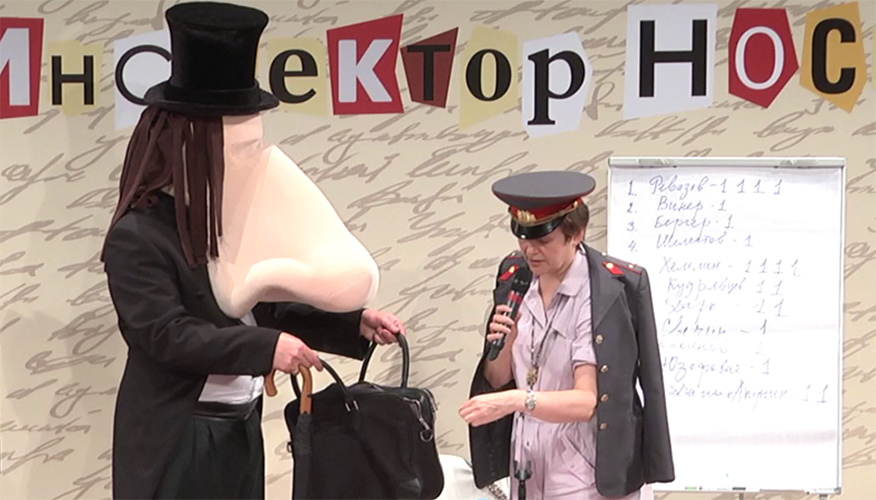
"Inspector of the nose" became the third project-reference of the main prize; Before that, the Nos -1973 and Baby -Non was. To talk about the achievements of the post -Soviet detective, the organizers sent invitations to the nominators; As a result, books of almost all noticeable authors-detective authors over the past 20 years have got into a long list of bonuses . In a strange way, Dontsova and Ustinova did not turn out to be in him, although perhaps their absence is already a statement in itself; The detachment line is carried out, so to speak. In the introductory word, Irina Prokhorova proposed the thesis that "a detective is a genre capable of saying a lot about our society, about how it changed over 20 years." It was proposed to talk about whether the Russian detective was formed at all, whether it was secondary to the classic and modern Western samples of the genre. Finally, the main reason for the discussion was the choice of the king or queen of the Russian detective.
They prepared for the debate properly. Two police inspectors went to the hall where the guests gathered, who reported that they were allowed to photograph in the hall only on the fifth iPhone, and generally withstanding the style in every possible way. From time to time, the police took out objects like lace underpants and openers from the pockets of guests. There was also a girl in the mustache and Kanier - a disguise in the spirit of Dr. Watson. She asked: “Have you accidentally saw the“ nose ”? He was gone! " (Gogol plot - why not a detective?) The courteous nose in the cylinder walked right there. On the emblem of the award, however, they painted not a cylinder, but a hat - who would be attributed to it from the outstanding literary detectives? Perhaps Philip Marlowe.
On the tables before the expert council and the jury were books. The variety of the Russian detective could already be judged by the covers: here is the intelligent minimalism of the historical detective (Akunin and Nikolai Svechin ), and a dousing trash, which looks profitable in the windows of the pervor tents (“Women's Day in the army” of Varvara Sinitsyna). There was an alarming detective music, which unexpectedly replaced the loud song "And Lenin is so young." Lenin really entered the stage - accompanied by Stalin and slurred character, which we failed to identify. Another trinity appeared from the opposite end of the scene-Putin in a costume of a pink bunny and two friends (one was in a children's hat-a “bear”, so this is probably Medvedev; the second could not be identified). Going in the middle of the stage, Lenin and Putin began to box as in slow shooting. No one won, because Irina Prokhorova, dressed in a policeman and a cap, were smashing the boxing. The action turned out to be the production of artist and fashion designer Alexander Petlyura.
The attitude to the detective it was very distant: thus, probably, the actors showed the origin of the elusive genre, the battle of the old Soviet detective with the new Russian. But further costumed reprisals were more respected by the case: the debate from time to time interrupted the squads, hooligans with revolvers, detectives with binoculars, agents of the NKVD and even Phantomas. Prokhorova every time indicated the uninvited guests with a rod on the door.
Behind all this, the debats actually turned out somewhat crumpled. The jury consisted of the chairman of Konstantin Milchin, Galina Yuzefovich, Andrei Avostsaturov, Maxim Krongauz and Nikolai Alexandrov (the latter was present virtually) and the expert council of Dmitry Kuzmin, Marina Boroditskaya and Andrei Levkin began to compile a short list. Konstantin Milchin divided the post-Soviet detective into several suckers-“historical” (Akunin, Yuzefovich), the conditional “cop’s truth of life” (Marinina, Koretsky, Kivinov, who know the features of the profession, are not hectic), “humorous detective” (Lev Gurses), “Russian intellectual thriller” (Arsen Revazov, Demyan Kudryavtsev). Then Milchin made an unexpected move: he said that the jury, who was faced with a choice - to reward living classics or “turn out”, finding new creators of the genre - chose the second option, and therefore, bison such as Akunin and Marinina, do not automatically fall into the list.
Experts were a little taken aback from such a statement. Andrei Levkin asked the jury why they played one game yesterday, and today they suddenly play another; Dmitry Kuzmin complained that the screening of “too qualified” authors deprives him of the opportunity to find out whether the figure of the writer Akunin is a figure and whether he has literary merits beyond the scope of the genre. The general dispute of the jury, experts and the chairman of Debatov began; Replicas were heard:
-Akunin was lobbying as anti-Marinin!
- So that the wives of intelligent people were not ashamed to read in the subway.
- What are we all about intellectuals and about intellectuals?
“We removed the masters, but still argue about Akunin,” said Prokhorova. In the intervals between dive - quite decent - the jury called their candidates in a short list. Pretty soon the leaders became obvious: first of all, Arsen Revazov with the book “Loneliness-12”, in which, according to Milchin, the “world of the middle class of zero” was recreated; Galina Yuzefovich called Revazov’s novel “An unfulfilled dream of Russian action -packed literature”, Aleksandrov - “an international detective in every sense”, and Kronhaus - “an attempt to win the whole world”. Revazov’s supporters regretted that this attempt did not end in anything: the novel turned out to be “ragged”, readers were waiting for continuation, but it still did not appear.
The second leader was Margarita Hemlin with the book “Inquiry officer” (the intrigue of which Milchin accidentally revealed to the audience). Hemlin's book was familiar to the jury and experts on last year’s nose; On the sidelines, Dmitry Kuzmin called it “of course, highly professional work”, the hero of which is an investigator working in the “hell of the Ukrainian outback of the late Nestinsky time”. Andrei Astitzaturov responded to the “investigator” as follows: “Here, at some point, the reader does not care about the genre specificity, to who killed; You begin to pay attention to intonation, to work with the word. ” Hemlin also got a voice from the "Council of Elders" - the first composition of the jury "Nose".
In addition, Demyan Kudryavtsev with the book “Gemini” and Oleg Dark with a collection of stories “At the same speed” (“A book that most of all did not want to be a detective” - Kuzmin) fell into a short list. The classics of the genre still remained overboard, but then Marina Boroditskaya took the word. Initially, she was going to vote for Vitaly Danilin, whose detective “really surprised” her. “But in this situation,” said Boroditskaya, “I cannot but pay tribute to a man who gave me so much pleasure, and I put forward Akunin.” The necessary second score to the Akunin "Azazel" gave the audience vote, and the list of five books was approved.
Of course, other books were also called - including in connection with the conceptual problems that the award set. Galina Yuzefovich spoke of a central figure in any detective - a detective. In an unspoken competition in the invention of the most unusual hero, detectiveists have been practicing for more than a century; The genre knows quite eccentric originals and “simple guys” endowed with the gift of the investigation. From the books of a long list, Yuzefovich was highlighted by Detective Julia Wiener “Diamond in a bag”, whose hero is a “vile grumbling disabled person”, tying his loved ones and sparkling with a disgusting language; When he becomes an involuntary accomplice of the crime, the reader catches himself on the fact that he begins to empathize with the unpleasant protagonist. Another important aspect of the discussion was the same reflection of social and historical reality. The names of Pavel Berger, who immerse the reader into the atmosphere of the Soviet 1930s (I did not read Berger’s novel, but I can hardly imagine this immersion-I judge by annotation , and Kirill Shelestov with the novel “Tamer of Rabbits”, in which Maxim Krongauz noted “the remarkable specificity of the space”: “The province is described very brightly.” Should the detective be true. To display reality, the parties did not agree, as evidenced by such an exchange of replicas between Milchin and Kuzmin:
- Ninety -percent of detectives is a mirror of the era.
- That is, this is the residual form of survival of a realistic letter?
В самом деле, было неясно, о чем здесь скорее идет речь: о достоинствах разнообразного, но все же замкнутого жанра, для определения которых была бы полезна специализированная премия наподобие «Хьюго» и «Небулы», или о качестве текстов, принимаемых в «большую литературу» / «новую словесность», — при этом принадлежность к детективному жанру здесь может быть обманкой, и, судя по всему, экспертам и The jury would like it to be so. Andrei Levkin expressed himself categorically: “I don’t understand what we are evaluating, what kind of glade we are here? For me, Leonid Yuzefovich exists from this list, everything else is another story. ”
After such statements, the results of the secret vote looked quite logical: the laureate of the award and the queen of the Russian detective became Margarita Hemlin with the novel “Inquiry officer” . Continuing some storylines of her novels “Klotsvog” and “extreme”, deployed in the same time and space, is a text about what is happening with society after the war: poverty, total distrust, a new glowing relationship in a new way. The criminal incident becomes one of the extreme events that people turn to, and maybe a straw that breaks the back of a camel. The jury vote was thus a conscious choice of “more than a detective”. Having avoided talking about whether the Russian detective took place as a large genre and a national cultural fact, the jury and experts answered the question of whether the Russian detective could claim to belong to the “new literature”. It turned out that for this he should not be quite a detective and certainly not entertaining reading; The heroism of the hero is not so important. Erast Fandorin, the only Russian detective, who became the very least international brand, was a creak in a short list. Of course, it may be so that the jury has become a hostage to the situation: a well -known book won, which meets the ideas about the “new literature”; If it already has the required depth, why look for it somewhere else? Meanwhile, a deep analysis of social relations, historical background and literary skill is also possible when working with entertaining texts: let us recall the works of IVF about Fleming or the recent article by Kirill Kobrin about the “sign of four” . This level of discussion, however, arises around the undoubted masterpieces of the genre, popular for decades that generate a cult. Is there a cult of Fandorin or Nastya Kamenskaya? May be; But still, he can not compare with the whole industry of Holmesian. Having chosen the “literature” and rejecting the “clean genre”, the jury, perhaps, went along the most easy way for itself.
“I am grateful to everyone who read and read my books,” said Margarita Hemlin, receiving a prize. - I want to add only one thing: when they talk about a detective, they rarely say that this genre can stand on a par with the textbooks and manuals of psychiatrists. This is the introduction to the world of psychology and psychiatry. As a patient can suffer from an incorrect diagnosis, the reader who will read some lies in such a book may suffer in the same way. There is no detective genre or “non-detective”: there is truth and not true, just in the detective this is very visible. ”