
Translated material
Conservatives "without virtue"
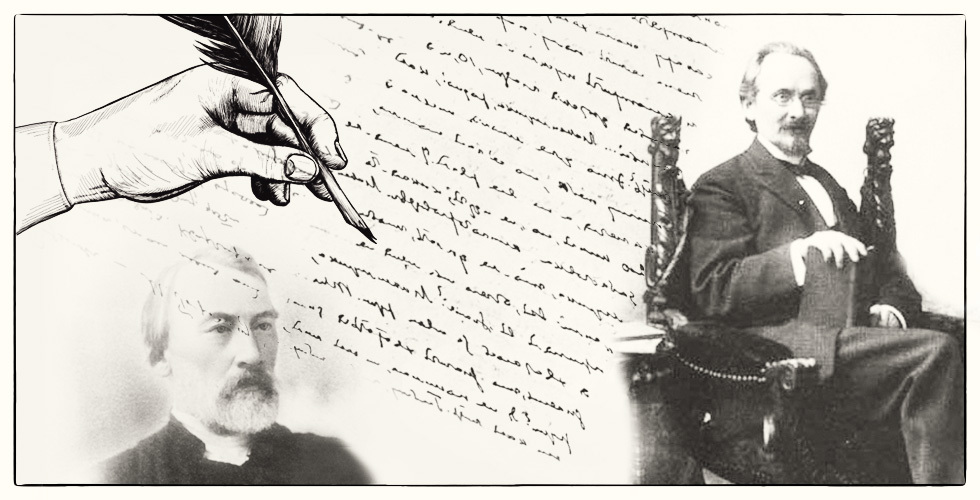
Rozanov learned about the very fact of Leontyev’s existence about two years before the death of the latter-the first text read by him was the two-volume of the East, Russia and the Slavism, who was found from the Moscow bookboats. Everyone knows what it is - to discover a large author for themselves, many are aware of the joy and miracle of the discovery of a large, but unknown or at least unknown in our circle of the author. The greater joy and amazement, when this author turns out to be our contemporary, who wrote for a long time, who wrote a lot - and nevertheless almost unknown: this is a complex feeling where happiness from the find is mixed with surprise before the silence of others - all the more when you have no doubt about the authenticity of the found. N.N. Officer Rozanov wrote 21.xi.1889:
“I read all this time, with admiration, which I have not experienced for a long time, 2 t <oma> Leontiev“ East, Russia and Slavic ”: here is the mind, here is convinces, here is language and tone! For the sake of God, can you get me a card with some fate-I want to know without end whether he is a hunchback or something: without a doubt, physically ugly, old, angry, smart without end, without end, unhappy. I am not interested in anyone like them " [1] .
He will receive a “card” only in1891 from the author himself, the famous “dark” picture in a hat and a pince -nez - on the back of which already in 1916, in the years when he put things in order and prepared for a noble old age at a rest, write, trying and looking for the exact formulation - which is the search process, a verbal “deposit”, thoughts caught at the very moment. Higher - where she is not yet quite, i.e. I did not separate from myself, did not become that it already exists separately from the author and therefore can be presented to the “reader” separately from him:
“But what, is it not to say this:“ This card is outside the style of Russian literature. ” After all, to <a> to this portrait - not a single portrait of a Russian writer. All “Taurus have a bag”, the head is “feignedly whirlwind”, everything is something indecisive and cowardly. "Imitators". This one is “I myself ”, and does not envy anyone and does not imitate anyone. On this blood - too aristocratic, “thoroughbred”, he did not approach our Meshnin from Chukhna, Khokhlov and the devil knows what - and is his Fatum and fate? !! The horse cannot go in the leg ”(p. 306).
Rozanov immediately allocated in Leontiev, which attracted him - “language and tone”, completely universal, teasing the public, the mind, expressing so that it is most convenient to write off this “paradoxes”, as N.P. Gilyarov-Platonov, the very smart clever and far from the “newspaper tact”, but, with the exception of almost “randomly”, from the monetary needs of written memoirs, which somehow “touched” the audience or high readers, from awkwardness, does not feel that the lightness and confidence of ownership of the word allowed Leontiev to say exactly what he intended to say. If anything interfered with, so it was precisely the “literary convention”, the adopted form: he, who knew how to convey his thought with one phrase, crossing the object to the subject easily and elegantly, the ideal interlocutor in letters-the best, as Rozanov believed, part of his written inheritance, in the puffy articles of the time when the “newspaper note” grew to four to five pages format, and the “feuilleton” could easily extend to the pages to thirty, if not fifty, moving from the room to the room of the daily newspaper (!), It turned out to be inappropriate: excessively serious and pathos for momentary chatter, too compressed for everyday skirmish, he did not know how to stretch the thought, painting it along the way, adapting it, adapting it, adapting it, adapting it. The average level of the era. In general, it is logical that one of the best stylists turned out to be an unsuccessful assistant editor: for daily newspaper work, other qualities were required, and Leontiev, with his lordly habits, could calmly give responsible instructions in restless Balkans, but it is difficult to require regular paper work-that in the chancellery, in the newspaper’s editorial, which is more important in the next front-line. Talent Skillful regularity, the same “virtue of mediocrity” that outraged him in the “average European” (not by itself, of course, in the clerk he fully appreciated and recognized, not agreeing to count the virtue of a serviceable employee with the top of human virtues-and in general, in Aristotelian, believing the multiplicity of virtues, if they are stacked in a united hierarchy, then Very difficult to arrange).
The published book turned out to be quite Rozanovskaya in his love for collecting “leaflets”, in the effort to “print everything”, forming a multi -layer text.
The correspondence between Leontyev and Rozanov began only a year and a half, in the spring of 1891; Already on November 12, 1891, Leontiev was gone. For seven months, the interlocutors managed to exchange 23 letters, while, as was the case with Leontiev and with other correspondents, the conversation from the very first words became not only serious, affecting the main content of his thought, but also involving. Leontyev was so quickly and deeply revealed to the interlocutor that he also required a response dedication: the line, which will later turn out to be characteristic of Rozanov’s great epistolary conversations, but in this case, Rozanov rather keeps the distance. For Leontiev, acquaintance, and remaining in absentia, with Rozanov, is the largest event, in the summer he will write, “that no one of the mature people saw so much understanding of my ideas”, he will send his “notebooks with stickers”, first published in this publication, i.e. The reviews collected together in the Russian press since the beginning of the 1870s, accompanying them before sending small and very valuable notes. The beginning of an article about myself, sent by Rozanov [2] , by reading, the exclamation of Simeon the God -Received - “now let go” - and an unprecedented sentence: to convey to complete the article “The Middle European as the ideal and instrument of universal destruction”. Rozanov is for him for those whom he had been waiting for the last years: a student worthy of a teacher, to those who understand the main thing, whose admiration is sighted, who see the virtues that Leontiev wanted to be seen. He is almost enthusiastic about a new acquaintance and wants to get to know him at all costs, persuading him to come, seeks to introduce him to his other students, he himself is called to patry through T.I. Filippova [3] , and maybe directly at I.D. Delyanov, Minister of Education, on the transfer of Rozanov from the Yelets gymnasium to Moscow, closer to those places, “where the marks of“ fruits ”are facilitated in every possible way” (p. 263, letter of 19.VI.1891).
If Leontyev strives for the closest rapprochement, then Rozanova arranges the distance - he will not take the opportunity to meet personally, answers less often than Leontyev writes him. However, with regard to the history of a non -accidental meeting, the common explanations through references to the reputation of Leontiev (the image of which Rozanov developed under the influence of insurance and Rachinsky), in our opinion, are not unreasonable - Rozanov’s behavior in other cases demonstrates that this kind of reputation not only did not serve as an obstacle to personal acquaintance, but rather could serve as an additional incentive. It seems that the explanation given by Rozanov himself in the note to the first, journal, publication of letters to him Leontiev (1903), quite sufficient:
“Of course, everything was very easy to fulfill, but some laziness and superstition that I would not see exactly the expensive and sweet that I already formed in the idea of an invisible person, forced me not at all to rush to date, and indeed not to take care of him” (p. 143-144).
He already had the image of Leontyev - and the real meeting could only interfere with him, and besides, “I was always lazy to“ travel ”,” writes Rozanov in the same note - and other cases in his biography confirm this review of himself (it is characteristic, how few memoirs of this rich response and sketches of the era, where it would be told about personal acquaintance with Rozanov, all the more, acquaintance, all the more Going beyond the “public places” - and those that are, are mainly left by people, at least at that time not very famous: people came closer to him “everyday”, “between business”).
Having turned out to be right regarding the “understanding” of his thought by Rozanov, Leontiev was mistaken in the hope of gaining a “student” - he already took shape himself enough to “continue” Leontyev: so, the proposal of the latter to convey the drafts of the “average European ...” aroused the interest of Rozanov, who at the same time by silence, the plans of “co -authorship”. More characteristic that Leontiev’s volumetric notes to the article about him, including purely actual order, were almost entirely ignored by Rosanov - he enthusiastically and carefully read Leontiev, but was by no means a follower. But in one Leontyev was right - Rozanov made a lot to memory of him, changing his assessments of Leontyev’s thought over the next decades, but constantly reminding him of him, interesting to him as a “phenomenon”, as a person, and not an abstract thought. In the first big article about Leontiev, he writes, explaining the nature of his interest:
“We have all a little“ pantheists ”, all a few“ Republicans ”-both in their education, and on some Russian, indeed, tendency to formless. We do not like any forms that crowd the imagination, weigh the mind. And even more so inexplicable interest, we find in a writer who suddenly reveals to us all the immense significance of these forms, all the impossibility without them of life, or at least its strength ”(“ aesthetic understanding of history ”, 1892, p. 955).
Leontyev did not speak out in his writing - equally artistic and journalistic - quite. A real, perfect writer turns everything to literature - as a rule, “as a person” he is uninteresting. Or, in the case of Rozanov, he turns “his human” to the literary, life itself turns out to be literature. As a result, Leontyev in correspondence and notes is often more interesting than in articles - in them he submits to the form (now they would say the “format”): he must certainly compose a novel, a story, an editorial - and “bends” for them, where he does not experience this restrictions, where he is free to write “as God puts on” he reveals in full, seizing a lot of expressive means. Up to endless emphasis, discharge, double, triple features - he begins to “draw” with a letter. Rozanov will be able to free himself from this oppression, create what is rarely possible the largest writers - not even his own shape, but a whole “its own genre”. Another thing is that he will find him much later than his acquaintance with Leontyev, trying to “coexist” for a long time with the usual framework of literature/journalism, going beyond them, painting the fields: creating notes that are more than the main text, the strengthening of the published “letters of readers” with notes - clinging to the usual, adopted form and bringing it to “indecency”.
What attracted him to Leontiev - the extraordinary courage of thought, freedom from the regard to the “public”, “for decency”, “for usuals”, for which many meannesses are ready to forgive, but the violation of which is inevitably punished: Leontiev was, according to the late Rosanovo article, “Slavophile without virtue (but with lovely personal qualities” (p. 1084) - this The wording is ideally applicable to the “literary Rozanov”, the image that he built (and which is so durable, “decorated”, which is practically inseparable from the “real”, “non-literary”).
***
The published book turned out to be quite Rozanovskaya in his love for collecting “leaflets”, in the effort to “print everything”, forming a multi -layer text, from a cut of responses about Leontiev, which were started by his niece Maria Vladimirovna, then he was eagerly continued by himself, who accompanied the texts before sending notebooks (sometimes given in whole, sometimes in fragments) Notes that become as it approached 1891, to the current disputes and relations, more deployed and tense, to the collection of Rozanov’s articles about Leontyev, written from 1891 to 1917. However, the center of the book remains Rozanov’s correspondence with Leontyev - the first, publishing (supplying the preface, the obsession and numerous notes) of the letter) Leontyev to his “Russian messenger” in 1903, in 1915 and again in 1918, planned to publish a book about Leontyev as the next volume of “literary exiles” (after the 1st volume published in 1913, where letters were collected for Rozanov Insurance and Gallery-Roborchi, who were commented on them, and several articles about them). As a result, the roll call of not only many authors, but also “different Rosanums”-from a novice conservative journalist of the 1890s to several phrases written shortly before death. In vain, however, the desire of the compiler, E.V. Ivanova (who wrote an interesting introductory article illuminating the history of the published texts), to give the Rozanov understanding of Leontyev at least the final “correctness”, which is directed, for example, the assumption that the mark made by Rosanov on all notes of the first edition of Leontyev’s letters was aimed for the second (“Note. Almost every word he said then is renounced ”(p. 42), if in vain, if only because if Rozanov’s words“ Leontyev is Kassandra, who ran through three and predicted ... <...> and as her , no one heard him ... ”(p. 59) were written in October 1918, then the notes were made in the fall of 1915, and the explanation is quite an explanation and the explanation is quite enough. sufficient, given to them at the same time:
“The notes I have handed over to the“ letters of K.N. Leontyev ”I leave how they are . But they dates back to the 1903th year <...> And at present their spirit and their tone is alien to me. But I was like this - and Pushkin said about everything “former” and we all repeat behind him:
Everything will pass, everything will pass.
What will pass, it will become cute.
We will treat the past as “sweet”. We will also look at the “present” as not eternal, but what will also ever become a “sweet past” ”(p. 58).
Actually, the last phrase is a sufficiently sufficient answer: the perception and understanding of Leontyev Rozanov will not be able to identify with any separate formulation or separate article, a note of any year-for decades he remained for Rozanov a significant interlocutor, to whom he addressed and remembered the public (and resembled the public)-sometimes with greater intensity, sometimes with a smaller one: " Candle. And I have grief. I burn. And the winds blow on me and bow. And without wind I stand straight. And God will repay me at his hour. But while I eat - believe that this light is true, i.e. What I believe and love him. But only he is not eternal. The eternal light is one at God ”(p. 58).
Beautiful, detailed scientific comments (most of which are prepared by A.P. Dmitriev) turn out to be another component of the literary mosaic, pushing the and so abundant internal multiple of the book that does not even harm even somewhat intrusively (from straightforwardness) trying to link Leontiev’s thought with modernity, the introductory article P.V. Palievsky, for some reason, who wants to be very common among conservative thinkers of the 2nd floor. The ideas of “conservative socialism” and the like combinations of the extreme right and extremely left -handed, directed against the “liberal”, “bourgeois” spirit of the era, to interpret as the unique contribution of Leontiev. However, this is also a feature of the era, however, the current one, when the “leading ideology of the Communists” is evaluated as a noticeable shift “towards faith” (p. 28), where Leontiev is an ally of the “people's Bolshevik” direction of the “becoming international”, which is anticipated by the “international-liberal”. “Again” “since the mid-1950s”, for which “any signs of the Union of Socialism and Faith were <...> are not just hostile, but extremely dangerous” (p. 28). Another thing is that the very specifics of the publication - tightly commented materials to the planned, but remaining unrelated Rozanovsky book - allows you to leave these "updates" outside the brackets as a strange tribute to no less strange time.
V.V. Rozanov and K.N. Leontyev. Materials of the unrelated book "Literary Exiles". Correspondence. Unpublished texts. Articles about K.N. Leontyev. Comments / Comp. E.V. Ivanova; ed. Prep.: A.P. Dmitriev, V.N. Dyadichev, E.V. Ivanova, G.B. Kremnev, P.V. Palievsky. - St. Petersburg: Rostock, 2014. - 1182 p.
[1] Rozanov V.V. Collected works. T. 13: Literary exiles. N.N. Fears. K.N. Leontyev / under the general. Ed. A.N. Nikolyukin. - M.: Republic, 2001. P. 222.
[2] “Aesthetic understanding of history” (1891-1892), completed after the death of K.N. Leontiev.
[3] At that time - the state controller.