
Translated material
"When they see the actor in uniform, with a machine gun, they immediately strain"
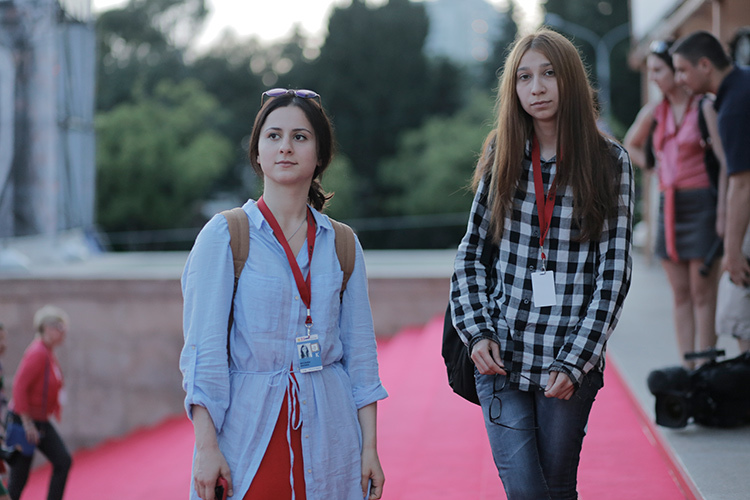
In the newly ended short -term competition of Kinotavr, the first two works of students of the workshop of Alexander Sokurov in Nalchik were shown. For three years, Sokurov’s course at the University of Kabardino-Balkarian was surrounded by an atmosphere of secrecy-students flatly refused to communicate with the press, and Sokurov himself did not give comments. And finally a camming out. The result is quite impressive. Perhaps the work of Malika Musaeva and Maryana Kalmykova are the only films “Short Meter” that work obviously outside the commercial trend, on the verge of cinema and video art (although Maryana and Malika themselves consider videoart something completely alien). Both directors work with the theme of Gender. “She waits” Kalmykova - a short, almost wordless sketch of a date in a female colony, “opening the door” of Musaeva - rather eloquent and at the same time very delicate portraitization of modern Chechen women and men (exhausted by the work in power structures, the husband cannot find mental warmth anymore and leaves the family).
- Tell us a little about yourself. How and why did you end up in Sokurov's workshop?
Maryana Kalmykova: I studied on the legal for two years, deducted and entered the Kabardino-Balkarian University. Actually, I wanted to rebuke too on a legal one. But it so happened that I ended up here. It seems to me that this is fate - I'm still trying to understand how it happened that I began to engage in cinema. I deliberately went to the course of Alexander Nikolayevich - although I had not seen him at that time.
Malika Musaeva: I have this first education, after school I entered Sokurov’s workshop right away. Not to say that it was consciously ... Everything turned out somehow strange. The fact that the workshop of Sokurov was opened in Nalchik, I found out at the last moment, literally on the last day of receiving applications. I went through all the stages of the creative competition and entered.
But actually I was going to enter journalism, and when Alexander Nikolaevich asked what kind of movie I would like to shoot, I replied: "Documentary." In general, I don’t watch films, but I loved to watch documentary cinema and wanted to do it. But, unfortunately, then, while studying, I realized that ... that it is more difficult for me to do documentary cinema than a gaming one. And while I'm shooting the game.
- As far as I know, you grew up in Europe ...
Musaeva: I was born in Grozny, in Chechnya, this is my homeland. We experienced the first war in our village. And when the second war began, we left and lived in Germany. In 2003, we arrived in Nalchik. It was the desire of our relatives-they said that the war was over, everything is more or less calm. In Grozny itself, we have not yet decided to live, because although the war was over, it was still unstable. And Nalchik is a calm city, and close, three hours driving to Chechnya. There are many Chechens, somehow closer to culture, to their people, to relatives. And under pressure, we can say, we moved to Nalogo to Nalchik. But parents never wanted to leave forever, they thought about returning back anyway.
 © Max Orekhovsky
- How does the learning process work in the workshop? As far as I know, you are not only directing, but also acting ...
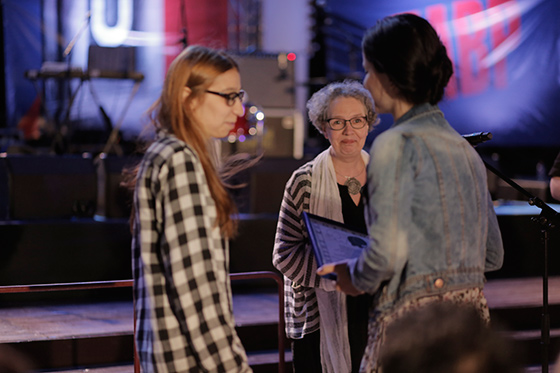
Kalmykova: Acting with us takes most of the time, at least occupied in the first two courses. Therefore, we have a lot of teachers from St. Petersburg and Moscow, who read literature to us - foreign and Russian, the history of the theater, the history of art, cinema, painting. Both dancing and stage speech. It is difficult, in fact, because we are doing this from morning to night ...
Alexander Nikolaevich comes to us once or twice a month for three to four days, and he also gives us lectures. Plus, then conducts practical classes with us. We can shoot on some microthemes, immediately try something. For example, we have a large hall at the university, and at the top there is a glass roof. Alexander Nikolaevich noticed this and said: "Here is a very cool space in order to shoot." And he gave us the task of inventing small stories that would have happened there. And we immediately shot them there.
- Do you have a clear program or does everything happen in improvisation mode?
Kalmykova: And so, and so.
Musaeva: He just comes, and each of his arrival is something new.
- Do you know in advance what the topic of the lecture will be?
Musaeva: No. We will find out what will be with us when he is already coming.
- And how do theoretical exercises go?
Musaeva: We can watch some excerpts from the film, disassemble the motion of cameras where the light is ... or we can watch some kind of full-length film and disassemble it simply meticulously: why did the actress look like that, what tasks were set, why such a mise-en-scene.
- And what films do you analyze?
Kalmykova: The last time we watched “Madison Bridges”, a wonderful film! Barry Lyndon Kubrick. Excerpts from the films of Alexander Nikolayevich himself, we also watch some scenes and analyze purely professionally.
Musaeva: Yes, along the mise -en -scenes, where the camera stands, what light should be ...
- Doing with Sokurov, do you feel the pressure of authority? Alexander Nikolaevich has a fairly clear idea of what cinema should be and what you can never do in it. Do these prohibitions somehow limit you?
Kalmykova: No, Alexander Nikolaevich never presses.
Musaeva: From the very beginning, we had an agreement that we did not show cruelty, murder, violence against a person on the screen. This is our only taboo. We were immediately told about this, and that’s it. Otherwise, we can shoot what we want, only Alexander Nikolaevich always says that we try to do it professionally. The question is not what topics you are taking off, what interests you: it just should be technically well done in the first place.
 © Max Orekhovsky
- Malika, did you shoot your film in Chechnya?
Musaeva: Yes. My topic is connected with the Chechen people, the action takes place there, so in another place, I think, this would be impossible. I just sat down and went.
- Did you have the actors Chechen?
Musaeva: Yes, local. From the National Theater.
- And how did the local authorities react to the shoot? Did they demand the script? Did you control the shooting process?
Musaeva: I was lucky, my uncle in the theater was an actor and director, and my father had acquaintances on television, so it somehow passed easily ... They, of course, asked. Suppose, when I went to television after some kind of chronicle or archive, there were some personnel were needed there, they naturally asked me-why. I had to show them that I would choose. But there were no particular difficulties. The only restriction was that, for example, you can’t take off actresses with an uncovered head, in too frank clothes, frank scenes are unacceptable.
- That is, you yourself have no prejudice to frank scenes in the cinema?
Musaeva: If I needed it for the artistic component of the film, then, of course, I could include such scenes. But on the set in Chechnya, this would be impossible in any case. And asking for it would also be incorrect. Because people live there like this, they were brought up so.
In fact, small problems were not with the authorities, but with the residents of the village. When they see the actor in military uniform, with a machine gun, they immediately strain and say that this all has already passed, do not shoot about it ... They want to quickly forget all this, burrow it, or something. They say: “Everything is fine with us. Why are you returning again to what happened? Everything is fine with us, everything is fine. ” But the last frame of my film, where little boys play with toy machines and shout: “You are Russian! You die! " -It shows more that they have inside, that they are trying to hide under the shell that everything is fine with us, everything is peaceful, we have forgotten everything, this is already in the past, but ... I would not call it hatred ... This is some kind of stretched nerve, and it still remained with the people. They are trying to blur these memories, but the memory remains, and no one is trying to treat it.
When I come to my homeland, to Chechnya, I do not have a feeling that I am at home. When I was small, and then, in my youth, it was, but now everything is changing-both people, and outwardly everything is different. I am not saying that this is bad, that there is, that is, and it must be accepted.
- Maryana, did you shoot in a real colony?
Kalmykova: Yes. This is a female colony in the Chokladnensky district. My main actress is a professional actress, at that time she studied at the third, it seems, course at the Institute of Arts. And all other girls are prisoners. In fact, we were easily allowed to shoot there. True, they, as before the commissions, were cleaned cleanly, prepared-but we did not need this at all.
- The colony administration was not interested in what cinema about?
Kalmykova: They asked, of course, they were interested. I said that this is a story about the love of a guy and a girl. Well, so that fewer questions arise.
- The version about love is for the colony administration, and you yourself, how do you formulate the theme of the film for yourself?
Kalmykova: This is a story about betrayal, that's all.
- How do you see your future?
Kalmykova: Our future is very vague. Because each of us wants to be realized somewhere, and it is very difficult for us to raise everything from scratch, it is insanely difficult. And I want, in fact, to see the world and work somewhere. I know for sure that most of us want to engage in cinema and will be engaged in cinema. I don’t know who fate will bring where, but about whether to stay or not, is a very complex, unresolved question. We perfectly understand the responsibility - because we were gained for this and taught us to work here.
Musaeva: Yes, the only thing we know for sure was to take us so that we help our people. And no one refuses this, and we will do this, this is the most important thing. What will happen next - no one knows. The only and most important thing is just to work, work and work. And then it will be seen.