
Translated material
Stockings in a stroller

Having finished with realism, the Kinotavrovsky competition moved to naturalism and experiments on the nervous system of spectators. Two truly loud premiers of the festival - the “Correction Class” by Ivan I. Tverdovsky and “Kino about Alekseev” by Mikhail Segal - are not similar, but have a similar constitution, habits and wrappers. Both films, not without dexterity, thicken reality in the tragicomic comic, both skillfully use drama to achieve a predictable emotional effect.
The “Correction Class”, whose heroes - excluded from Russian society, hidden from the sensitive eyes of the layman to the apartment and special prospecting of disabled, is another example of the return of the supplanted , noticed at the Kinotavra in the early days. Of course, it returns in even more grotesque and macabric form - with all its apparent acute sociality and documentary. Although Tverdovsky’s film is based on a story written by Ekaterina Murashova based on her real experience, “Class Class” is a natural social horror. The genre, obviously disposed to the operation and manipulation of the viewer. And, as it should be in the modern horror, the director of Tverdovsky actively uses the principle of swing: each scene of violence, humiliation, oppression and brutality follows the vocal Comic Relief . The “Correction Class” is Browning “Freaks” , where literally everyone becomes evil dwarfs: “defective”, their teachers and unfortunate parents. Tverdovsky very accurately and intelligibly conveys the atmosphere of universal shame, reigning in a repressive society (not necessarily Russian - the film has Kafkian universalism), when the fact of your existence becomes obscene when you yourself are yourself.
 Frame from the film "Class Class"
Of course, such a nightmare cannot be realistic (implausibility is one of the terrible details of such a situation), so the film is abundantly blocked by shock episodes full of perverse romance. Schoolchildren lie down for Russian Railways trains to get the emission of adrenaline, an idiot in love with a wheelchair of his lover, at the same time in the fury of an unrequited feeling, destroying the surrogate substitute for the object of his passion - and caressing it. The brown girl puts white stockings on her paralyzed feet to seduce a classmate. A cheerful Carlitsa deftly performs the dance of small ducklings. Children smear the portrait of their just deceased classmate. X*yak! X*yak! X*yak!
In his Pankovsky rapture, the capabilities of Kino Tverdovsky are somewhat similar to the von Trier, and something to Larry Clark. He clearly enjoys the fact that he can hold the viewer on a short leash and drag him behind him to the final, that he can take a pedal for a long time, which can do everything that he pleases in the frame - the same enjoyment of power over the viewer can be seen in “dissecting the waves” and especially in “dancing in the dark” with her blind heroine, singing in a loop. “Class class” from beginning to end - this is a song in a loop, a cynical, but frank technique, which is a rarity for Russian cinema - works.
Mikhail Segal’s “Cinema about Alekseev” is a more subtle example of similar manipulation of the viewer (it is no coincidence that both films are produced by one person - Natalya Mokritskaya). As a director, obviously mainstream and inextricly comedy, Segal prefers to lead the viewer gently, buying him with a soulfulness and feigned humanism. The story of all the forgotten old man, ex-barda Alekseev (impressive Kambet Alexander Zbruev, who has not already been shot, seems to be 10 years old), extracted by the will of an elderly fan from the Tula closet exclusively for his own selfish needs, is disguised as a love story. Rather, under the history of teaching love. The moron Alekseev, the heir to the romantic losers of the cinema of the 70s (here Segal continues the trend of the “geographer”), glues girls monotonously, is joking, knocking on friends and colleagues and constructs machine guns better than “Kalashnikov”. Genius and stupidity are incompatible with villainy: the only fan of the bard is a girl who, in his sensitive 12 years, saw an unshaven poser in a sweater and with a guitar - and never fixed from the image of an “interesting person”.
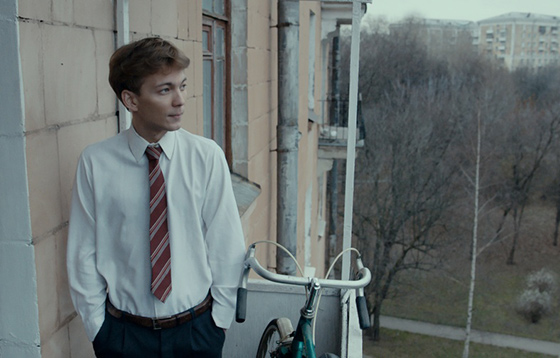 Frame from the movie "Cinema about Alekseev"
The story of the insignificance, in its defeat, turned into a tragic figure, is told by the ridiculous language of the joke, in which the sixties in general gets pretty. All the shrines of the Soviet intellectual are turned into caricatures: the performance of Efremov in “Contemporary”, director Tarkovsk and actor Solonitsyn, the romance of fogs and the smell of taiga. Unfortunately, this anecdotism is felt only at the scenario - visually the “cinema” is still far from the film comic book, which was probably conceived. In any case, the poetic episode revealing the picture with beautifully scattered Slow - motion with mushrooms and salted cucumbers promises the penetration of the past era into the microcosmos. Alas, promises in vain.
Segal's film appeals to the sensitive hearts of the spectators by a demonstration of love, over which time is not dominant. But in this plot itself, a self -destructive mechanism is laid - love here, in principle, discuss all 95 minutes, thereby emasculating, like a revolutionary slogan, and enthusiastically reflecting over the process of this kindness. So at the end, this word itself begins to cause a curve grin - and it doesn’t matter already, this is earthly love or heavenly, taking or giving (this dichotomy is taken from the rhetoric of the heroes of the film itself).
Be that as it may, Segal demonstrates in a new work a noticeable jerk up: his heroes already live (albeit some kind of jerking), his narrative is full of eloquent underhearsing-although all this subtlety is destroyed by a multi-sized finale that turns a light, ironic film test into a viscous, chewed porridge. However, epilogues of commercial films generally often adorn a similar substance, for some reason taking it as a cream.