
Translated material
Samotle
Refugees begin to arrive from the south-east of Ukraine to Russia
The New Times correspondent spoke with the Ukrainian family who decided to escape from the Civil War in Rostov-on-Don
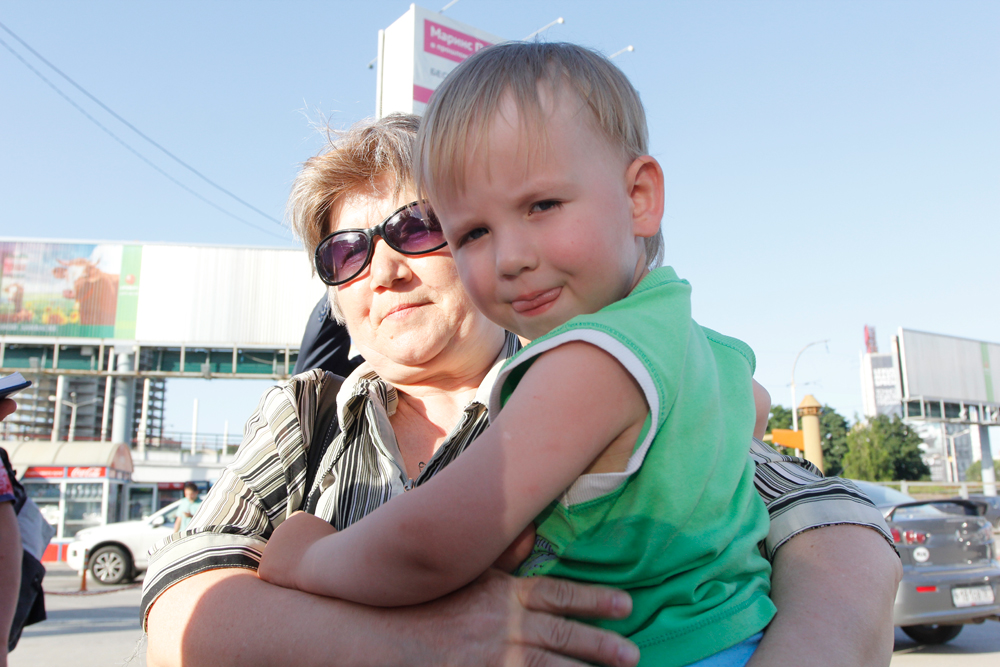
Grandmother Marina, refugee from Kramatorsk, with the grandson of Timur at the Rostov-on-Don station /photo: Mikhail Maltsev
54-year-old Marina, with whom we are talking in the car on the way to their new temporary apartment, asks not to indicate her last name in the journal: “Please do not. You never know what ... every day there is worse. It is not clear how it ends. ”
Marina, her two-year-old grandson Timur and 34-year-old son Alexander-from Kramatorsk.
Son Alexander is silent. He is an autistic.
Timur in his singing, so far that the language does not know the words enters into a conversation. He murms and bursts excitedly, tries to explain something. Marina's youngest daughter, Timur’s mother, stayed at home, but as soon as they arrange, she will also come to Rostov.
- Did you get it difficult to get out of Kramatorsk?
Marina shrugs: “We left early in the morning, there was no shelling. At night, there was somewhere in the area of Slavyansk. Mortars, probably. "
After a little pause, he adds:
“The trouble happened in Red Liman. Rights there were shot in the hospital. ” (The Ukrainian sources of The New Times categorically refuted this fact. - TNT.)
People and numbers
The conversation does not stick, Marina clearly does not want to say anything about hostilities. It is possible to find out that there are no anyone in the militia of her relatives. “We are not afraid of militias,” she says. - But the National Guard is afraid. I can’t imagine how after all this we will live in one state. ”
- Why did you decide to leave Kramatorsk?
| *The referendum on self -determination was held in the east of Ukraine on May 11, 2014. |
“The city has problems with water, the water supply is damaged. Electricity problems begin, ”Marina says all this in such a hopeless tone that you understand: she is very scared. Some enthusiasm appears in her voice only when she recalls the referendum*: “The whole city has come. I have never seen such a unity of the people. ”
In Kramatorsk, the railway tracks were damaged, and Marina and his family sat on a train at Rostov at Rostov at a neighboring station.
- Why Rostov?
“I contacted the Rostov volunteers, and it became clear that it would live in the city. Then they decided to get by the railway. "
"
"It does not fit in my head that all this can happen in the 21st century, literally a few hours of driving from us"
"
On June 4, the Governor of the Rostov Region Vasily Golubev introduced an emergency regime in nine regions of the region bordering Ukraine. From May 23 to 30, according to the regional department of the FMS, 6514 citizens entered the region. But the refugees are far from all, there are much less real refugees. So, for example, in the Dmitryadovsky recreation center in the Neklinovsky district, according to the regional administration, there are only 210 of them, including 122 children.
With official statistics, there is generally some kind of leapfrog. Children's Ombudsman Pavel Astakhov, visiting the Rostov Region on June 4, unsubscribed in his microblog: “Over the past day, a record number of citizens of Ukraine entered the Rostov region - more than 7000! Every day the number of refugees is growing. ” Seven thousand per day is a lot. These are serious problems for the Rostov region itself. But it is worth digging a little deeper, and it turns out that "more than 7000!" - This is the total number of people crossing the border in the Rostov site. How many people want to get refugee status or Russian citizenship - there are no correct numbers in nature yet.
"We need to help them"
The Kiev train, on which the Marina family arrived in Rostov, we met at the Rostov station along with the volunteer Anatoly Kotlyarov. He is the organizer and coordinator of the Volunteer Movement "Bratsk Aid". It helps refugees from Eastern Ukraine: he meets, takes him to where they accept - to campsis and boarding houses. Or in Rostov families, ready to provide a shelter for those who run from the war. And there are still few such families for a million Rostov-on-Don. A few dozen.
The meeting with the mistress of the apartment, in which Marina and his son and grandson will live, passes as everyday as the conversation in the car. Neither hugs nor solemn acquaintances are generally a drop of sentiments. Women look embarrassed. It seems that they do not look at each other.
- Come on. Eighth floor.
The mistress of the apartment is also the name of Marina, and she also asks not to name her surnames:
“Why? I do not want to know at work. Inquiries will begin, chatter ... "
Recently repaired two -room apartment. I inherited. Quiet center. Thirty thousand a month, if we take it. Mistress of about forty -five years old. She lives in a neighboring house, she has another kopeckoy there. Apparently, it is - the middle class.
“We need to help them,” she explains why she decided to settle the unfamiliar family of refugees. - It does not fit in my head that all this can happen in the 21st century, literally a few hours of driving from us. There is such a horror ... "
A conversation with Marina-mistress, as with Marina-Twinkle, fits into the curly discreet phrases, in which “trouble” and “horror” do not stand out in any way-not the slightest pause, no special modality. After three words from “horror”, we calmly discuss where to put the table in the kitchen - close to the sink or better along the long wall.
“In the coming days, I think, a stream of people will pour,” Anatoly Kotlyarov predicts. - My coordinators counted about eight hundred people who are preparing to go to Rostov today. And these are only those who got in touch with us. And most are chosen on their own. ”
On paper and in life
Kotlyarov shows correspondence with the groups of the group in a smartphone - hasty chains, without capital letters, without commas: “Get out by a car”, “They will have”, “Mom with a four -month -old baby”, “Two elderly”. With one of those who need to be found, the connection disappears in a midst: roaming is gluttonous. Someone calls from the checkpoint or from the border point: “They don’t miss us. What to do?"
“Refugees should still somehow get to where it is planned to place them,-Kotlyarov, a temperamental person, worries. “But Ukrainian border guards do not produce some people on cars: either the insurance is overdue, the car is bought on credit, and according to Ukrainian laws, you cannot go abroad to such.”
“If people crossed the border on foot,” Kotlyarov continues, “then they can get to the nearest GAI post for ten kilometers. The problem is also that it is impossible to get through in the evening in the evening. ” For example, the other day in Taganrog refused the family grabar. Reason: quotas ended on documents for citizenship. Sent to Rostov.
... Looking around and drinking water, Little Timur starts to explore his new refuge. From furniture - one sofa. Having patted his palm on it, Timur decides to check what is outside the door. Autist Sasha goes after him on his heels and says something-monotonously, completely inaudibly. But Timur hears him. And something even answers. He waves it off - they say, leave, do not interfere - and runs to the next door.