
Translated material
In the siege
How the warring Donetsk lives, what the militias hope for and how the wounded kibalchish met his love
At the time when the Russian President was talking (with witnesses) with the President of Ukraine in Normandy, the war continued in the Donbass. The Ukrainian army repelled the city of Krasny Liman from the rebels, which is 30 kilometers from Slavyansk, but after a two-day battle they occupied the border station "Stanichno-Lugansk" in the Lugansk region. And the main question that journalists from Moscow is asked here - when will Russia bring its troops here? About the fact that Putin promised to respect the choice of the Ukrainian people, they either did not hear or did not take it seriously
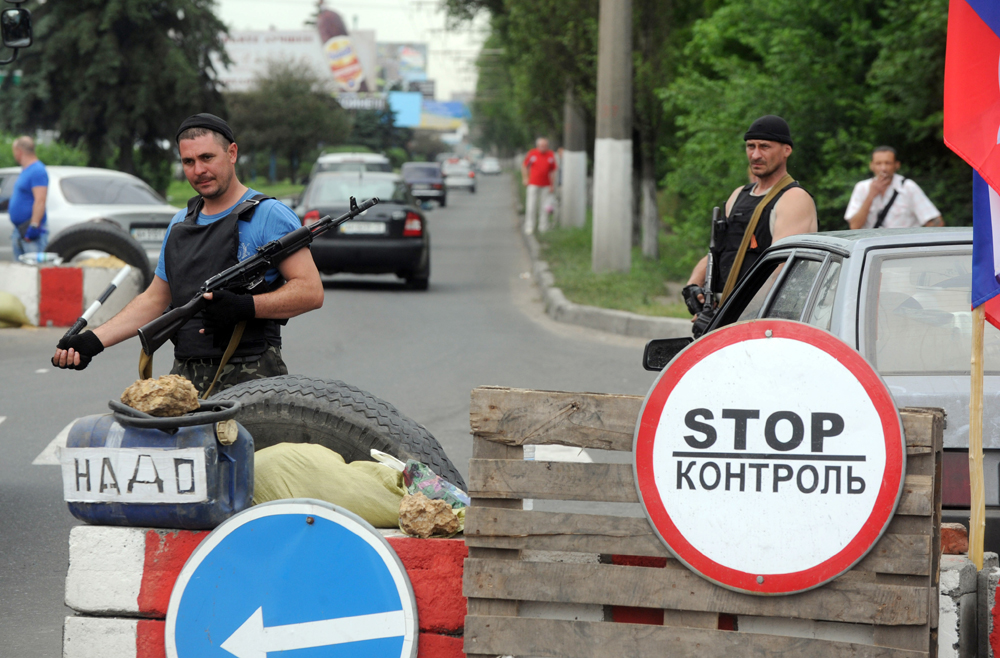
Militias at the checkpoint on the outskirts of Donetsk. June 2014
Donetsk is the wide prospectus, crossed by long straight streets that are going into infinity: like on Manhattan, only without skyscrapers. However, there is no shortage of modern hotels and business centers made of glass and concrete, shopping malls and restaurants with excellent and Moscow standards inexpensive food. There are many parks and green boulevards planted with scarlet roses, spilling the impulsing smell of school holidays and freedom. Only in the last month the city has been empty, there are no more traffic jams per hour of peak, half of the shops and banks are closed, car dealerships were empty, from which the owners took all the products after several “requisitions”, and in the evening, instead of couples, harsh machine gunners in camouflage go along the deserted center.
The main topic for discussion: when and where to leave? Every now and then new rumors appear: the Ukrainian military does not release anyone; They will soon close the station; Soon they will announce a general call. All this is not true: the station works, although many trains have been canceled, and you can’t get other tickets; The tracks are open. In Donetsk itself, the evacuation, although not officially declared, is in full swing. Numerous universities transferred the summer session to August and September, dormitories are empty. Many enterprises, including the Rinat Akhmetov, the richest businessman of Ukraine, were sent to unlimited vacation: “We even have electronic passes blocked for two weeks,” an employee of one of Akhmetov’s companies told the magazine. According to the same manager, some businessmen completely closed their plants and even took out the equipment, fearing looting or nationalization, the fact of the closure of enterprises confirmed in an interview with The New Times and the speaker of the Supreme Council of the self -proclaimed “Donetsk People’s Republic” (DPR) Denis Pushilin. Employees of the Government of the DPR took their families and employees mainly to the Crimean sanatoriums: “Russia helps us, places it for free,” explained the New Times, the coordinator of the press center of the DPR Claudia Kulbatskaya.
Crimean syndrome
If it is easy to leave Donetsk, the hottest point of Donbass, Slavyansk, was blocked by the Ukrainian army. You can get around the checkpoints, but not everyone is being decided on it. As a resident of Slavyansk Maya told The New Times, shops do not work in the city, salaries and pensions are not paid, and banks are closed, there are no water and gas in many areas, then artillery volleys are heard: “We get out the products by acquaintances, my aunt worked in the store,” says Maya. “We are afraid to leave, we sleep away from the windows, but there are no fights in our area yet.” Information about the problems with products was confirmed by The New Times and Peter Dudnik, the pastor of the Gospel Church “Good news”, who, together with his parishioners, organizes the evacuation of children and the elderly from the city: “There is no corridor, our militias miss everyone to leave, and with the Ukrainian troops they have to negotiate for each car,” says the priest.
At the same time, both Maya and many wards of Peter Dudnik (the pastor himself refused to speak on political topics) support the DPR, went to the referendum on May 11 and voted for independence with whole families. “They thought that Russia would help like in Crimea,” says Maya. In the same spirit, many Donetsk residents, including doctors of Donetsk hospitals, teachers of Donetsk universities, taxi drivers, and random passers -by, answered the question of the New Times correspondent. Moreover, according to the observation of the interlocutors of the magazine, if before the start of the anti -terrorist operation (ATO), many, but not the majority spoke for the DPR, more and more people restores more and more people every day. However, Russian television, which is only watching here, also greatly contributes to such moods. And despite the fact that for the majority of the citizens of the townspeople, the main thing today is the world - the world, many said that they were ready to take up weapons. "So what do you not take?" - asked The New Times by the doctor of one of the Donetsk hospitals: “Well, I will not tell you everything. Here I am at work, and then what happens then, no one cares, ”the young doctor answered meaningfully. The mood in Donetsk resembles Crimea, where the author spent two weeks in March: many of those with whom he managed to talk advocate for independence or joined Russia, and only a small part, mainly young people, says that he wants to live in Ukraine, to be part of Europe, accusing Moscow of unleashing a civil war. However, talking to such Ukrainian patriots was not easy: in the city there was a fear of the cellars of the SBU, captured by the militias, where, according to rumors, opponents of the new government fall.
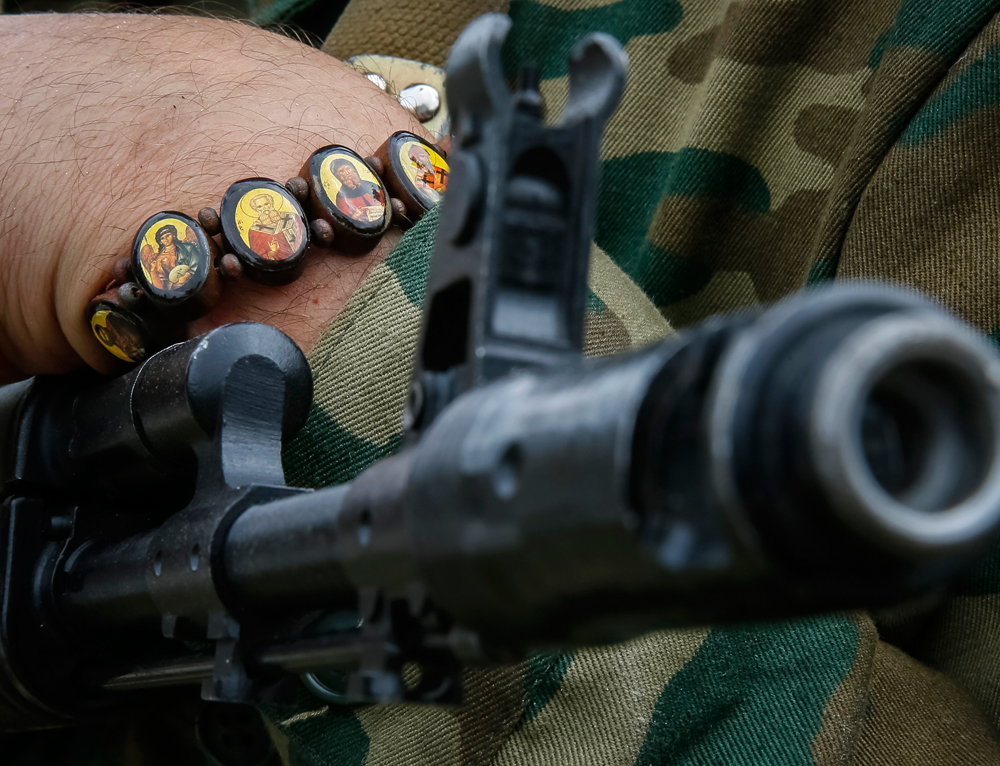
A militia from the Vostok battalion: in one hand of Kalashnikov, on the other - a bracelet with images of all saints. June 2014. Photo: Maxim Zmeyev/Reuters
There is nowhere to retreat
There are almost no barricades in Donetsk itself, the main forces in the protection of the city were relocated to the outskirts. On the way to Donetsk you are passing several blocks in a row: first the Ukrainian army (often with BMP and anti-aircraft guns), then-militias. Between the last Ukrainian post and the first fighters of the DPR, usually from 2 to 10 kilometers, however, if you slowly go along the roadside in the neutral zone, you will certainly see the sentry in the cabin with a machine gun. At the first post, the DPR is checked by the trunk, then again a pair of intersections strengthened in case of assault, and already in residential quarters there is a calculation with military equipment. If the Russian Orthodox Army, consisting of local volunteers, is responsible for external posts, then for the fortified internal - the Vostok battalion: the Russian tricolor flutters over them, and even the citizens of Ukraine are on guard, their commanders are Russians with a military past. Local residents with food and water are still approaching all checkpoints, compassionate women bring hot in thermos: “So, boys, eat. Today is borsch. "
Donetsk militia willingly communicate with journalists, hoping to get the answer to the question: why did Russia still not introduce troops? If pro-Ukrainian youth in the city does not like Vladimir Putin for the support of the separatists, then here in it was disappointed due to the fact that the Crimean script has not yet worked. The social profile of the militias is different: miners, builders, businessmen, car mechanic. They sewed the form themselves, bought body armor with their money (1800 hryvnias - $ 150). Only weapons received on a receipt from the elder in the group. Everyone immediately remembers their Russian roots: who has parents from Rostov, who has a grandmother from Voronezh. “We lived for 23 years without our homeland, without a flag, we are for the Donetsk Republic and for Russia,” - this is one of the answers.
On the Putilov checkpoint 2 km from the Donetsk airport with a magazine correspondent, a fighter nicknamed Likhach talked-he has two higher educations: an engineer-designer and architect. Before the war, he had a good job and money, but "this is our house, our city, we have nowhere to go from here, we will protect it to the last drop of blood." And here is a week to prepare (Likhach did not even serve in the army) and - into service. Lihach does not occupy pathos, but it is clear that he is not a talker: a tire is laid on a voluminous biceps - he dislocated his hand when the marauders were detained. Likhach says that the airport is in the hands of the Ukrainian army, last night there even a civilian aircraft sat there, on which reinforcements were most likely. The airport is shot around the perimeter with snipers, and every night in the nearest forest belt there are shootings between opponents. Immediately nearby, on May 29, the Metro store, it is also within the reach of sniper rifles, which does not stop the inhabitants of neighboring areas: “Every now and then we go in that direction for intelligence and catch the looters,” says Likhach. “There they are here on public work, the trenches are digging.”
Floors of the Donetsk power
The barricades were cleared at the entrance to the Donetsk Regional State Administration (OGA). The fact that this is the heart of a self -proclaimed republic is reminiscent of only broken tiles, a sharp smell of urine at the entrance, and all the same people with machine guns. Interestingly, in addition to military issues, the leadership of the DPR does not seem to be engaged in the city. Employees of the administration dispersed, that is, the administration subordinate to Kyiv, continue to work in buildings of other departments. Taxes enter the Kiev budget, while Kyiv pays pensions and salaries, the streets are removed, the products are imported. According to The New Times, the leadership of the region, including the heads of the Ministry of Internal Affairs and the SBU, left the capital, only Mayor Alexander Lukyanchenko remained from the authorities in Donetsk: he was anrail for political statements, this is probably why the DPR machine gunners visited the City Council, but did not capture. At the same time, the police work in the city (police officers, however, go without weapons, at least those who met the New Times) and employees of the road traffic inspectorate (DAI), but according to the townspeople, neither those nor the other are interfering when the DPR fighters need to “temporarily seize” someone's car. (“We only take the traitors and on a receipt, we use it carefully,” one of the commanders of the Russian Orthodox Army explained The New Times.)
The same commander, however, said that there are criminals in the city who “squeeze” the car under the guise of the DPR fighters: “We are fighting them, we return the cars.” “The bandits seized power in the city,” an employee of the regional administration who wished to remain an unknown person who wishes to remain. - When they occupied the building, they stole all portable equipment: cameras, laptops, tablets. They broke all the doors, because they opened them from the feet, no one thought that there were keys in the dispatch. ”
Inside the OGA, a revolutionary mess still reigns. On the ground floor, blocks of sandbags and reinforcement, broken furniture, mattresses, bags with garbage on the floors, on the doors with broken locks, leaflets glued to adhesive tape with warning inscriptions: “Bushed!”, “You can’t!” And "Do not come in, kill!" In the press center on the 7th floor, located in the office of the deputy governor Tamara Lukyanchuk (a sign with her name is still hanging on the door), the situation reigns a home. The mess on the tables, dirty cups full of nurses of the saucer, the Belarusian flag in a glass with handles. It was here on June 2 that armed people brought to the "preventive conversation" of the chief editors of local newspapers "Evening Donetsk" and "Donbass". Despite the fact that the DPR Prime Minister Alexander Borodai expressed regret in connection with such a “excess”, the editor-in-chief of his newspapers was temporarily suspended.
The coordinator of the press center Claudia Kulbatskaya is simultaneously engaged in the issuance of accreditation to journalists, collecting the press to the rally of mothers of Ukrainian military, who are going to demand to release their sons from the military unit located in Donetsk, and the evacuation of children from the city (“I sent my grandchildren to Yevpatoria today”). Her phone calls her, a blogger comes to her, offering to organize a newsletter of the DPR news through his base, another Dima’s press center, which was dressed in camouflage, comes out of the rest room to go through the checkpoints, the press center secretary brings coffee Claudia, and then sits to Dima to the knees and begins to kiss deliciously. There are all their own.
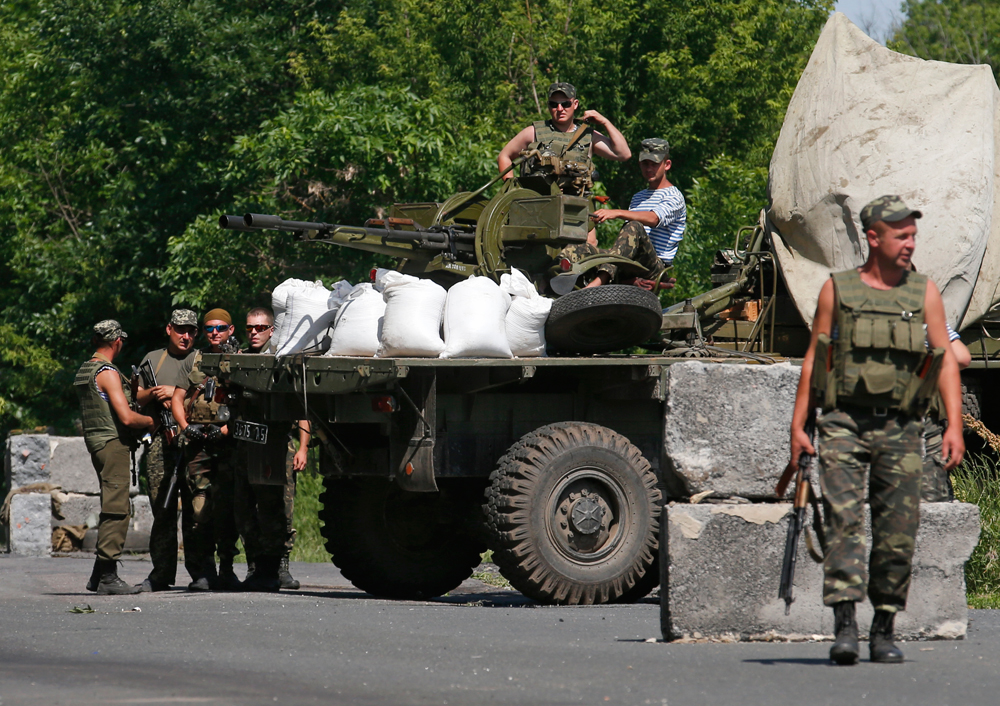
Ukrainian soldiers at a checkpoint near Ambrosievka, Donetsk region. June 5, 2014/Photo: Gleb Garanich/Reuters
Patriot of the empire
The only place in the Regional State Administration, which retained at least the visibility of the order, is the 11th floor, where the foster Prime Minister of the DPR Alexander Boroday and the chairman of the Supreme Council Denis Pushilin are located. In the lobby, in front of Pushilin’s office, however, it also smells of tobacco smoke, the window is broken on the stairs, the guard with Kalashnikov is climbing into it every now and then to smoke. Two sit on leather chairs next to non -working elevators: a military man in a single -color Khaki color, a blue beret, a mass of medals and major stars on the uniform and an elderly man in civilian and glasses. "Where are you from?" - asks a man with glasses. “Intelligence management,” the major replies. "Weapon?" - "Makarov." - "Cartridges?" “Two clips.” Then, between the two men, a lively skirmish occurs, which concerns the mobilization on June 5: “It is impossible when non -persons are engaged in this,” the major swears. “We must call the units, ask who is killed, who is wounded.” “You can contact Khodakovsky (Alexander Khodakovsky - commander of the Vostok battalion. - The New Times),” his interlocutor in civilianity suggests embarrassedly. “What am I your Khodakovsky? I have a direct submission to Moscow. I am a Russian officer! " - the major gets excited. Civil, realizing that the case takes an unexpected turn, leads the blue beret to another room.
"
- Where are you from? - Intelligence department. - Weapon? - Makarov. - cartridges? - Two clips. - You can contact Khodakovsky. - What do I need your Khodakovsky? I have a direct submission to Moscow. I am a Russian officer!
"
Pushilin himself - a gray suit, a nondescript tie - is more like a bank clerk than the warlike leader of an unrecognized republic. He almost doomedly agrees that dual power is present in the DPR, however, immediately recover: "There is a certain imitation of power from Kyiv." Pushilin explains this by the fact that Donetsk pays twice as many taxes to the country's budget than he receives subsidies: “All this is a lie about the fact that we are a subsidized region.” People with machine guns do not obey the government. So, when asked about civil hostages, who are kept in the basements of Slavyansk, Kramatorsk and Donetsk (on June 1, a list of 44 people was published, including activists, businessmen, officials and even a theater director), Denis Pushilin replied that they would like to exchange for activists of the DPR, but Kyiv was not very baked about their fate. Immediately, however, it explains that for each detainee there is an evidence base for espionage activities, and a power block is generally engaged in detentions, which the government does not affect. “We are engaged in politics and developing strategic decisions,” explains Denis Pushilin, without going into specifics and immediately moving on to dreamy reasoning that he is a patriot of the Russian Empire, and the DPR is only the beginning for the unification of all Slavic peoples under the banner of the “Russian world”. What to do to those young people who were born in Donetsk, but consider themselves to be patriots of Ukraine? “We were always taught the wrong patriotism, imposing on us Ukraine,” says Pushilin. “Yes, and then, these are only rare exceptions.”
However, the young government hopes not only for the imperial patriotism of its supporters, but also for the help of a neighbor: “The Russian peacekeeping contingent must be introduced into the Donbass,” said Pushilin. “There are not enough volunteers from Russia.” But what about the "Russian officer" in his reception? - “Simple bravado. There would be actually a Russian officer, you would not have heard that. ” And he adds: “You are more careful, please, there is a real hunt for journalists now. You can not be afraid of us, but Ukrainians can do something with you, and then blame us. ” In the lips of the speaker, this, however, sounds more like a threat than as a concern.
Putin with fragmentation
As the commander of the Russian Orthodox Army nicknamed Samarkand explained to The New Times, almost all volunteers who come to the Donbass from Russia go to hot spots - Slavyansk, Kramatorsk: “There are no fighters with experience, there is no time for training.” According to Denis Pushilin, natives of Transnistria, Poland, and countries of the former Yugoslavia also fight in the ranks of the People’s Militia. This does not mean, however, that only foreigners participate in active battles, the number of Russians estimated different sources of the magazine from 5% to 10%, reporting, however, recently the number of arrivals has increased greatly: the checkpoints, along the so -called green border with the Rostov region, are arrived in the country with volunteers and weapons through the so -called green border. According to several interlocutors of the magazine, it was the intensified stream of assistance that forced the Ukrainian army to try to block the border with the help of heavy equipment, and the militias - to start in response to fights for individual border posts.
“We still had a flower and conflict period,” says Kibalchish. - And then a wound. Doctors first said that I would stay disabled for life. But she went with me, went out of me, some medicines did not rely on me for free, she bought for her "
"
To understand who is really fighting here, The New Times correspondent went to the Donetsk hospitals, where the wounded from the front is delivered. In all three central hospitals - them. Kalinin, TsGKB No. 1 named after Вишневского и Донецкой областной клинической травматологической больницы — был введен специальный режим: отменены плановые операции и госпитализации, больных стараются выписывать как можно быстрее, причем не только гражданских, но и самих раненых. При этом врачи подтвердили The New Times, что не испытывают недостатка в медикаментах или крови для переливания: раскупорили запасы лекарств, хранившиеся на случай форс-мажорных обстоятельств, к тому же с лекарствами помогает Красный Крест. «На станции переливания крови повесили уже объявление, чтобы люди не приходили, все хранилища забиты», — сказал журналу заместитель генерального директора по хирургической службе больницы им. Калинина Андрей Сагалевич. Точное число раненых врачи сообщать отказываются, непонятно к тому же, кто из пациентов принадлежит к ДНР, а кто является пленником, если не заложником: «У некоторых раненых специальная охрана, мы не знаем, кто они, но видим, что относятся к ним по-разному», — рассказал врач одной из больниц, попросив не указывать его имени. Впрочем, если в больнице им. Калинина охраняются отдельные палаты, то в областной травматологии автоматчики дежурят прямо у входа в приемное отделение.
Есть среди раненых и россияне, но немного — те же 5–10 %. «К нам очень много привезли кавказцев, когда была битва в аэропорту 26 мая, — рассказал один из врачей отделения травматологии. — Их кого ни спросишь, откуда они, все говорили — Грозный, Владикавказ, Махачкала. Настоящих имен, впрочем, никто не называет. «У нас тут одни Пушкины и Некрасовы, вчера вот Путина привезли. С осколочным», — смеется Андрей Сагалевич.
And about love
Путина в хирургическое отделение больницы им. Калинина доставили 4 июня вместе с 15 другими бойцами из Семёновки, окраины Славянска. 13 человек выписали на следующий день, двое остались лежать с ранениями средней тяжести. Ехали на старом разбитом автобусе, пробираясь ночью полями в объезд украинских постов, вместе с ранеными несколько гражданских сопровождающих, в том числе 15-летняя Настя, дочь полка, которая суетится возле автобуса и кормит вояк с руки растаявшей на жаре шоколадкой. На пороге отделения, рядом с Настей сидит другой сопровождающий мощный мужчина лет 45 по кличке Камаз. Камаз — россиянин. Родился в Ростовской области, переехал в Симферополь, в марте вступил в отряды крымской самообороны, охранял Симферопольский аэропорт. За спиной у Камаза — Карабах и Приднестровье, в Крыму был небольшой бизнес, но заниматься им было неинтересно: «Когда в Крыму все закончилось, я понял, что там мне ловить нечего, а тут наступает фашизм. Сидеть на месте я не мог». На Украину Камаза переправил Союз десантников России, но, по его словам, есть и другие организации, которые занимаются снаряжением ополченцев. Границу пересекали все в той же Ростовской области и именно на КамАЗах: «С нами много ехало народу, крымчане, парни из Ростова и даже из Челябинска, — рассказывает Камаз. — Кадровых военных не было, вообще мало у кого есть даже профильное военное образование. Но у большинства — боевой опыт». Денег, по словам Камаза, им никто не платит, приехали по зову сердца, «сражаться за русских братьев».
Впрочем, если у многих приехавших на Украину россиян есть за плечами постсоветские войны, украинцы, вставшие под флаг ДНР, часто ничем таким похвастаться не могут. В соседнем отделении неврологии в 6-местной палате лежат пятеро раненых из другого «привоза». Грязно-желтые стены, железные койки с тонкими матрасами, армейские ножи в изголовьях. Двое раненых из Харькова, один из Одессы и двое из Донецкой области. Один из харьковчан, невысокий темноволосый живчик, чем-то напоминает Мальчиша-Кибальчиша из советского мультфильма, только без буденновки и с залитыми зеленкой шрамами на пол-лица. Кибальчиш окончил вуз по специальности «Автоматические системы управления», работал начальником смены на нефтебазе, получал немаленькую для Харькова зарплату — $1000. «У меня родители там не последние люди», — поясняет Кибальчиш. По его словам, он вместе с другим харьковчанином из той же палаты (18-летним разнорабочим) участвовал в протестах против киевской власти, захвате 6 апреля харьковской областной администрации, а когда митинги были подавлены, связался через интернет с Игорем Стрелковым и приехал в Славянск. «Мой дед погиб в Великую Отечественную, я не допущу, чтобы на мою землю снова пришли фашисты», — аргументирует свой поступок боец. Что думают по этому поводу родители? «Мама плачет, отец гордится», — говорит парень, впрочем, родители узнали обо всем от знакомых, только когда он был уже в больнице, но навестить не могут: чтобы не раскрыть настоящее имя. Повоевать Кибальчишу много не довелось: при одном из артобстрелов водитель автобуса, в котором он оказался, не справился с управлением и врезался в столб. Итог: множественные переломы позвоночника и лица.
На соседней койке сидит тихая тонкая девушка, которая во все время разговора не отрывает глаз от компьютера (в больнице есть бесплатный Wi-Fi). Это Рита, с которой харьковчанин познакомился на фронте. Рита работала медсестрой в психиатрической клинике в Славянске, а в свободное время, как и многие другие жители, помогала повстанцам: приносила им еду, воду, сигареты, стирала, готовила. So we met. «У нас был еще цветочно-конфетный период, — рассказывает Кибальчиш. — И тут ранение. Непонятно было, смогу ли я когда-нибудь ходить, врачи сначала говорили, что инвалидом на всю жизнь останусь. А она вот со мной поехала, выходила меня, некоторые лекарства мне бесплатно не полагались, она покупала за свои». Рита смущенно улыбается, краснеет и утыкается в компьютер. «Ну а как же ж. Разве можно иначе?» — бормочет она и улыбается своему раненому герою. После выздоровления оба собираются вернуться на фронт: Кибальчиш хоть писарем, если ходить не сможет, Рита — медсестрой. Выпишут его, правда, только через пару месяцев, остается только надеяться, что любви у Риты и Кибальчиша будет больше, чем войны. Как и у всей Украины.