
Translated material
Nowhere to wake up
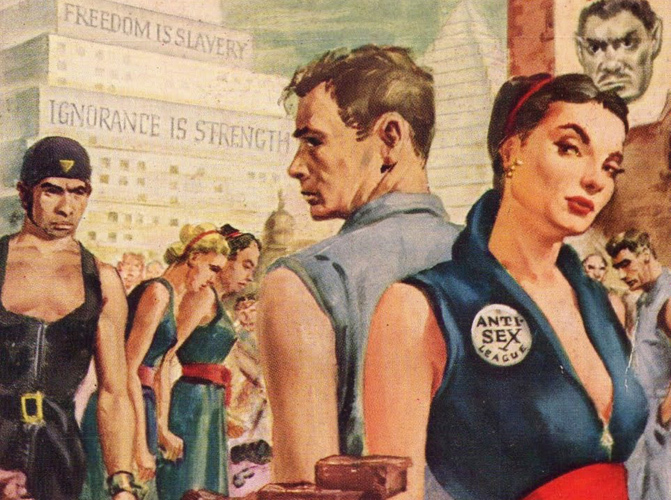
This book fascinated him, or rather, supported him. In a sense, she did not open anything new to him - but that was precisely in her charm. The book said what he himself could say, he was able to put his thoughts in order. She was a work of his mind close to him, but only much stronger, systematic and undaunted. It was impossible not to come to the conclusion: the best books are those that are already known to you.
George Orvel. "1984" [1]
Sixty -five years ago, a book was published in the UK, which had an extremely important impact on the further course of world history - both the second half of the past century and the first years of the present. Despite the fact that thirty years have passed since the fictional events described in it, now and then there is a feeling that all this is happening right now. In recent weeks - more and more often.
On June 8, 1949, the British Publishing House "Secer and Warburg" published a new book by the writer George Orvella [2] . Advertising announcements placed in publications that reported on book innovations informed potential readers that the book under the uncomplicated name - “1984” is a fantastic novel, which takes place in the distant future, in the very year that is put on the front side of the cover in the form of the name. Two weeks later, the author of the book turned forty -six. After another seven months, he died.
The novel, on the other hand, healed his own life, completely different from many other works, created in a similar genre by other writers. This genre received a stable stigma in literary criticism-“anti-utopia”, that is, utopia of the scruff of the stump-linen, inside out. Simply put, utopia is when the writer fantasizes about the excellent leaning future, in which everyone will be fine, and anti -utopia - when he warns of the possible, complete abominations and nightmares, in which everyone will have problems.
Orvella’s novel was not just one of the examples of the anti -utopia genre - since the appearance of the appearance, he occupied the most upper and still not disputed line from competitors.
This is explained by many factors. Here is a completely amazing plot and style, and especially the final of history. No cherapy ends. A single hero does not win a monstrous dragon. On the contrary, the dragon devours the hero, and a priest, gets rid of him natural for his digestion. The shit falling from the dragon's ass takes, however, a human form. It looks like a person, and speaks like other people. But they all talk only about one thing-how they love, how they really adore their dragon and cannot live without him. Moreover, they not only talk about it - they also think about it. And from everyone carries shit.
As the saying goes, there is something to amaze at our penalty hut. Not otherwise, Shnyr again forgot to take out the parach ...
* * *
The modern Russian reader Roman Orvell “1984” is known in two main translations - Viktor Golyshev and Vyacheslav Nedoshivin. For the first time published in the USSR in the late 1980s, when the Soviet Secret Police stopped allowing a parach from the hut to the camp toilet for reading and storing this book, they have since been repeatedly reprinted [3] . However, few of those who are not in the subject, it is known that neither one nor the other was the first. Both Golyshev and Nedoshinov, whose translations were published with a very small temporary gap in 1988-1989, share the second and third place. The first - if not in quality of the text, then, in any case, in the time of its appearance - unconditionally occupies the very first Russian translation of this famous work. I mean the translation of V. Andreev and N. Vitov, where in both cases - pseudonyms instead of genuine surnames.
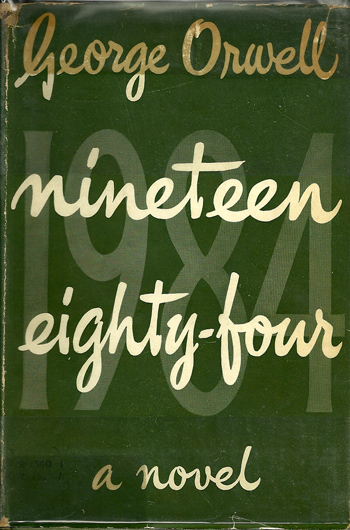 © Secker & Warburg First edition of 1984
The first Russian translation of the novel “1984” was published in the form of a book eight years after the appearance of the original. Of course, outside the country, whose inhabitants are used to read mainly books written and published in Russian. This is natural, since the publication of such a book in such a country in such years seems even more fantastic than its content. (Although I have repeatedly heard the same completely irreily look at the story. That as if, in the early 1950s, Orvell’s book was translated and printed in Moscow on the orders of Stalin himself. That allegedly was made either twenty or thirty or as much as fifty of its copies-all numbered and taken for special Kremlin library. These copies were intended only for the highest Bolshevik mafia - members and candidates for members of the Politburo, secretaries of the Central Committee, the heads of the Department of the Central Committee, so to speak, the advanced experience of managing the English comrade O'brain. What ... However, I have never seen a person who claimed that he or he was in his hands, one of these Kremlin roslice of Orvell’s books, or personally knows the one who held it.
The first publisher of the first Russian translation of the novel “1984” was the malicious anti-Soviet publishing house “Sowing”, which was a commercial enterprise of an equally malicious anti-Soviet organization of the NTS (People’s Labor Union). This organization was based at that time in West Germany, in the city of Frankfurt-on-Main. Accordingly, the publishing house was also located there, which, in addition to many purely party products - all kinds of brochures, leaflets, transcripts and resolutions held by the “hard workers” of conferences, symposia and collloxes dedicated to the most important topic - the struggle of world communism - also books, including good ones.
The choice for the publication of the Russian translation of Roman Orvell was, without a doubt, the choice is correct. Moreover, the initiative, as it turned out inadvertently thirty years later, emanated not only from the publisher. In 1986, in an interview, dedicated to the 40th anniversary of the founding of the “Tolstoy” literary and party journal “Class” and published in the same journal, the main literary Enteysovets Evgeny Romanov (Ostrovsky; 1914-2001) recalled:
“For the 1984 publication, we received a large subsidy from the widow of Orvell, according to his dying wish. The most difficult translation <...> was made free of charge now the deceased <and> professor N.E. Andreev (Cambridge) and N.S. Vitov (Monterey) " [4] .
Consequently, the copyright to the transfer was provided to the Entesovites for free, and they did not pay a single American cent or at least the West German Pfennig for the work of translators. About how much was earned in the publication, Partygenosse Romanov tactfully silent in an interview.
Be that as it may, in 1957 the book came out [5] . The publication of the Russian translation in the form of a book was preceded by its publication in parts in the Enteesovsky "Tolstoy" magazine "City" [6] .
A few necessary words about who were the first translators of the novel “1984” into Russian.
V. Andreev - this, in fact, is not Andreev, and even more so not “N.E.”. This is the pseudonym of V. Gorevoy, a person who is so little known about that I could not find any reliable biographical information about him. It is possible that Goreva is also a pseudonym. Andreev N.E., who is called as one of the translators, Evgeny Romanov (Partygenos, apparently, has been trifling in memory for years), is Andreev Nikolai Efremovich (1908-1982), historian and literary critic, a native of St. Petersburg, an emigrant for the first, Belogvardeisian wave, who replaced several countries and replaced several countries, and replaced several countries and replaced several countries and replaced several countries and replaced several countries and replaced several countries. Completing his scientific career with the rank of extraordinary professor of Cambridge University, and the life path on the shores of foggy Albion. Nikolai Andreev is the author of the most interesting memoir book “What I recall”, which he wrote the whole second half of his life, but did not manage to complete; It was first published after the death of the author [7] .
The first Russian translation of the novel “1984” was published in the form of a book eight years after the appearance of the original. Of course, outside the country, whose inhabitants are used to read mainly books written and published in Russian.
As for the second translator, co -author of V. Gorevoy (Andreev), designated as “N. Vitov ”, then Nikolai Pashin (nee Pashin; 1908–1976)-Soviet post-war emigrant-revolt, collaborationist of the Second World War, also known as the elder brother of the writer Sergei Maksimov (Easter 1916-1967), as well as a collaborator and a non-returner, man, was hidden under this pseudonym. extremely talented, fate of strange and tragic [8] .
It is these two people who belong to the palm of the Russian Orvels-the very one, for the storage and distribution of which in the USSR followed the inevitable responsibility under the article: first the ominous 58th, and then the primitive 70th (“anti-Soviet agitation and propaganda”)-up to seven years of political launch laces and Chervonets-if repeatedly; Yes, and the post -alignment link - up to five years.
* * *
Despite the threat of fading repressions for reading Orvell, Soviet people - to whom it was lucky - they still read Russian translations published in the West. And the most daring and distributed. Orvell books published by foreign publishers, although barely, were seeping through the “Iron Curtain”-in the 1950s, and in the 1960s, and later.
Anti -utopia “1984” made an indelible impression on her readers who had a dubious pleasure to live in a society where each of them could feel, which means to be Winston Smith, in his own skin. Especially if these were readers not ordinary, but professional, themselves not alien to writer's ambitions. Moreover, the writers are professional.
The Soviet writer Anatoly Kuznetsov read the novel “1984” already in the West - after “chose freedom”, being in London in July 1969 on a creative business trip. The story that was described in the book before the English colleague completely shocked the writer, a none-evident writer, forced to enforce his dream of shooting an agent-provocateur of the Soviet secret police. Having entered the Radio Liberty (where he spoke with weekly conversations within the 1972-1979, as part of the program “Writers at the microphone”), Kuznetsov dedicated the cycle of his radio broadcast, Orella’s novel, entitled “Teleskrin” [9] - by the name of the horror of Winston Smith, the apparatus for eavesdropping and spying on the inhabitants of the 1984 Orvelian world. In the three parts of the cycle, which took the air in October 1974, Kuznetsov spoke in detail about his habitat in the house with the Soviet analogue of teleskrin - an ordinary apartment telephone that allows the KGB to eavesdropped everything that happens in the apartment not only during the telephone conversation (which was never doubted by the USSR, but also with the tube laid on the tube. Having told in all details about his personal experience of interacting with the KGB as an object of police surveillance, the writer completed the last conversation of the cycle with optimistic words:
“In addition to the task of collecting information, this whole hypertrophied surveillance system has a different, no less important, and maybe even more important task at today's stage: to inspire fear. Namely: "The KGB is known - every sound, every step." The citizen is trembling, frightened - is not dangerous, convenient for the leadership of them, and the more such ones, the calmer power. Not afraid - this is for the KGB like a stake across the throat. Today, the KGB is afraid today, rightly seeing in them a serious threat. But the number of not afraid in recent years is growing and growing. Apparently, any system of maintaining fear, right up to the Orwell telescrins personally at each, has its own limits in time; Like everything in the world, in general, the beginning, spectacular development and the inevitable end ” [10] .
Orvelian nightmares did not leave Anatoly Kuznetsov for a long time. Three years later, in December 1977, speaking with the next radio expert (the theme of which this time was the fact that the Communists that struck him for a long time was not necessarily the Soviet ones-they are always easily ready to deny the most obvious facts, if at least more or less contradicts their delusional theories and the picture of the world), Kuznetsov again spent direct analogies between the monstrous world Orvella and the Soviet "real socialism":
“The Book of Orvell“ 1984 ”is considered fantastic, but I did not read a more realistic description of the Soviet Union. The naming of things by other names, grotesque techniques belong to a purely artistic arsenal of funds. The hero of the book works in the Documentation Department of the Ministry of Administration, that is, the Ministry of Truth, where he is doing this. He monitors the slightest changes in state information today and should insert a new version everywhere where the previous version was. Say, some person was considered a hero. Now it is announced that she is an enemy. The army of employees sees the mention of the hero from the old bindings of newspapers, books, magazines, brochures, posters, films, sound recordings - and inserts a new version of the enemy there. The old copies of the newspapers are gained and reprinted again, pieces of films are cut and ceased. If the mention of something needs to be removed, it is removed so that there are no traces. The future historian will not even suspect that it was. No " [11] .
Anatoly Kuznetsov himself could become the Soviet Orvel. Since even before the flight from the “Kumach Paradise”, having no idea about any Orvels and Haxley, he began to write his own antiopian novel about death in the totalitarian society of a thinking person. The fate of this work with a strange name for a Russian -speaking person - “Teich Five” - developed dramatically: it has disappeared. What, I believe, in the future it makes sense to write separately.
* * *
Each writer dreams of writing a book that will turn the consciousness of millions of people who read it. But not everyone manages to fulfill their dream. Lucky units of hundreds and hundreds of thousands possessing the ability to clearly formulate their thoughts and put the right words in the correct order. Of the among those who wrote in the twentieth century, among them-Mikhail Bulgakov, Vasily Aksenov, Alexander Solzhenitsyn; Perhaps another couple of names. From among those who wrote in French-Albert Camus; In English-primarily George Orvel.
This man generally possessed, if not for the gift of foresight in his pure form, then clearly the ability to foresee the future events. First of all - political.
At the beginning of 1938, ending his most significant (after 1984) book - “Memory of Catalonia”, the autobiographical history of his participation in the Civil War in Spain on the side of the Republicans, ”telling about his return from Spain, where he miraculously survived, Orvell wrote:
“Outside the window of the car, England flickered, which I knew from childhood: slopes overgrown with wild flowers, flooding meadows, in which large sleek horses, leisurely streams, bordered with and ineve, green breasts of visible in the frontaders of cottages are thoughtfully pinch; And then the thick peaceful jungle of the London outskirts, barges on the dirty river, posters notifying cricket matches and royal wedding, people in pots, pigeons on Trafalgar Square, red buses, blue police officers. England sleeps with a deep, serene sleep. Sometimes fear finds me - I am afraid that awakening will come suddenly, from the explosion of bombs. " [12] .
The book "Memory of Catalonia" went on sale at the end of April 1938. Less than a year and a half, a new world war broke out in Europe. A year later, German bombs poured almost daily on London, old buildings collapsed in the fire of fires, the inhabitants of the English capital were killed under their walls ... The serene dream ended. Awakening has come. In the history of World War II, it received the name "Battle for England."
Then the cannibals who untied the war - Stalin and Hitler, brutalizing the smell of a smoking human blood, clung to the pharynx of each other, and the threat of invasion passed. England was saved, and George Orvell, who became a fighter of the counter-propaganda-the World BBC service, began to accumulate material for writing the last two works-the satirical parables of the “Moravod farm” (1943) and the antitotalitarian novel-anti-nyutopia “1984”.
* * *
George Orvell died in January 1950, incomplete forty-seven years old. Tuberculosis is an insidious disease, people affected by them are used to get sick for a long time and die suddenly-as a rule, when a sudden improvement suddenly occurs during the disease and it seems that it is not still lost, which is about, a little more-and a miracle will happen. And you can continue to live, work, take care of the family. And - create. Most often, such hopes are nothing more than illusions. Особенно горестно бывает, когда смерть приходит за писателем до того, как ему удается поставить в манускрипте своего романа последнюю точку в последней фразе финальной главы.
Орвеллу в этом отношении безумно повезло. Он если и не написал все что хотел, то успел взять в руки главную свою книгу. Всегда совершенно равнодушный к земной славе и прямому ее следствию — материальным благам, он сумел высказаться во весь голос. И не просто высказаться, но и отправить свое грозное предупреждение потомкам. Суть этого предупреждения максимально проста и доходчива: НЕТ И НЕ МОЖЕТ БЫТЬ В ЭТОМ МИРЕ НИЧЕГО БОЛЕЕ ВАЖНОГО И ЦЕННОГО, ЧЕМ СВОБОДА. Свободу человеку надлежит беречь сильнее всего, что у него есть. Потому что те, кто, становясь перед выбором — свобода или колбаса? — выбирает колбасу, чаще всего просто не понимают, что, отказываясь от свободы, человек тем самым отказывается и от всего остального. Потому что, после того как исчезнет свобода, вслед за ней обязательно исчезнет и колбаса. Это — аксиома. То есть истина очевидная, никаких дополнительных доказательств не требующая.
В сущности, весь описанный в романе «1984» мир представляет собой один непрерывный кошмарный сон, из которого некуда проснуться. Противостояние одного маленького человека и могущественной сверхтоталитарной машины заведомо обречено на поражение. Always. Не поможет ни тайно ведущийся дневник, в котором можно писать правду, зная, что через плечо не заглядывает вездесущее око телескрина, ни запретная любовь в каморке мистера Чаррингтона, ни откровения о сущности окружающего вас абсурда, почерпнутые из разоблачительной книги «Теория и практика олигархического коллективизма». Потому что мысль, зафиксированная на бумаге, станет только лишь вещественным доказательством на предстоящем следствии, женщина, спасая свою жизнь, после ареста обязательно предаст первой, а на отчаянный вопрос после жестоких истязаний в камере пыток: «А книгу-то эту — кто написал?» — вы непременно получите от своего палача ответ: «А я и написал».
Помните об этом, сталкиваясь с неизбежностью выбора между стабильностью и жизнью. Она пока еще принадлежит вам.
And the last.
До тех пор, пока в России не ликвидирована власть тайной политической полиции, важнейшим русским писателем остается англичанин Эрик Блэйр, писавший под псевдонимом Джордж Орвелл. Или — Оруэлл. Это уж кому как больше нравится произносить.
[1] Перевод с англ. Сергея Юрьенена, 2014.
[2] Я предпочитаю именно эту транскрипцию данной фамилии на русский. - approx. автора .
[3] Русский текст «1984» В. Голышева довольно быстро вытеснил из печати работу В. Недошивина и ныне считается «каноническим»; хотя при внимательном филологическом анализе обоих текстов оба они выглядят совершенно равноценными по качеству перевода.
[4] Миссия «Граней». Интервью с основателем журнала Евгением Романовым // Грани (Франкфурт-на-Майне). 1986. № 141. Цит. по: Свободное слово «Посева»: 1945—1995. — М.: Посев, 1995. С. 69.
[5] Орвелл Георг. 1984. Фантастический роман / Перевод с английского В. Андреева и Н. Витова. — Frankfurt am Main . Possev - Verlag , 1957.
[6] Орвелл Георг. 1984 // Грани (Франкфурт-на-Майне). 1955. № 27—28. С. 3—67. 1956. № 30. С. 3—78. 1955. № 31. С. 3—49.
[7] Андреев Николай. То, что вспоминается: Из семейных воспоминаний Николая Ефремовича Андреева: В 2 т. — Таллин, 1996.
[8] Сергей Максимов — прозаик, поэт и драматург. В 1936—1941 гг. провел пять лет в ГУЛАГе на Воркуте. После войны жил в Западной Германии и в США. Оставил после себя два романа, одну повесть, полторы пьесы и десятка два рассказов на лагерные темы, по силе иногда превосходящих не только А. Солженицына, но и В. Шаламова. Ни единой книги С. Максимова на родине его до сих пор не издано.
[9] См.: Кузнецов Анатолий. На «Свободе». — М.: Астрель; Corpvs , 2011. С. 352—372.
[10] Ibid. С. 372.
[11] Ibid. С. 565.
[12] Орвелл Джордж. Памяти Каталонии. — Paris : Editions de la Seine [1971]. С. 279. Без указания автора перевода.