
Translated material
Speech that no one heard
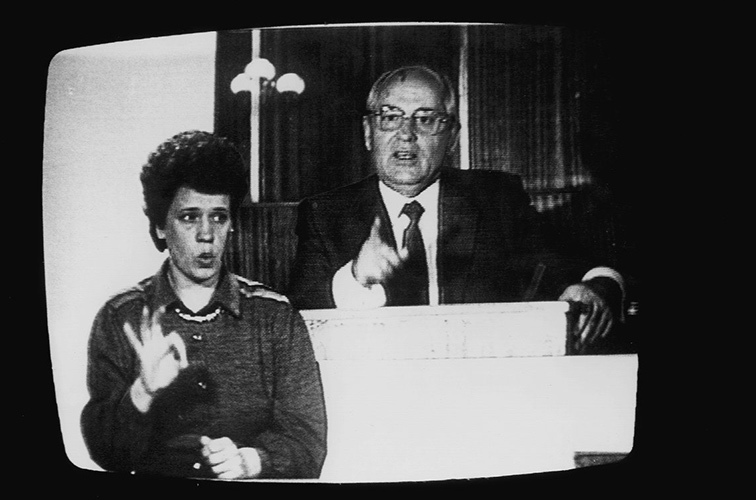
The archive of Yegor Gaidar contains a small manuscript "immediately after socialism (Russia and reform)." This is a memoir text that Gaidar began to write shortly after leaving the government, but did not finish. Subsequently, much of it was included in the book “Days of Deads and Victories” (1996), but there was no very significant fragment in the final text of the book.
In this fragment, Yegor Gaidar describes the situation of the late 1990 and gives the text of the speech written by Mikhail Sergeyevich Gorbachev written for the USSR President.
Here we first publish this never -mentioned speech and fragments of the comments of Yegor Gaidar to her.
... It seems that it was decided that first M. Gorbachev will speak on television, turn to the people, and will put out the essence of the alleged heavy, but necessary measures. They instructed me to prepare the text of the speech.
I must admit - he had never worked with such a sincere hobby, hoping that Gorbachev, realizing the inevitability of serious economic transformations, would want and be able to convince the people of this, then, relying on their support, he would break the resistance of the bureaucracy. Work will begin ... The storm will not subside, but in the raging sea, the state ship will finally take the right course.
So, I ask the reader to imagine that he is again in March 1990, returned from work, turned on the TV. On the screen is the president of the USSR.
Dear comrades!
With growing concern, society monitors the situation in the economy. The volume of industrial production continues to fall. It is more and more difficult to get the necessary goods for life. Prices quickly go up. We must face the truth. The bodies responsible for managing the national economy have lost control of the situation.
And in the most remote corners of our country and in the Kremlin, people try to understand what the reasons for growing difficulties are: what needs to be done to correct the situation. I want to share my considerations about this.
I will not mention heavy inheritance, adverse trends in the world market, even important miscalculations in the financial policy that have been admitted in recent years. For all the significance of these factors, the main thing, I think, in another - in inconsistency, indecision of the economic reforms begun.
At the first stage of perestroika, ideological stereotypes were still affected by us, the very word “market” was perceived as sacrilege in relation to socialism. The lack of consent in the highest echelons of the country's leadership, the party on the question of where to lead the economy. And yet for me - and I take my share of responsibility for the compromise nature of the transformations - the main thing was the understanding of serious social problems associated with a forced transition to a market economy. Indeed, radical reforms are not only economic independence of enterprises, stimulating high -performance labor, with which almost everyone agrees, but also flexible market prices, and rigid responsibility for the effectiveness of management. And this is much more difficult for society to accept. I wanted to delay the most severe, unpopular measures as much as possible.
As a result, mutually rejecting elements of command-administrative and economic structures were intertwined in the management system. As the center was released from the hands of the control levers, their place was occupied by not strict market discipline, but by the dictatorship of departmental monopolies, local arbitrariness.
It is impossible to try to continue to maneuver, to look for acceptable half measures for all. The time has come to choose - either to the usual teams and reports, or decisively forward, to the market. That is how the question is today.
The problems of economic development were discussed in detail at the II Congress of People's Deputies. A government program was approved, aimed at the exit from the crisis. Some of the measures provided in it work, give a return. At the same time, evaluating a rapidly changing position, we can say: we no longer have the time that the government has asked to stabilize the economy. The destructive processes who have gained their own inertia nullify the efforts aimed at economic recovery. The development itself is pushing for radical solutions.
It is impossible to try to continue to maneuver, to look for acceptable half measures for all. The time has come to choose - either to the usual teams and reports, or decisively forward, to the market. That is how the question is today.
I am convinced: an attempt to turn back would be fraught with disaster for the country. You cannot enter one river twice. Rich natural resources, in vain was torn in the era of stagnation, you can’t return back, as you can’t return the faith of society that the wordless, poor life under the supervision of the wise chiefs is natural and acceptable. It would be the way to self -isolation in the world, poverty, to growing social conflicts and the inevitable explosion of popular anger. No matter how difficult it is, even the path of radical reforms is risky, only he can withdraw the country out of a serious crisis.
We need the market today to liberate a person, to use the huge creative potential of the peoples of our country, to return it to a worthy place in the circle of developed states. To bring the economic foundation to the democratic transformations begun, to undermine the basis of the omnipotence of the administrative apparatus. To make the shelves of our stores full, the ruble is full -hearted, and the life of Soviet people is wealthy.
The formation of the regulated market in our country goes into the field of practical work. We are talking about the formation of the economy, which is based on the complete independence of enterprises operating in conditions of competition as independent producers. The active regulatory role of the state in the field of production development, ensuring social guarantees. The economy, in which the predominance of state and collective property is determined only by their effectiveness with complete equality and free competition of all other forms. Where economic activity is clearly separated from public administration itself, markets of goods, labor, financial resources are developing. Finally, this is an economy open to the world with a convertible ruble, in which the effectiveness of economic activity is checked by rigid competition in the domestic and foreign market.
Already this year, the mass transformation of state enterprises to joint -stock companies will have to be launched, widely deploy the sale of the population at market prices of housing, small enterprises that are inappropriate to maintain state property, machines and equipment, precious metals, foreign currency.
Tomorrow will be published a presidential decree containing a program of actions to prepare a transition to a regulated market economy. We start her immediately. But we start not by defrosting prices, but with credit reform, a sharp tightening of state financial policy, and demonopolization of the economy. And only then, in 1991, having mastered the markets for regulating the market, blocking the channels of flow into the circulation of excess money, creating reliable prerequisites for the effective anti -inflationary policy, in the mass order we will switch to free prices, balancing demand and supply.
I will dwell on several fundamental aspects of the upcoming work.
The main reason for the increase in inflation in the country is the deficit of the state budget. The efforts that are still aimed at stabilizing the financial situation were still indecisive and therefore ineffective. I consider it necessary to immediately accept the emergency budget for the second half of 1990. We will have to revise the entire program of centralized investment, the purchase of weapons, assistance to foreign countries, subsidies, management expenses, bring them into line with the real capabilities of the state. To implement enterprises and cooperatives unfinished, preserved objects. Already this year, the mass transformation of state enterprises to joint -stock companies will have to be launched, widely deploy the sale of the population at market prices of housing, small enterprises that are inappropriate to maintain state property, machines and equipment, precious metals, foreign currency. If all this is not enough to stabilize the financial situation, you will have to go to a proportional reduction in all articles of state expenses, protecting only a limited circle of important social programs.
If the state does not converge ends meet, if politicians who thirsty for popularity want to increase expenses, regardless of income, this is not a reason to shake the ruble. With the Regulation, in which the Council of Ministers, the Ministry of Finance dispose of the resources of the State Bank as its own, will have to finish. It was decided to withdraw the State Bank from the subordination of the Council of Ministers, transfer the country's gold and foreign exchange resources to its management, and prohibit direct lending by the Central Bank of the State Budget. The state bank, endowed with broad powers, independent in its work, will be fully responsible for the stability of monetary circulation in the country.
It is frightened by many that significant savings have accumulated in the population. Persistent calls to confiscate part of these means today have become an element of the country's political life, destabilizing an already difficult situation. We carefully dealt with this issue. It turned out that walking from one seal from one information about the extremely uneven distribution of savings are not supported by reliable facts, and are not true. The overwhelming part of the population of the population in the savings bank is concentrated on relatively small deposits, is clearly labor. If the money is made dishonestly, then it is a case of law enforcement agencies, courts to establish this. The savings themselves, in comparison with the volume of national wealth, are by no means excessive, they can and should be used as a support for the program of the degradation of the economy. I can assure that the government does not intend to conduct any confiscation of money.
It is necessary to urgently withdraw department stores, cafes, canteens from all kinds of tenders and trusts, convert wholesale organizations from distribution bodies to commercial centers, sell unprofitable stores to joint -stock companies, cooperatives, and citizens.
Another thing is that in the transition period it is really important to take accumulated savings from the consumer market, to prevent their release from causing a sharp increase in prices for everyday goods, to stimulate the direction of funds for the acquisition of housing, securities, and the development of entrepreneurial activity. Measures aimed at solving such a problem are known in world practice, relevant proposals are now being developed.
Another area of work where it is necessary to achieve serious progress until the prices are defrosting is demonopolization of the economy. I will only say about one area where monopolism is especially sensitive - about retail trade. Its existing structure is perfectly adapted to suppress the interests of the consumer. It is necessary to urgently withdraw department stores, cafes, canteens from all kinds of tenders and trusts, convert wholesale organizations from distribution bodies to commercial centers, sell unprofitable stores to joint -stock companies, cooperatives, and citizens. In short, to form a developed structure of competing trading enterprises.
In general, the demonopolization program refers to the disaggregation of artificial associations, and the stimulation of the predominant development of small enterprises, and the formation of a system of commodity exchanges. We will have to promptly create the basics of market infrastructure over a few months, which in normal conditions have been formed for decades.
Particular attention is deserved by the formation of a system of social security, retraining and employment of workers released from social production. Their flow will increase. Everything must be done so that unemployment does not become a source of acute social conflicts. In a word, a huge job is needed to organize economic life in fundamentally new market conditions.
No matter how hard we try to limit the scale of prices, it will not be possible to prevent it at all. To promise this would be simply irresponsible. But it is possible and necessary to protect the poor families, low -income groups of the population, those who receive low, fixed income and more sufficiently all suffer from inflation from its consequences.
It is planned to introduce an automatic increase in the minimum wage, pensions, benefits, scholarships depending on price growth. Similarly, the salaries of health care workers, education, culture, and other groups, the wages of which do not depend on the self -supporting results of the activity, will not be adjusted with an increase in the income of enterprises.
The integration of the Soviet economy in the world market will also be difficult, painful. We will have to coolly change the usual price ratio, bring them closer to international standards. It turns out that many enterprises, which were considered advanced, do not withstand competition in tough world standards. Their groups will have to seriously pull up or think about the future. But the possibilities of a breakthrough in the field of improving the technical level, production efficiency open the widest.
It was decided to remove all unreasonable restrictions that prevent the attraction of foreign capital, to go to the active use of concessions, to allow foreign firms, including in such areas, such as banks, insurance business. I am convinced - this is not necessary to be afraid.
The main factor in the self -isolation of the Soviet economy is the weakness of our ruble. Until recently, the transition to its convertibility was talked about as a matter of a distant future, about the prospect of the subsequent millennium. Meanwhile, all financial, stabilization measures that are planned for the coming months are objectively leading to convertibility. It is necessary to start solving this problem immediately. Of course, you will have to abandon the artificial ruble, not confirmed by the market market. Moreover, to go to his conscious, sharp understatement in order to create powerful incentives for export, increase the competitiveness of Soviet goods in the world market, put an obstacle to ineffective imports, increase external debt.
It was decided to remove all unreasonable restrictions that prevent the attraction of foreign capital, to go to the active use of concessions, to allow foreign firms, including in such areas, such as banks, insurance business. I am convinced - this is not necessary to be afraid. Our great country has no reason to seek salvation from integration processes behind the fence of protectionist restrictions. Experience shows that only widely opening the doors to international economic cooperation, you can become an integral part of the developing world economy.
A special question is the foreign economic policy of the coming months, carried out in the most painful period of the transition to the regulated market. It was decided to significantly reduce the export of TVs, radios, refrigerators, cameras, other consumer goods that have become witty in the country. At the same time, it will be necessary to sharply increase the import of industrial goods of consumer consumption, to create significant currency reserves that allow you to bring down waves of excitement demand, to control the outbreaks of inflation. Here we need an understanding of foreign partners. We also hope for their active assistance in the mass training of qualified personnel that own market regulation tools, accelerating the integration of the Soviet Union into international economic organizations.
Over the years of perestroika, it was possible to achieve considerable in weakening of international tension, improving the general political climate on Earth. Now it's time to use this foreign policy capital for the country's internal needs. No matter how much you want to soften the difficulties of transition to the market, it will be difficult. It was at this time that our foreign partners will actually be able to show which of them really wants to deal with a stable, democratic, dynamically developing Soviet Union, and who seeks to use our serious but temporary difficulties to achieve conjunctural benefits. I hope that the first approach that meets the real interests of the whole interconnected world will prevail.
Comrades! We are on the threshold of serious, deep reforms, designed to coolly change the economic appearance of our country. They will inevitably affect the lives of every Soviet family. Not all of the measures provided will be popular, you will have to go to difficult, tough solutions. It is important to justly distribute these inevitable hardships, to prevent them from the weakest, destitute. Серьезность стоящих перед нами проблем требует не бесконечных колебаний, а хорошо организованной работы, направленной на их разрешение. Если хотим выбраться из трясины бедности, слаборазвитости, в которую все сильнее затягивает нашу великую страну. Иного пути нам не дано…
Нет, никто, конечно, речь эту в марте 1990-го, да и вообще никогда не произносил. Горбачев с ней ознакомился и — отложил в сторону. А привел я ее здесь, с некоторыми сокращениями, для того, чтобы показать, как виделась мне ситуация в ту, теперь уже кажущуюся невероятно далекой, весну, когда еще оставался шанс выйти из кризиса ценой пусть немалых, но не чрезмерных жертв и избежать распада Советского Союза…