
Translated material
Memory. Nikolai Fedorov
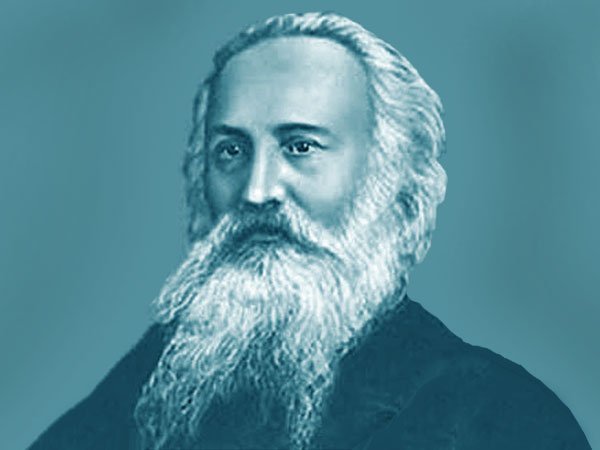
On June 9, 1829, Nikolai Fedorov, a Russian thinker, the creator of the “philosophy of the common cause”, one of the founders of Russian cosmism was born.
Personal business
Nikolai Fedorov was born in the village of Klyuchi of the Tambov province. He was the illegitimate son of Pavel Gagarin. It is only known about his mother that her name was Elizabeth Ivanova. I received a surname from the parish priest Nikolai Fedorov and his godfather Fedor Belyavsky. He received primary education at the Shatsky district school, then at the Tambov gymnasium. In 1849, having graduated from the gymnasium, he entered the Law Faculty of the Richelevsky Lyceum in Odessa, but he studied there only two years, since his uncle Konstantin Ivanovich Gagarin, who paid for his training, died. Then Nikolai Fedorov came to the first idea, which formed the basis of his philosophical teaching: "The thought that through us, through intelligent creatures, nature will reach completely self -awareness and self -government will recreate everything destroyed, and destroyed by its blindness."
For several years he taught history and geography in district Lipetsk, Bogorodsk, Uglich, Odoev, Borovsk and Podolsk. Since 1869, he became an assistant librarian in a private library founded by Alexander Dmitrievich Chertkov . Since 1874, the librarian of the Moscow Public and Rumyantsev Museum (later this book collection became the main Russian state library). Having resigned, he lived with his student Peterson in Voronezh, made a long trip to Ashgabat. In the last years of his life, Fedorov began to work again in the library at the archive of the Ministry of Foreign Affairs in Moscow. He died in Moscow on December 28, 1903. He was buried in the cemetery of the Sorrow Monastery. After the destruction of the monastery, his grave was not preserved.
Nikolai Fedorov was distinguished by asceticism in everyday life. He repeatedly refused to increase the salary, and distributed most of the money available to those in need.
What is famous
The creator of the original philosophical teaching, the main purpose of which he proclaimed to overcome death, and later - the universal resurrection of the dead ("fathers") by means of modern science. The ideas of Nikolai Fedorov gave rise to the direction of religious and philosophical thought, which is known as “Russian Cosmism”.
What you need to know about
Perhaps Nikolai Fedorov was no less mercy of his many years of work in the library. For 25 years he worked as a librarian of the Rumyantsev Museum, compiled the first systematic catalog of his books. In the memoirs of many people who happened to work in the Rumyantsev library, it is told about the modestly dressed old man “from the catalog”, who was always ready to help in finding the desired book and was perfectly oriented in a rich library collection. They even said that he knew the content of all the library books. In the apartment of Fedorov, as well as in the “catalog”, where he served, Lev Tolstoy, Athanasius Fet, Vladimir Solovyov were.
Direct speech:
"God gave people a revelation through the prophets when they were still children in science. Now he gives a revelation through science. Now scientists play the role of the prophets!", - the statement of N.F. Fedorov, quoted in the memoirs of L. L. Sabaneyev
"In the Chertkovskaya library, I noticed one employee with an unusually kind face. I have never met anything like this later. It is clear that the face is a mirror of the soul," - K. E. Tsiolkovsky about a meeting with N.F. Fedorov
"He knew how the entire library of the Rumyantsev Museum knew his fingers, and very often it was easier for him and rather take the desired book directly from the shelf than to look for it with the help of a catalog," the memories of G.P. Georgievsky
10 facts about Nikolai Fedorov
Nikolai Fedorov for the first time in Russia proposed the idea of international book exchange.
The name “Philosophy of the Common Affairs” was given by Fedorov’s teachings by his students Vladimir Kozhevnikov and Nikolai Peterson , who, after the death of Fedorov, prepared a three -volume meeting of his works for the press (two volumes were published in 1906 and 1913).
The philosopher refused to be photographed and did not allow to draw his portrait. Artist Leonid Pasternak, while working in the library without the knowledge of Fedorov, painted several sketches , with the help of which he later created the only portrait of the philosopher
Fedorov urged to turn the Moscow Kremlin - “the sacred fortress, guarding the dust of the ancestors” - to the “educational museum”. The philosopher proposed to paint the Kremlin walls with images of key events of Russian history and the future “universal affair” of the regulation of nature and resurrection.
The great influence of Nikolai Fedorov was experienced by Konstantin Tsiolkovsky. The very idea of mastering space space occupied Tsiolkovsky in a lot due to the Fedor's goal of the “resurrection of the fathers”, because the Earth will become cramped to huge humanity.
After the revolution of 1917, for some time there were groups of adherents of the teachings of Nikolai Fedorov. Among them was a philosophical and literary group of biosysts, ideologically close to the anarchists. Biocosmists put forward the slogan: “Death is death! To the assault on the universe! ” They published magazines "Biocosmist" (Petrograd) and "Immortality" (Moscow). One of the leaders of the biosysts - the poet Alexander Yaroslavsky - wrote the fantastic novel “Argonauts of the Universe” about the flight to the moon.
After the space flight of Yuri Gagarin, an article “Two Gagarin” appeared in one of the European newspapers, dedicated to the ideas of the philosophy of the common cause of Russian cosmism. The name of the article reminded that Prince Gagarin was the father of Nikolai Fedorov.
The ideas of the philosophy of the common cause are used in the modern fantastic novels “Quantum Thief” by the Finnish writer Hannah Rayyaniemi (2010) and “strange bodies” of Marseille Teru (2013).
The only monument at the moment Nikolai Fedorov was erected in Borovsk, where he worked as a teacher for some time.
Links
Article about Nikolai Fedorov on Russian Wikipedia
An article about Fedorov in the "New Philosophical Encyclopedia"
Article about Fedorov in the Encyclopedia "Circumspices"
Internet portal "N. F. Fedorov "
Collected works of N.F. Fedorov in four volumes
Fedorov on the site "Chronos"
Interview with S. G. Semenova, researcher of the work of Nikolai Fedorov