
Translated material
New Soviet, new shelf
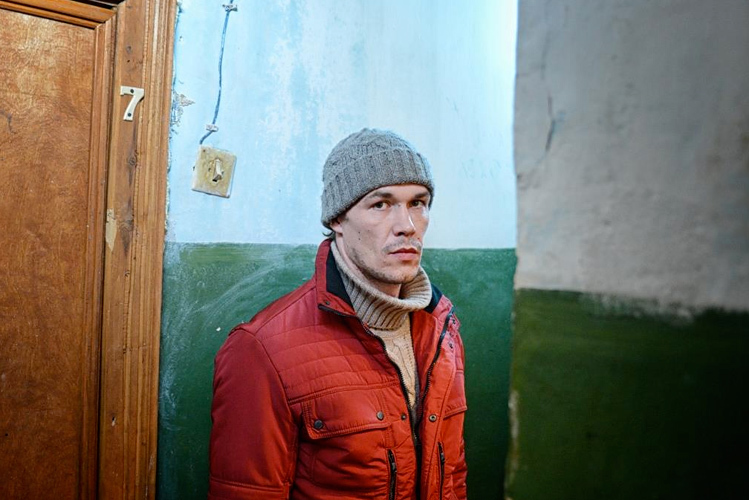
The 25th film festival "Kinotavr" ended the other day with unintelligible results. All beautiful talk about today and relevance that sounded from the scene of the Winter Theater at the opening ceremony ended with a complete flight of paintings that talk about today. And this is almost the entire program of the Kinotavra! The further rolling fate of these films causes no more optimism than the decision of the jury: a picture of reality, depicted in almost all competitive films - even in Anna Melikyan’s fabulous and fabulous “star”, is great from the one that is now imagined in the Ministry of Culture and the State Duma. The detailed enumeration of these differences in the current political situation would look like a denunciation, so we will leave only a general conclusion: it is difficult to imagine all this movie in the box office, and it is even more difficult to imagine what will remain of it if the authors decide to stop annoying cinema -contact in accordance with censorship requirements. Here you will have to join the very neck. In safety, except that the winning film, the retro-ethical movie of Alexander Cotta “Test”, in which the problem of the mat in the cinema is solved in a radical way-the heroes do not speak here at all.
In the same place where the heroes have not yet been deprived of the right to vote, an unexpected revival of Soviet film traction turns out to be a common trend. Namely - the director’s desires not only reflect social reality (for more about the wave of new Russian realism , see here ), but also to form a political agenda, attracting the attention of the party and the people to the problems of housing and communal services, housing and supplies, etc. It is precisely the same - indicative of the agitation cinema of moral anxiety, for (or from) the simplicity of the pronounced woolly language of the poster, - the “fool” Yuri Bykova, looks like the “fool”. Not a film, but an anti -tank shell released by the author of the Russian Kleptocracy. The first half an hour is generally a pure gelman -pantils (imagine the finally reborn heroes “I ask the words” and “we, the lower signature”, which the hero of the “ticket to life” challenges). More recently, we wrote about a clearly navigated cultural request for such a movie - and it was more surprising to see it literally a week later on a large screen, accompanied by applause, turning into a violent standing ovation.
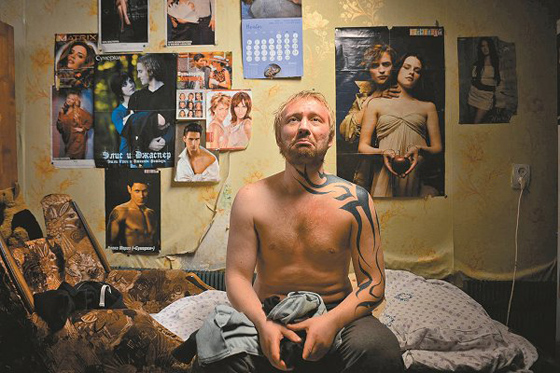 Frame from the filming of the film "Fool"
Like the previous “major”, “fool” is a tragedy of a conscious individual who is opposed to the rotten system. In this case, the educated plumber Dmitry Nikitin, an indifferent young man who is doing and a broken bench in the yard, and up to 820 people who are in a stinking 9-story building, becomes a hero. The house falls (this is the Setlain of an excellent foreign poster of the film made by Kirill Glushchenko), and, in general, it is obvious that this house is Russia.
The situation in the cracked structure is not even revolutionary-this is some kind of terrible inversion of the Maxim who are common about the tops and lower classes, the disposition of the apocalyptic and does not foresee any exit even in the form of a bloody bath. The tops cannot save the people (abuses with the housing and funds did not leave the city the possibility of resettlement of an emergency dormitory), and the bottoms simply do not want to be saved - restless agitators are immediately lying under the breath.
A portrait of today's Russian society drawn by Bykov (namely today, which is very different from yesterday) very accurate. But this portrait is precisely the collective, sociological, devoid of subjectivity and living features. The software monologues of the forces of good and evil in the agit films here displace all their lives here, and the terrible grin of Russian capitalism (the money is commemorated through the word) is depicted without a shadow of satire. This is not Gogol or Saltykov-Shchedrin, but pure Nekrasov, gradually degenerating into a emasculated production drama. Meet Nikitin.
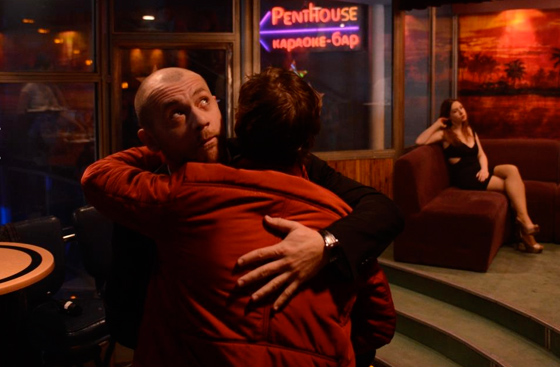 Frame from the filming of the film "Fool"
Such selective use by the current directors of fragments is obviously important for them to culture of the USSR at first causes bewilderment. Even the “Cinema about Alekseev” by Segal, a film that is the most rooted in the Soviet texture that exits it from the inside, looks rather limited and conditional in comparison with its authentic analogues-“long happy life” or “July rain”, paintings in which the skepticism in relation to the Soviet man was nevertheless combined with psychological reliability and well-known poetry. Now, either poetry (“test”), or life and psychologism (“what is my name”, “hope“ hope ”,“ another year ”), or irony and sarcasm, or a platform pathos of social criticism (“ fool ”). If the Soviet tradition is alive, then why is it cut into pieces?
Not alive, that’s the point. Over the past quarter of a century, the Soviet one miraculously did not head out, but thoroughly delayed - like kefir forgotten in the refrigerator. This stratification accidentally or accidentally repeats the stratification of Russian society-the original state here can only be achieved by an energetic shaking, but ... Singers of resentification like Prilepin or Prokhanov joyfully salute the Soviet one as animals again, but this supposedly life is just not free of death, the one that zombies and vampires in horror films possess. The frostbitten, so to the end and not dead in the 90s, the Soviet project has now temporarily thawed and became ready not for resurrection, of course, but to use. And on the Kinotavr we observed not his renaissance, but further disintegration. Grandmother died, and the youth finally shares Heritide: one got a trough, the other - skis, and the third was lucky - a bicycle.