
Translated material
Do you need a state order in the cinema?
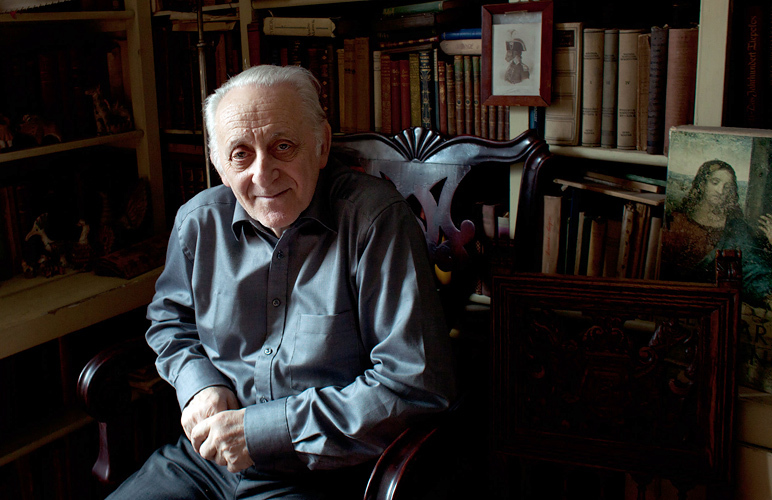
Yesterday it became known that the Ministry of Culture terminates the employment contract “In connection with the expiration of its validity” with the director of the State Central Museum of the Kino, Naum Kleiman (he held this position since 1992). The Ministry of Culture later said that termination of the contract does not mean dismissal and that telegrams with a notification of termination are always sent before the expiration of the contract. Nevertheless, we publish the thoughts of one of our largest cinema experts about the effectiveness of the state order in the cinema and about what the attempts of officials are leading authoritarian to “lead the culture”.
The question of the state order was debated in the twenties. Then they noted the confusion between state and social orders: the first is associated with the real allocation of more or less significant funds from the state budget to create (say, on the screen or on stage) works with a specific topic or ideological trend, the second is a metaphorical designation of public expectation or request and is not necessarily associated with targeted financing of the state.
Of course, there are state orders such as, for example, in the case of the film “Bades“ Potemkin ””, when they coincide with the order of social. Let's take a closer look at this happy occasion. At the beginning of 1925, the Annunciation of the All-Russian Central Executive Committee was organized to celebrate the 20th anniversary of the first Russian revolution, special state funds were allocated for the shooting of the 1905 film, it was supposed to be shot throughout Russia. The director was chosen by Sergey Eisenstein, who has already established himself as a “strike” as a director of new thinking. There was not enough time or money to shoot “1905”, and due to a number of circumstances, it was only necessary to limit himself to an uprising on an armadillo, but Eisenstein managed to invest in one historical episode the main motives of the entire revolution. He managed to express the meaning and spirit of the whole through a part: the impulse to freedom, which has literally covered all the layers of society, the meaningless cruelty of despotism, which in response to violence also received violence, but also the mutual solidarity of different classes, ethnic groups, social groups ... On the other hand, it was a picture that reflected not only the 1905th, but also 1925: the time of the NAP's climax. Only in the situation of the new economic policy, in the context of abandoning the ideology of “military communism”, one could make a film where the main motto was the word “Brothers!” - Call to the cessation of violence. In a sense, Potemkin led the line under the era of two revolutions and the civil war-he reflected the new ideological and psychological state of the state and society. Formally, the civil war was completed in 1922, there was still an inertia of hatred in society - what was produced by the era of wars and uprisings, but grew a “request for normal life”. The film was adopted by the whole world, including far from only “left circles” - because it was a picture against despotism, a film about the need and the possibility of an end to violence.
The most famous of all Soviet films of the thirties - Chapaev - was not a state order.
This is the case when a state order coincided with a social order. But then a conversation came to the fact that there is no need to confuse state and social orders. The art captures with all its feelings what society awaits, and responds to these requests. And the role of the state is not to interfere, but, as far as possible, to help it, first of all, by laws, the conditions of the greatest favors.
I return to Eisenstein: a year later he received a state order for the film “October”-to the 10th anniversary of the October Revolution. At this time, the social order has begun to change, and the state has already changed: there were discomfort in public administration and in the ideological sphere, there was talk about enemies who not only surround the young Soviet republic, but also nested in it, the expulsion of Trotsky, etc. Stalin was very profitable to have enemies: under the sign of this it was possible to mobilize and put under his control all the power and repressive structures, justify his own owners Errors and economic breakdowns, etc. The authorities were waiting from the anniversary film by the painting “Victory under the Iron Management of the Bolshevik Party”, and in style - the second “Potemkin”.
Eisenstein wanted to make a film that is directed, as he himself said, to "teach workers to think dialectically." To create a picture of all the forces of the 1917 revolution - and failed to win the struggle for power, and defeated in October. Society needed precisely the education of independent historical thinking among citizens, and the state began to demand a victorious anthem and the glory of the now ruling forces. Obviously, the social order is dispersed here with the state.
Surprisingly, the most famous of all Soviet films of the thirties - Chapaev - was not a state order. No hopes were laid on him, it was the ordinary “historical and revolutionary products” of Lenfilm. But the “brothers” George and Sergey Vasiliev and Adrian Ivanovich Piotrovsky, then the artistic director of Lenfilm, caught a social order - hope for the “People’s Leader”. Note that Chapaev is not too Marxist, he confuses, where Lenin is, and where the 3rd International does not know what communist theory is. However, a request for a “leader from the people”, far from ideology, but human and fair, was caught. And then some substitution occurred. The beginnings of the social order, materialized in such good paintings as the “youth of Maxim” Kozintsev and Trayberg and the “peasants” by Ermler, where the hero-leader was flesh from the flesh of the masses, began to be replaced by the cult of the Supreme Leader-Lenin. There is a state order for films about Lenin, then - for films about Stalin. And further the state order was more and more dominated by, and the social was pushed back.
The role of the state is not to interfere with art, but, as far as possible, to help it, first of all, by laws, the conditions of the greatest favors.
As a result, we came to the small-braided of the forties, to the exhaustion of our tradition of the 20s-the best tradition of mass, intellectual, humane cinema. As Eisenstein said, “talking panopticons”, when the characters did not touch either the soul or society made up for leaders, generals or figures of Russian culture and science (Stasov, Popov or Belinsky).
As a result, everything “collapsed”. And only in the time of the thaw, after the twentieth congress, the capture of the requests of society began. In response, they made a number of paintings that were not “state orders”. They were state -owned only on financing, but not in imagery and not even on problems.
The fact that now the state order begins to replace social, will not lead to anything good. Not a single ministry, not a single wise minister, not a single official, even if he graduated from at least three academies, will do what the artist can do: catch the movement of souls, penetrate the aspirations and hopes of society - and find the appropriate figurative system, which will at least a little reorganize, improve, raise the society to a new level. I can give such an example. Officially in America, the state does not interfere in film production. But there was a period in the early 1950s, when it became clear that America was not just skilling, it rolls into the abyss if racial hatred, mutual rejection of white and dark-skinned. Hollywood, without waiting for state orders, made films such as “Wester Story”, “constrained by one chain” (“not bowing their heads”) and others that began to overcome this racial dislike and hatred. Cinema did its job - it helped society overcome this ailment without a direct order from the state. (Excesses of political correctness in the new time went the other way, but this is also adjusted.)
In the 30s, Hollywood left pure entertainment, New Deal Cinema - Cinema "New Course" by Roosevelt. Fords of Ford, Wyler, Kapras, King Vidor helped society and the state to get out of the crisis. After a wave of suicide swept due to depression in the United States, entertaining genres-comedies, musicals-gave people hope for a way out of the crisis, convinced that it was worth living. They affirmed the self -worth of life and that active American optimism that helps to overcome difficulties. Here is a classic example of how a social order defines a repertoire and even stylistics without any state order. Although, of course, President Roosevelt appreciated the internal mobilization of the movie: during the war, the American state turned to filmmakers with a request to help in the fight against Nazism, Japanese aggression, etc. It was a different case. From the budget, a series of documentaries that were shot by game directors were financed - it was a state order, and it was completed. But in fact, the success of such an art is determined by the social, not state order.
 © Julia Ryzhenko / colta.ru
As you know, society is heterogeneous, it consists of many groups and layers - stratum. And the social order consists of many different, even heterogeneous requests. And only when the country's cinema responds to the requests of all or at least most of the strata of society, we can talk about national cinematography , and not about the existence of film production in the country. Now, in my opinion, we have no Russian cinematography that reflects and forms society as a whole - there is the sum of more or less successful and more or less random films, of which the majority remains simply not seen by the audience of our own country, not to mention the wide world.
But here are examples from our past. When a generation of “thaw children” was formed, an order for simultaneously several social layers appeared. The answers to order that intellectual part of society that tried to comprehend the historical tragedy of the twentieth century (not only Russian) and find a moral support for the future, Andrei Tarkovsky was looking for. His fellow student Vasily Shukshin is the expressor of the requests of that “village Russia”, for which the socio-moral side of the fate of our village was the acute problem. Urban, not too “highly”, normal citizens gave a request to honest and responsible relations between the state, society and people. This was formed by the theme and poetics of the films of Khutsiev, Kulidzhanov, Danelia, Ryazanov, Abuladze.
Their “older brothers” - Chukhrai, Rostotsky, Ordynsky and their peers, called the “generation of lieutenants,” had to restore the honor of the soldier, because in the forties the victory over Nazism was attributed to the commanders - Stalin and the generals. “Ballad of a soldier”, “Clear sky”, “The fate of man”, “And the dawns here are quiet” and a number of other films repaid the debt to those who died for the freedom and honor of their homeland. And they also needed to return to society moral guidelines, shot down by a period of repressions and injustices, to return the concept of what is good, what is bad, where we live in truth, and where it is not. Otherwise, it was impossible to turn on in peacetime. And look what the older generation began to do with them - Romm, Calatosis, Raizman ... And after them - the younger ones: Larisa Shepitko, Elek Klimov, Andrei Konchalovsky, Gleb Panfilov, Ilya Averbakh, Vadim Abdrashitov and others ... Cinema in different genres, addressing different audiences, tried to understand why and how were the criteria to help, to help, to help, to be killed to help. country, society and man to get out of the crisis ...
In our management, culture still reigns an absolutely medieval concept of predestination and linear dependence.
In other words, all generations together took the function of response to a diverse social order. Each responded in their own way-and only the totality of their responses created genuine folk cinematography .
Here are the comparisons of different answers that reflect their strata and complement each other.
Grigory Chuhrai, who himself passed the war, created the image of a young man in the “Ballad of the Soldier”, ideal not because he performs a feat in the war, but because he shows humanity in the rear, sacrificing his vacation from the front, and this explains the best of all the slogans why he would sacrifice his life for the sake of victory over the enemy. The film has become an absolutely accurate expression of a person’s natural morality - the norm that has returned to life after the twentieth congress. What Alyosha went to war, so he died - morally pure, capable of love and self -sacrifice.
What did Tarkovsky do in "Ivanovo childhood"? His war is terrible not only by killing people physically - it is terrible that they cripple their souls. The boy whose soul is filled with hatred is already a victim of the war, regardless of whether he will die or not. Tarkovsky went deeper than Chukhrai in philosophical and psychological terms, but the tragedy of his interpretation does not cancel the historically and socially justified idealization of the "generation of lieutenants."
The same thing happened with Shukshin, who did not create the ideal images of the Payzan, as he did, for example, Pyryev in the “Kuban Cossacks”, but the village of village approached the tragedy differently than the “village man” Vladimir Tendryakov and the townspeople Mikhail Schweitzer, who responded to the same “Social Order” - responded with the amazing film “Tight Node” - with the images of the villagers who were ready to work in the villages, ready to work in the villages. collective farms, but outside the "party leadership." Shukshin showed what happened to the peasant as a result of collectivization. Egor Prokudin, the tragic hero of Kalina Red, is a peasant, torn from his ground and became involuntarily “rolled-floor”. Having joined the gang, he is doubly unhappy, his sobs in front of his mother - repentance not only on his own behalf, but also on behalf of the history of the state, which, tearing his son from the earth, left her poor and blind. By the way, Shukshin wanted Yegor to end with himself at the end of the film, but he was forced to make the hero killed the “friends” ...
Naive dunce, they are guided by infantile ideas about management.
Films created on the social order of their time remained alive in the new era - in contrast to the products of direct state order, such as “military epic” Yuri Ozerov or “documentary reports” about the successes of the collective farm system.
The social order, as a rule, is not formulated “from above” or “from below”, the artist often captures him before the society itself is aware of it, and the matter of professional criticism is to understand the new phenomenon (film, book, play) and help the viewer - and therefore, to society, understand it.
In the best times for culture, the critic is a navigator that gives landmarks to the viewer: what to look, how to evaluate, how to understand. Criticism should also be an intermediary between an artist, public and power. The authorities are not obliged to be an artist, but it must rely on the expert community - first of all, so as not to harm the natural development of culture.
Unfortunately, now the voice of criticism is absolutely negligible. Neither spectators look in the direction of criticism, nor filmmakers listen to her, or even more so officials. We now don’t have that “rulers of thoughts” - there are simply authoritative experts by which you can verify your reactions. Of course, there are first -class critics that are not inferior to European, but there is no order from the state (which wants to manage the culture itself), nor from the side of society (which instilled the desire to "have fun and distract" in the cinema). The figure is the figure of success: how much money is invested in the picture and how much the box office helped out ... The society was taught that there is only commercial rental. And we just disappeared non -profit.
Once non-profit films did not give planned income, but they, thank God, showed them. Not everyone loved or understood, suppose, the films of Abuladze or Khutsiev, but nevertheless they could be seen. There were trade union palaces of culture, cinema halls in universities, the system of the cinema cinema bureau of the Union of Cinematographers, and what did not go at the state rental, one could look at all these club sessions. Now none of this is, everything is destroyed. But non -profit rental is the only salvation for domestic cinema, and for European and Asian - for everything that is not Hollywood.
There is nowhere to show non -profit cinema, and in society a degree of cinema is greatly reduced as the leader of life. Previously, boys and girls came to the cinema to learn everything: how to kiss, how to dress, how to behave with adults. And this really largely determined society. Now the first word is Entertainment , and the main principle - they showed you a movie - look and forget: tomorrow we will show you the same, only with other actors ...
 © Julia Ryzhenko / colta.ru
The European Film Academy recommended that all states help to create a “second circle” parallel to commercial infrastructure. How? At least in the early years, the state could deduct 3% of the taxes that it receives from Hollywood and its own commercial firms - similarly to how France gives its national film production a 10% of the film distribution taxes. Может быть, государство сможет также помочь покупать некоторые фильмы национального производства, чтобы их увидели свои граждане. И этот второй круг при правильном руководстве смог вскоре бы стать самоокупаемым. Вот истинная сфера для государственного заказа!
Как только этот принцип кинопоказа обернется потребностью общества — я вас уверяю, и критика появится, и фильмы станут снимать все лучше и лучше. Я очень хорошо помню: когда мы пришли во ВГИК в 1956 году, там был такой преподаватель драматургии — Крючечников, который однажды сказал: «Хрущев принял решение сделать резкий рывок. Было 8—10 фильмов в год, а теперь надо 140. А где он возьмет столько талантливых людей?» А талантливые люди в это время ходили в ассистентах или сидели в простое и не могли добиться постановки. Когда же за два года произошел прыжок в кинопроизводстве — некоторые удивились: где раньше были эти таланты? Чисто статистически в каждую эпоху рождается примерно одинаковое число одаренных людей, которые составляют главную ценность общества, дело государства — дать им возможность реализоваться. Ради них и ради себя.
У нас государство часто вмешивается не в то, во что нужно, дает деньги не туда и не тем, кому нужно, — вот в чем беда. Чиновники убеждены, что государство — это они (хотя армия Людовиков XIV — это анекдот), они думают, что власть может определять развитие искусства. Но подлинная культура не подчиняется никаким приказам чиновников. Ибо культура — саморегулирующийся процесс. Мы не можем приказом головы управлять действиями всех наших органов. Не можем приказывать мозгом сердцу или улучшить его приказом пищеварение — мы можем только поддерживать их здоровым образом жизни или лечить их. К сожалению, эта метафора не воспринята государственными чиновниками. Они считают, что они — та голова, которая умеет и даже должна управлять течением рек, обменом веществ — и созданием шедевров. Это все, думают они, может чиновник, если он облечен властью. Наивные самохвалы, они руководствуются инфантильными представлениями об управлении.
Государство должно уважать достоинство и самостояние своих граждан, в том числе деятелей культуры.
Культура есть не только естественный процесс, но и процесс вероятностный. А в нашем управлении культурой до сих пор царит абсолютно средневековая концепция предопределения и линейной зависимости: причина — следствие, причина — следствие. В головах многих «управленцев» до сих пор господствует детерминизм примитивного толка. Ибо они сами — не дети культуры, они — продукт так называемой образованщины, внешней нахватанности, а иногда и просто невежества.
Любое объективное социологическое исследование вызывает раздражение необразованного чиновника, если не совпадает с ожиданием. Его логика: раз не совпадает, то надо принудить результат.
Есть замечательная история из физиологии — о том, какую поправку сделал к учению академика Ивана Петровича Павлова его ученик Петр Кузьмич Анохин, один из создателей теории функциональной системы. Как, по Павлову, вырабатываются рефлексы? Предположим, ребенок дотрагивается до горячего чайника, обжигается, отдергивает руку, и у него вырабатывается рефлекс на горячее. Анохин говорил, что в основе целенаправленного поведения, активных взаимоотношений организма и среды лежат системные процессы «опережающего отражения действительности». Если ребенок дотронулся до чайника раз или два, то у него возникла «модель ожога», и потом, протягивая руку к чайнику, он руководствуется моделью ожидаемого и корректирует свое поведение. Если он принимает во внимание свой опыт, он больше не будет обжигаться, а если он глупый или руководствуется принципом «все равно хочу схватиться за ручку» — можно лишь пожалеть беднягу…
Протолкнуть то, что «я хочу», — принцип тупого авторитарного руководства: государством, экономикой, искусством. Хотя исторический опыт давно доказал, что от этого принципа происходит много социальных травм, катастрофы целых обществ и даже государств. Наблюдение Анохина многое объясняет не только в физиологии и психологии. Независимо от контента, его формула фактически универсальна. Каждое общество и каждое государство может по-своему пренебрегать историческим опытом, но любое пренебрежение приводит к беде.
За ХХ век накопилось множество примеров пагубности попыток «руководить культурой» — они вели в пропасть. Я надеюсь, что у нашего государства хватит чуткости остановиться перед пропастью и не повторять ошибок прошлого.
 © Julia Ryzhenko / colta.ru
And the last. Говоря о «государственном» и об «общественном» заказе, надо отдавать себе отчет в условности этих терминов. У нас государство чрезвычайно лоскутное. Имеется в виду не только то, что страна сшита из разных этнических областей и культур. Сама структура управления нашей страной — сочетание очень многих и разных формаций. Ленин говорил еще в начале двадцатых годов, что Россия совмещает пять разновременных укладов: в ней сохраняются общинный строй, остатки феодализма, недоразвитый капитализм, хищный империализм, начатки социализма… Все это, как слоеный пирог, совмещено и в общественном сознании, и в государственной структуре. Мы свергли самодержавие — и возродили идею царя, которого называли теперь вождем. В 1924 году, после смерти Ленина, Маяковский и другие лефовцы заклинали не делать ему памятников, не превращать его в полубога: увы, на это был и государственный, и социальный заказ, которым сполна воспользовался Сталин. Беда в том, что у нас подлинно демократическое общество не было развито, было мало граждан — было много подданных.
Пушкин писал Чаадаеву (по-французски, я позволю себе процитировать тут канонический перевод этого знаменитого письма от 19 октября 1836 года):
«Действительно, нужно сознаться, что наша общественная жизнь — грустная вещь. Что это отсутствие общественного мнения, это равнодушие ко всему, что является долгом, справедливостью и истиной, это циничное презрение к человеческой мысли и достоинству — поистине могут привести в отчаяние. Вы хорошо сделали, что сказали это громко».
Есть у Александра Сергеевича и гениальная формулировка условия полноценного общественного существования: «самостояние человека». Залогом этого самостояния он называл «любовь к родному пепелищу, любовь к отеческим гробам», что можно понимать не только как необходимость знать и любить историю своего государства, но и как потребность почитать ее трагедии и помнить ее жертвы.
Есть, наконец, и пророческий совет, данный Поэтом Читателю в «Евгении Онегине»: «Учитесь уважать себя…» Ибо без уважения своего человеческого достоинства нет уважения ни к другой личности, ни к обществу в целом, ни к государству.
И наоборот: государство должно уважать достоинство и самостояние своих граждан, в том числе деятелей культуры, иначе оно никем и ничем управлять не в состоянии, а может только разрушать и саморазрушаться.
Если государство объединяет, сохраняя, наше многокультурное разнообразие — создает тот общий знаменатель, который сохранит наше единство и своеобразие в мире, роль государства в культуре становится по-настоящему благотворной.
Recorded by Julia Ryzhenko