
Translated material
Why Brazilians hated football
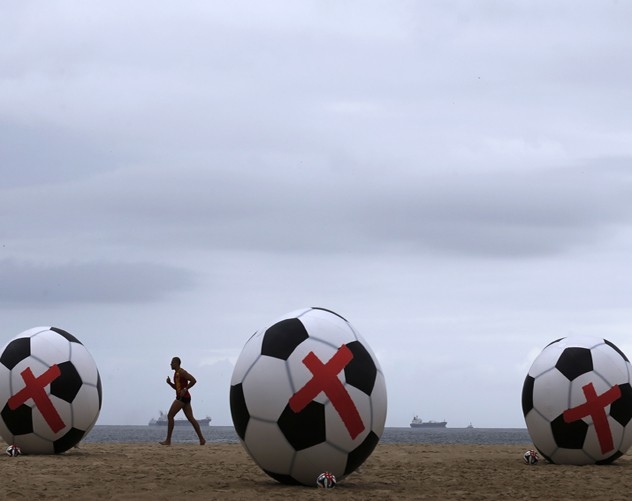
Brazil is a distant country and some kind of too frivolous to pay close attention to it, so only scraps of a common image fly from there to Russia. Previously, it was a new southern giant, the most promising economy, a counterbalance of the United States in the Western Hemisphere, uniting with which we will squeeze the dollar out of international circulation together in Brics. But now it's all in the past. The last year of Brazil is a wild country of the third world, where the corrupt elite builds football stadiums directly on the bones of the undercomical and incomplete population, but the stadiums are immediately scattered, because everything is cleaned up, inefficient and no one needs at all.
Inner boycott
This picture, of course, is a little rude and stereotyped, but no one agrees with it like the Brazilians themselves. All the last months before the start of the World Cup, they are struggling with all their might for themselves and everyone around them, who used to live in hell, where neither schools, nor hospitals, nor buses, and even with this damned mundial, the country was generally on the verge of collapse, because all the budget money had to be thrown for the construction of no one in the islands in the middle of the Amazon.
The World Cup for Latin America is not so unprecedented. It was held in Chile, in Argentina, in Uruguay, in Mexico and even in Brazil itself, however, already in 1950. But nowhere before he caused such a strong public indignation, as now in Brazil. According to surveys , a whole 61% of the Brazilians believes that their mundial will negatively affect the development of the country. In the largest cities, people, as to work, go to thousands of protests against the championship. Famous Brazilian football players refuse to act in the former -fashioned formalists of the championship. Stars, politicians and other public figures are afraid of the word good to say about approaching competitions. And even Paulo Coelho himself said that his legs would not be in any of the matches, although he has tickets.
How could this happen? Yes, and in Brazil - the very football country in the world. Where are those people who filled the streets with festive processions seven years ago when they learned that Brazil won the right to hold the 2014 Mundial? Where did those 79% of the Brazilians go, who supported the championship in surveys, when they were only awarded in 2007? They disappeared. Now saying something good about the championship is a bad tone in Brazil, not a single decent person will allow himself this. The mundial is supposed to hate. To hate so strong that, for example, in Rio de Janeiro, 22% of the townspeople admit that they want the Brazilian team to lose.
Testament 18 dollars
Search for rational reasons for such a strong hatred is a hopeless thing. Well, yes, the Brazilian authorities did not have time to finish all the infrastructure projects that they promised to pass by the beginning of the championship. Yes, the Brazilian Mundial will be the most expensive in history. Yes, during the preparation, the initial estimate managed to grow almost four times. But with the previous championships, was it different?
Even in Berlin, the new Central Station was opened just a few days before the start of the 2006 mundial. And the new metropolitan airport, which was promised to open for the next year, has not yet been completed. Almost every next world championship is the most expensive in history - especially in developing countries where the authorities are trying to put as much as possible in any case of the necessary infrastructure projects.
And of course, everywhere there were conversations that these football stadiums later, after the games, would not need anyone. In Brazil, there are now a lot of such conversations, although it is impossible to imagine in which country of the world then football stadiums can be built at all, even in Brazil they, it turns out, is not needed by anyone. Especially everyone is outraged by the stadium for $ 270 million in Manaus-they say, who needs it there, in the middle of the Amazon, two and a half thousand kilometers from Rio de Janeiro. As if in a city with a population of almost two million people there is absolutely no one to love football.
Of course, the amount of $ 3.6 billion spent on the construction and overhaul of the twelve stadiums can hit the imagination of many Brazilians, where the average salary only recently exceeded $ 800 per month . But on the scale of Brazil, this amount is completely insignificant. The Brazilians were around on the topic of how many poor kids could be learned and cured for these billions, but in reality the mundial $ 3.6 billion did not even amount to 1% of the money that the Brazilian budget has spent over the past four years on education and healthcare. If you smear them two hundred million of the country's population, then $ 18 per person will come out. And these $ 18 must also be distributed for seven years of preparation: it turns out $ 2.5 per year - they would have shoved without a championship.
Pele v. Coelho
Just a couple of years ago, the Brazilians perfectly understood all these calculations and had nothing against the championship. And then for some reason they stopped understanding. What happened to them? Nothing unusual, just a crisis. The zero were the most successful decade in the history of Brazil. Over the two periods of the presidency of Lula (2003–2011), 30 million Brazilians rose over the poverty line, state expenses for education and healthcare have increased five to six times, the number of students three times, the number of doctors per thousand inhabitants-one and a half, and children's mortality reduced, and in terms of life expectancy, Brazil caught up with Eastern Europe.
Now the modernization of the social sphere of Brazil has not stopped, but simply slowed down. It is impossible to maintain the same pace when in 2010 the Brazilian GDP grew by 7.5% , and in the last two years it has grown by only 1-2%. But the Brazilians have already spoiled, they are used to the fact that life is prettier every day, and do not want to know anything about cycles in the world economy. They needed to find some reason for which all the troubles could be attributed. Such that it is simple and understandable so that it is easy to resent with it.
The mundial hit the arm. It happened just recently and almost by accident. In the first protests in June last year, the championship was not mentioned-the reason for the splash of discontent was that tickets for public transport in the San Paulo were risen by 20 sentavos (3 rubles). It turned out that the protesters even support the training program for the championship in some way, so they were outraged by the poor condition of the transport system. But the logic was never a strong place of mass protests: everything began with discontent with infrastructure, but soon a semantic leap occurred, and it turned out that, on the contrary, it was necessary not to trample the money for expensive infrastructure projects for the mundial, but to give everything to the holy - for education and healthcare.
It is very difficult to object to tearful arguments about undersized and incomplete children, no authority will help here. Even when the legendary Pele defended the championship, rallies came out against him with such banners . Naturally, it is much easier not to risk reputation and agree with the masses that yes, schools and hospitals are more important than stadiums. And when more and more public people claims to be consent to the requirements of protesters, it becomes completely indecent to object to them.
Well, what can you object to such a wonderful humanist as Paulo Coelho, who, in solidarity with the Brazilian poor, will not go to any match, although he has tickets? Is it possible to ask the wise writer, what other spheres of life is his painful conscientiousness apply to - besides football? For example, how is he with nutrition? A piece of throat climbs or intravenously has to be introduced, because he cannot break, knowing that at that time they starve in Favels? And one more thing: why did he take tickets then? Why sponsored this holiday of inequality? Did he not know then what was happening in his native Brazil, and only now his eyes opened?
Or in the same Amazon city of Manaus, where an unnecessary stadium was built to the championship, an opera festival opened a few days ago. How is it possible: many residents of the Amazon to the nearest hospital are three days of the journey, and then the money is trample on some opera? And the opera theater in this wilderness from where? It is urgent to re -profile it to school for the poor. It does not matter that dozens of countries of the world have already checked on themselves where such reasoning leads. It does not matter that as a result, everything will only be worse. Stories about the tears of the child are still invulnerable to common sense.