
Translated material
Lugansk: The war does not choose
How Lugansk militias squeeze out Ukrainian border guards
In Kyiv, they declare the intention to "immediately close the border with Russia in the east of the country." However, on June 4, the last Ukrainian border guard left Chervon Partizansk of the Lugansk region 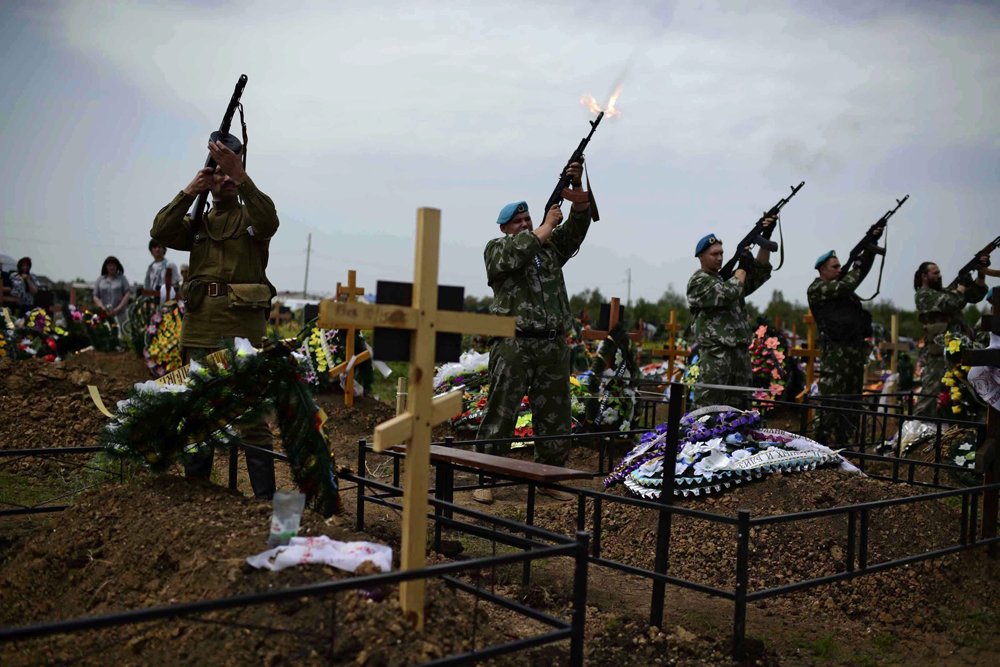
Artillery beats in its
Lugansk, June 4, hot afternoon. In the cemetery, an acute grave is dead silence. Having raised the trunks, the fighters of the rebel army of the self -proclaimed “Lugansk People’s Republic” (LPR) in the form of former Ukrainian Weadeshniks are waiting for the teams to fireplace. Immediately near the group of fit and strong girls and guys in camouflage with yellow-blue chevrons are activists from the patriotic movement "Cascade". In the honorary guard at the grave, “restorers” stretched into the string in the soldier's uniform from the time of the Great Patriotic War. Everyone came to bury Batu - that was the name of Alexander Gizai, a veteran of Afghanistan, a history teacher, the leader of the Cascade, known throughout the city of a peacekeeper who raised several generations of street children, orphans, children from difficult and poor families. He was killed by a Ukrainian missile released by a Ukrainian fighter.
Women cried sobbing, young men looked like tears and promised to "take revenge on the goats for dad." To whom exactly - they did not specify. Watching how a friend is buried, Vladimir Sokovronsky hardly selected the words: “The absurd death: the Patriot of Ukraine killed the Ukrainian rocket. Does not fit in the head. Like everything that is happening now. ”
“The absurd death: the Patriot of Ukraine killed the Ukrainian rocket. Does not fit in my head, ”said Gizai's funeral."
Gizu, who for many years drove his students in search of the remains of the victims of World War II, categorically did not like everything that was happening in the east. It was not his war. On the day of his death, he came to the building of the administration of Lugansk, where he passed a popular gathering to take his wife and daughter home. I did not have time - the Ukrainian aircraft launched more than 20 missiles in area: five women and three men were killed. By the way, the square bears the name of the heroes of the Great Patriotic War.
The cemetery silence was torn by the team "Fire!" And the roar of a volley. No one shuddered: in Lugansk shooting will not surprise anyone. The war here is everywhere: on the streets, in residential quarters, on roofs, attics and in the porches of typical high -rise buildings. On the day of the death of Gizai, the militias, who were in the houses on the outskirts of Lugansk, fired at the Ukrainian border guard for 14 hours. 14 o’clock the border guards listened to shots, the whistle of bullets and “Shche did not die a jam” - to raise the spirit, their commanders cut the Ukrainian anthem to the whole coil. When the planes flew, the fire subsided. Locals literally on tiptoe made their way along the walls to their porches, gloomy and dirty militias from many hours of shooting and stress came out to meet them. Seeing journalists living on the top floor of Lucy Bykov attacked us: “It was your Chechens who shot our boys! I saw one of them from the window! ” Having calmed down, she took us to the attic, where the rebels left a carpet from machine gun and machine-gun sleeves, iron boxes of cartridges, whole batteries of Molotov cocktails. Downstairs, at the entrance, a female wig with long hair of the brown -haired woman was lying onto the stick. For some reason, it was a wig of the local residents who were most afraid of.
"Bright Rus'" with B. Nikitskaya
The militia of the “Lugansk People’s Republic”: Cossacks, former specialists, former journalists, political scientists, military, unemployed miners and church servants, men and women who were ready to kill and die in the war against the Ukrainian army. The next day after the bombing on the heroes Square, strong guys with beards appeared and without a mustache in black T -shirts with the word “reserve” on the chest: “We are not Wahhabis,” they explained, smiling broadly. “We are Orthodox volunteers from Society“ Light Rus' ”with an office in Bolshaya Nikitskaya in Moscow.” The leader of the bearded man Vladimir Morozov explained that the volunteers who arrived to the Ukrainian border with the assistance of the Russian authorities took three days to "break through the border and deliver two" Gazelle "with medicines to Lugansk."
“Ukraine lost Lugansk - people will never forgive Kyiv bombing,” says Morozov. When asked if “bright Rus'” works with the Kremlin, the volunteers preferred to answer: “They work with us.” 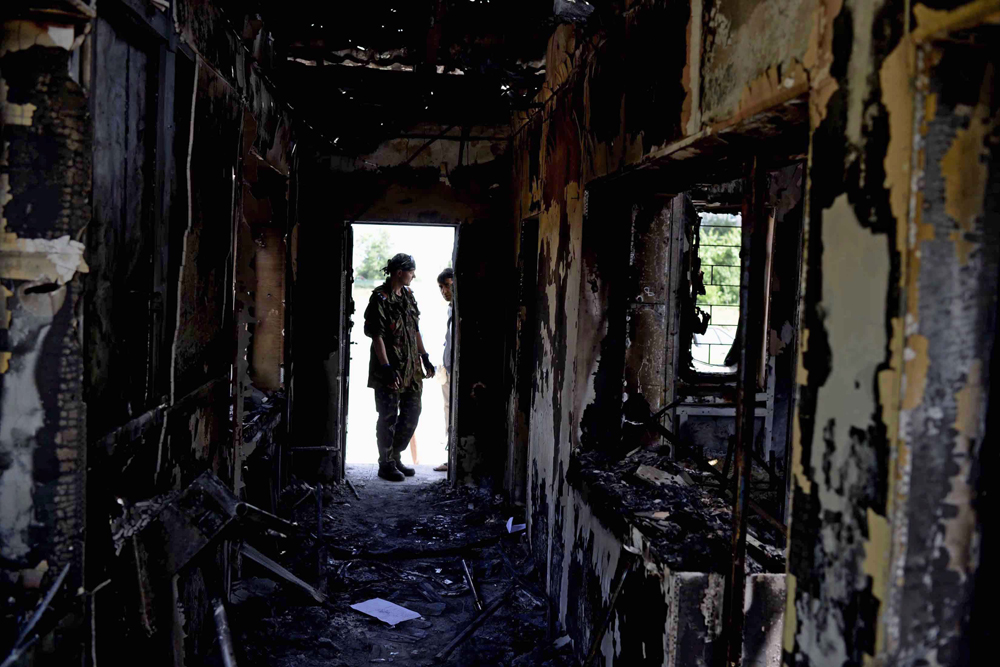
Orthodox army. In sandals
Morozov’s words about the lost Lugansk are more and more like the truth. In the administration building, the governor of the self-proclaimed republic, Valery Bolotov, who suffered from the bombing of the administration, called the press conference and called the entire population from small to great to mobilize to the war against the “Kyiv junta”. There are already several dozen women among the LPR militias. Some of them call themselves an Orthodox army and live in a fortified camp surrounded on all sides by the barricades, opposite the Great Builders of the SBU in the center of Lugansk. A dozen two militias in camouflage costumes, but in sandals, and sometimes even in ballet shoes, they serve on numerous checkpoints between the red ray and anthracite.
This is not the first time Bolotov urged the population of Lugansk to join the militia. On May 3, the audio recording of the governor’s speech, reinforced by the columns, was repeated every 15 minutes in the camp opposite the SBU. In case of disobedience, the military was declared enemies of the people.
One evening, several hundred militias gathered in the square. “Everyone crashes into groups of 20 people and choose commanders. Ahead is a real war, everyone who is not ready, goodbye! Our main goal is Kyiv! " - one of the commanders named Timur commanded a hoarse voice into a microphone. It seemed that everyone was ready for battle, even women: they took with them from the house who was a gun, some of a wooden club. That evening, the militias took the city military registration and enlistment office.
By June 3, only a small base of the National Guard in the town and the Lugansk airport remained under the control of the Ukrainian army in Lugansk. Exactly at 9.30 pm, the sky over Lugansk was exploded by red tracing bullets and almost immediately spoke machine guns and machine guns. The city did not sleep. The militias of Bolotov with short interruptions watered the military unit of the guards before dawn. The next morning, local residents, many of whom spent the night, closing with children in bathrooms, went out into the street to see what was left of the old Soviet military unit. Under the broken windows of the barracks, the boys collected sleeves in empty cigarette packs. Three bloody traces on the wall of the neighboring house captured the wounds of militias. On the ground, in heaps lay the uniform of the National Guard, left by those who survived: they were released home. On the same morning, leaving the militias their uniforms, weapons, computers, the last border guards left the base in Mirny. At 11 in the morning, when the relatives and colleagues of Gizai gathered with wreaths in the recreation center of the builders to take him on the last journey, the militias of Bolotov carried out boxes with weapons from the border part in Mirny. Without this part, as without the central border government, there were left near the dozen checkpoints on the border with Russia. By the evening of the same day, the border guards of Krasnoy Partizansk lost control over the border. A column of twenty military and civilian cars, with wives and children, at a speed of 40 kilometers per hour, stopping and calling up with the Ukrainian military still remaining in these parts, in fear that, due to any turn, the militia can open fire, strangers in their country, border guards leaving the Russian border and farther.