
Translated material
Championship and chaos in Brazil
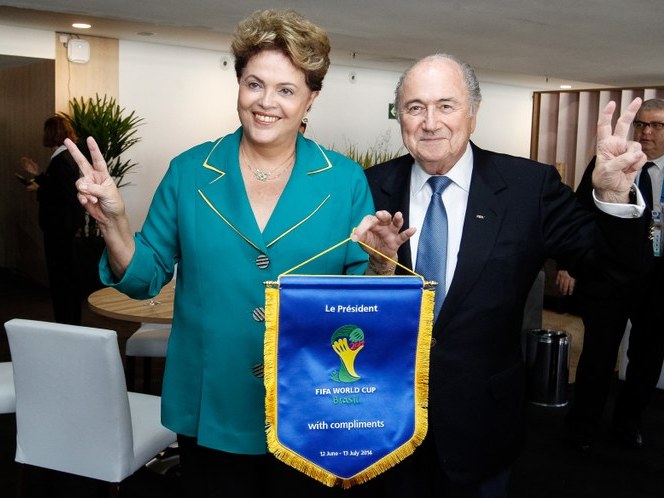
The right to become a country organizing the World Cup in 2014, Brazil received in 2007. At that time, it experienced an impressive economic rise - the most serious in many decades. Foreign investments were received in the country, inflation was kept under control, and property inequality began to smooth out a little. But already on the eve of the championship Brazil, it was completely different from the country that received the right to become an organizer seven years ago, and people spoke with demonstrations against this event.
Journalist and analyst Anderson Entyuns (Anderson Antunes) in Forbes offers to figure out how this happened. Partially, the responsibility for the current state of affairs, in his opinion, lies with the former President of Brazil Luisa Inasiu Lula da Silva, who intensively sought this right to show the world what superpower Brazil became. Then the Brazilians themselves liked this idea. “Meanwhile, Lula da Silva forgot that the best way to demonstrate the growing potential of the country, its status and stability is to provide it with more social, economic and political freedom (Mexico in this sense acts much more and is more effective and will probably overtake Brazil, turning into the largest economy of Latin America).”
Lula chose to invest in the organization of the championship. According to sounding estimates, the minimum budget of the organization of the World Cup is about $ 12 billion. In fact, this amount is usually several times more, which often causes corruption scandals. In the case of Brazil, talking about the theft of money sound constantly. Also, the author notes, there is a possibility that some stadiums are not ready for operation, not to mention grandiose infrastructure development projects that were positioned as a direct bonus for citizens from organizing the championship. “The very idea of organizing the World Cup in the country was actually represented by the leaders of the party of workers and other union parties with the“ main dish ”, which would demonstrate the changes that were extolled as wonderful. The anger of so many Brazilians was caused by this is precisely to this isolation from reality. ”
Having come to power in 2002, the Brazilian party of workers constantly emphasized that her management style changed the life of citizens for the better. “However, despite the recent improvements, Brazil still remains a country with the highest level of inequality, and its poorest citizens pay a huge part of their income in the form of taxes and receive the least state support. It is not surprising that some of them take to the streets with protest. ”
According to Entyuns, during the championship, safety problems are likely. He also believes, “for Brazil, this event will not be another chance to get a sixth position in the world ranking, but the reason for the Brazilians to recall their leaders who are responsible for what is happening, especially taking into account the fact that the World Cup may influence the presidential elections that will be held in October.”
The BBC presents the context of the championship in two parts: on the one hand, the current president of Brazil Dilma Rusef said in his appeal that, contrary to the forecasts of the “pessimists”, the Brazilian people are full of willingness to accept the championship. She also stated that the budget reserved for the preparation of the event was not redundant and really went, first of all, to create an infrastructure that will become the main bonus for the country. Also, according to her, the budget did not exceed $ 11 billion and did not delay the funds intended for education and healthcare. On the other hand, strikes take place in San Paulo, people are unhappy, and more and more armed forces are involved in the streets.
David Zirin in The National expresses the version that riots in Brazil in connection with the championship in many respects to the hands of various political forces that are vigorously heated. “First of all, the fact that every political force in Brazil is trying to win through discontent that is growing throughout the country is true. For example, a transport strike in San Paulo is headed by a legal actric opposition Brazilian Social Democratic Party. It is also true that all the political parties of the establishment that will compete with her [the current president - “Polit.ru” ] in October of this year want to turn dissatisfaction with the preparation for the championship into the decision of the voters against her party of workers, under the guise of the “struggle against corruption” in the government and trade unions. They also want people to ignore the fact that they are supported by many of the large construction companies, which are beneficial for the construction of the stadium and infrastructure and the demolition of houses. On the left, an organization like the Central Sindical E Popular (CSP) is used to arrange more strikes and captures and ask why “huge amounts” are spent on the World Cup, while there is not enough money for education, healthcare and transport. ” In the past, the author emphasizes, the World Cup was the most effective political tool of autocracy. Now the principle is the same, only different forces use this tool.
Finally, the American showman John Oliver spoke at HBO with a comment in which he urged not to forget what role the international federation of football (FIFA) plays a huge fund and enormous influence and often abuses this. In particular, he emphasized, FIFA regularly agrees to hold the championship in countries that are completely not suitable for this both in socio-economic and often according to climatic parameters (here he refers to the fact that in 2022 the championship should be held in Qatar with a probable 50-fraud heat). And she behaves not as a non -profit organization, which it is considered by status, but as a business, the purpose of which is to receive profit from the championships, taking care of the consequences little.
As a confirmation, Oliver recalls that FIFA is ready to trample local legislation, if it is unprofitable for her. So, in 2003, the Brazil government introduced a ban on the use of alcohol in stadiums due to a huge level of mortality associated with it there. However, one of the main sponsors of FIFA is the Budweiser beer manufacturer. “FIFA,” said Oliver, “diligently took care of protecting Budweiser from a law designed to protect people. And surprisingly, FIFA won. They successfully pushed the Brazilian government so that it adopted the so -called “Badwizer Decree”, allowing the sale of beer at football stadiums. At this stage, it remains either to get into shock, or to be glad that the International Football Federation is not sponsored by manufacturers of cocaine or chainsaws. ”