
Translated material
From the cosmodrome in Plesetsk, a rocket with a satellite "Glonass-M" was successfully launched
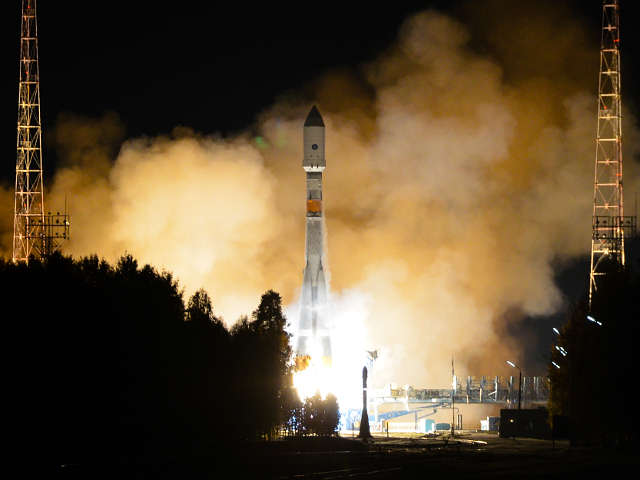
From the Cosmodrome Plesetsk today, at 21:17 Moscow time, the Soyuz-2.1B launch vehicle with the Frigate Higher Block and the Glonass-M satellite on board, ITAR-TASS reports with reference to the official representative of the airborne defense forces Alexei Zolotukhin.
"The launch was carried out by the combat calculations of the airborne defense troops from the launch setting number 4 of the site number 43 of the state test cosmodrome Plesetsk. The start of the launch vehicle was in the standard mode," Zolotukhin said.
At 21:20 "Soyuz-2.1b" was taken to support by means of the Main Testing Space Center named after Titova. The head of the acceleration block "Frigate" and the Glonass-M satellite was separated from the third stage of the launch vehicle 9 minutes after the start, at 21:26. Within three and a half hours, the motor installation of Frigate will work out several inclusions, as a result of which the target orbit of the apparatus will be formed.
In the estimated time, the Glonass-M navigation satellite of the global positioning system of Glonassa successfully separated from the Handicraft block "Frigate" and entered the target orbit. After withdrawing to target orbit, he was taken into control by the main testing space center named after Titov. A stable telemetric connection is installed and maintained with the spacecraft, all on -board systems function normally.
This year, this will be the second launch of the Russian navigation satellite of the GLONASS series. In March, Plesetsk was launched into the space of Glonass-M Spacetle with the help of the Soyuz-2.1B launch vehicle. By the end of the year, it is planned to launch three more such devices - in October with Baikonur using the Proton -M rocket. The launch of Proton in mid -May turned into an accident, after which the authorities took up the search for sabotageists .
The launches of the spacecraft of the GLONASS system are carried out on the Soyuz-2.1B launch vehicle from Plesetsk since February 26, 2011.
The Soyuz-2.1B missile is a modification of Soyuz-2. It has a engine with increased energy characteristics on the 3rd stage compared to the 1A option. In the Soyuz-2.1B, in relation to the previous version, the accuracy of excretion, stability and handling, the mass of the payload has been increased.
GLONASS is a Russian navigation system. Its orbital grouping today includes 29 devices, of which 24 are used for their intended purpose. Two more satellites are brought to the orbital reserve, two are on the study of the chief designer, one at the stage of flight tests.