
Translated material
The organs went through the wallets
The Investigative Committee presented to the supporters of Alexei Navalny - Nikolai Lyaskin and Konstantin Yankauskas - an accusation of fraud. Where did the new criminal case come from and what is its essence - the New Times found out
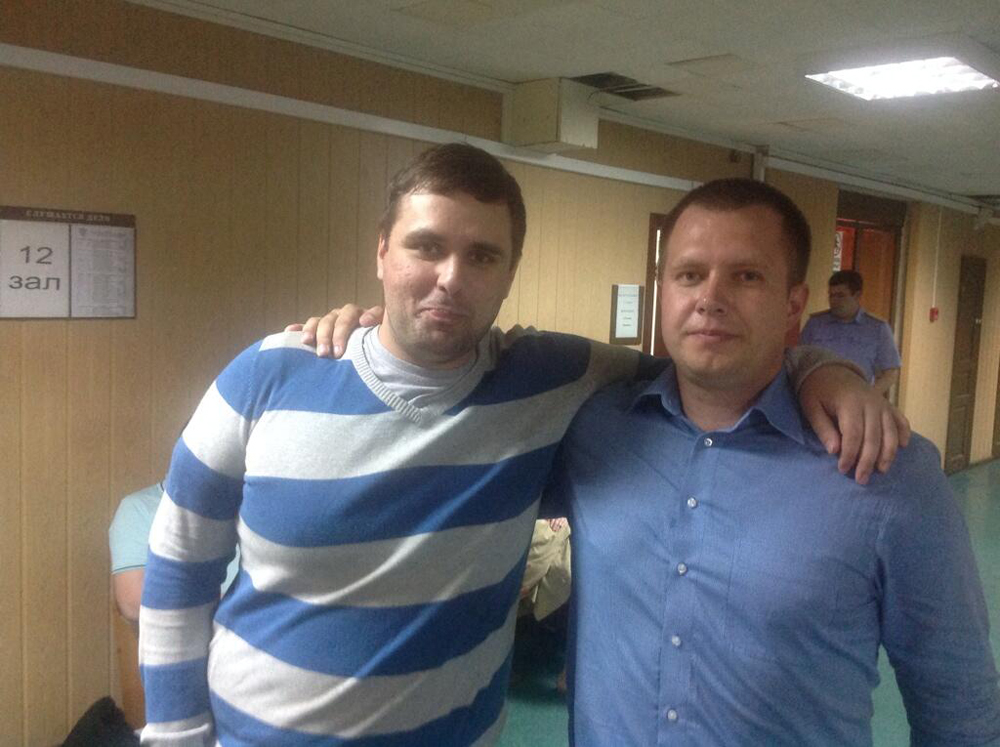
Konstantin Yankauskas (left) and Nikolai Lyaskin (right) June 11 in the Presnensky district court of Moscow. Yankauskas on this day was sent under house arrest /photo: Zyuzin headquarters /Twitter.com
“In case of accurate circumstances, on an unidentified day, but no later than July 2013 N.N. Lyaskin, K.S. Yankauskas, V.L. Ashurkov and persons unidentified by the investigation entered into a criminal conspiracy aimed at theft by deceiving someone else's property on an especially large scale ” - this is an excerpt from the decision to attract as the accused, which the investigator Vitaly Tyurin presented to Nikolai Lyaskin on the morning of June 11. The case was in the building of the Main Investigative Department of the Investigative Committee (SK) of the Russian Federation for the city of Moscow on Novokuznetskaya Street, where Lyaskin and another person involved in the case of Konstantin Yankauskas were summoned for interrogation.
The fact that the supporters of the opposition policy of Alexei Navalny was instituted a criminal case was known on May 23 - on this day, investigators conducted searches in their apartments, as well as in the office of Yandex.Money. The version of law enforcement officers is as follows: allegedly last summer, during the pre -election campaign of Navalny, members of his headquarters are Nikolai Lyaskin (businessman, head of the Moscow Party of Progress Alexei Navalny), Konstantin Yankauskas (municipal deputy of the Zyuzino district, co -founder of the December 5 party) and Vladimir Ashurgov (executive director of the struggle fund corruption)-about 10 million rubles were stolen from electronic accounts (Yandex-Koshelkov), which received donations from citizens. Lyaskin at first went on the case as a “suspect”, Yankauskas - as a witness.
On June 11, everything has changed. Investigators transferred both to the status of the “accused”: Lyaskin left under the subscription about the lower room, and by the court decision, Yankauskas was sent under house arrest until July 17. Ashurkova, who is now abroad, plan to put on the wanted list.
The defendants of the case were charged under Art. 159 part 4 "Fraud committed by an organized group or on a particularly large scale." Punishment - imprisonment for up to 10 years with a fine of up to 1 million rubles.
| *In total, 103 million rubles from 16,994 were transferred to the election account of Alexei Navalny. |
According to The New Times, a team of 100 investigators is working on the case, law enforcement officers are going to interview almost 600 people - of those who transferred money to the campaign of Alexei Navalny to the Moscow Mayors last year*.
Interrogations
On social networks Facebook and Twitter, new messages from people who have already been questioned or want to interrogate law enforcement agencies in the case of Yandex-Kselki almost daily.
To someone, as the former general director of Kommersant, Demyan Kudryavtsev, called the phone and invited to the economic crime department (he postponed his visit for health reasons). They came home to others. The psychologist of Maria Rabinovich, who was not found in the apartment, left the note: “I ask you to call O.A. Sumsky by tel. <...> Urgent! " (Rabinovich did not call back.) The daughter of the famous actor Alexander Filippenko did not find the house, but her neighbor was “mortally frightened”. “Dad and I were on tour. On June 9, they returned from Voronezh from the Platonov festival, and a neighbor with square eyes met us at the door. He exclaimed: “Horror! Horror! The investigator came to Sasha! " - told The New Times Alexander Filippenko. It turned out that the investigator came to her on Saturday, June 7, and, having waited at her door to her door to a neighbor, said that he came to find out if Filippenko transferred money through the Yandex-Koshelek to Navalny’s election campaign, and left his phone number. Alexander did not call back.
Those whom the police found at home were interviewed by a special questionnaire, which they brought with them. A photo of one page from such a questionnaire user vladimirovich posted on the website Politota.d3.ru. There are about 13 questions in it: the scatter of topics from "Do you have virtual accounts?" To “Are you familiar with the closest environment of the above persons (Ashurkova, Lyaskin, Yankauskas, Navalny. - The New Times). If so, then name their questionnaires and contact details, as well as the circumstances of the acquaintance. ”
"
“The transferred money was spent as intended for the Navalny campaign. I don't want to submit an application "
"
Lawyer Vladimir Lazarev, who was dressed in civilian lieutenant colonel A.S. Petrov (his surname was recorded in the protocol of the witness interrogation, which was at the disposal of The New Times) at 12 o’clock in the afternoon on June 7, said what the latest question was on this list: “I don’t remember literally, but the essence was:“ Do you know that the supporters of Alexei Navalny raised about 10 million rubles on their electronic wallets and appropriated them to themselves? Do you feel deceived? " In the protocol of the interrogation, Lazarev’s answer on this point is as follows: “I believe that the transferred money to virtual accounts were spent on purpose A.A. I do not consider myself deceived by the above persons. <...> I do not want to submit an application to law enforcement agencies on this occasion. ”
According to the lawyer, the policeman showed him a list of several dozen names of people whom he still has to interview: “He looked not very happy. He said that in the morning their department was collected and all instructed to conduct such surveys. I myself once walked in uniform and understand that there is little pleasant in this. ”
Lazarev took a copy from the protocol of his interrogation. “Once the UK took up for this, the documents must be in hand,” says the lawyer. - If the story will have a continuation, then they can also be called for interrogation, and here you need to remember that you used to say. I know how they interrogate there. ”
Wallets and schemes
| ** Federal Law of 12.06.2002 No. 67-ФЗ (as amended on 05.05.2014) “On the Basic Guarantees of Electoral Rights and the Right to Participate in the Referendum of Citizens of the Russian Federation”. |
The New Times contacted Leonid Volkov, who was headed by Navalny’s election headquarters in the summer of last year, and now lives and works in Luxembourg. He explained why electronic wallets were used to collect donations. The Federal Law on Basic Guarantees of Electoral Rights ** says: a voluntary donation of a citizen is “a citizen of his own money to a citizen of the Russian Federation to a special election account of the candidate”. “That is, a person must personally carry out a bank transfer,” Volkov explains. “But we understood that there are a certain number of people who do not want to go to the bank, but are ready to donate money through electronic wallets.”
The scheme was invented as follows: someone from the staff of the headquarters transferred his personal funds in the amount of 1 million rubles to the election account (this is the maximum admission of donation from an individual), then starts Yandex-Koshell and asks everyone to compensate him for this amount. The first such donor was Vladimir Ashurkov, who on July 19, 2013 published a photo of the payment on his Facebook page and accompanied it with the corresponding request: “<...> I today made one million rubles to the election score. <...> but informally, I did it on your behalf. <...> If you want, transfer a feasible amount to my Yandex-Koshelk.
Ashurkov also wrote that all funds that will exceed 1 million rubles, he will transfer to another volunteer of the headquarters, who will also open his Yandex-Koshell and transfer 1 million rubles to the campaign.
According to Volkov, the headquarters of Navalny did not expect that people on the first day transfer to Ashurkov about 4 million rubles. Then the wallets opened Lyaskin and Yankauskas, but they also transferred significant amounts. As a result, these three wallets raised 10 million rubles, and the investigation now claims that they were all stolen. “We“ gave ”all the excesses to other people who transferred them to the election fund on their own behalf,” says Volkov. And he adds: - It turned out that we still violated the electoral legislation, because it suggests that people should transfer their personal funds, and not donated, but the problem that arose with excess could only be solved. There is still no criminal offense here, we all spent by purpose. ”
"Perhaps they are looking for a person who can be put on so that he said:" Yes, my money is stolen "
"
The head of the Interregional Association of Electors Andrei Buzin, a specialist in electoral law and the leading expert of the Voice association, does not see violations in such a scheme. “Formally, you can find fault with anything,” said Buzin The New Times, “but, in fact, if all the money that the Navalny team received from the sacrifice has entered the election fund - there is no violation of the procedure for financing the election campaign, nor more fraud here. Yes, the law says that a person must sacrifice his personal funds. But if he was given 1 million rubles, are they now not his personal? "
According to Buzin, the “mediation” in the financing of election campaigns is a common thing: “For example, the United Russia party has its own support fund that accumulates donors and then transfer them to the election account. And no one finds fault with them. ”
In August 2013, the leader of the LDPR party Vladimir Zhirinovsky demanded that the prosecutor's office check the financing of the Navalny campaign - they say, if there are foreign money there. But neither the Prosecutor General’s Office nor the Ministry of Internal Affairs during inspections was then revealed.
And in April, already 2014, Zhirinovsky again remembered the mayor's campaign of Navalny and filed a deputy request to the Prosecutor General’s Office, in which he demanded to verify the legality of the use of Yandex-Koshelka when raising funds. It was not possible to contact the New Times to contact Zhirinovsky.
The investigation of the case on the Yandex-Kshtelki was taken by the Main Investigative Department of the IC of the Russian Federation in Moscow. At first they opened the case under Art. 141.1 of the Criminal Code of the Russian Federation “Violation of the procedure for financing the election campaign”, and then re -qualified it for an article on fraud.
This article, in a conversation with The New Times, the lawyer of Yankauskas Sergey Panchenko, suggests the presence of victims, but there are no such people in the case - for this reason, police officers interview all electronic wallet donors. “Perhaps they are looking for a person who can be pressed on so that he said:“ Yes, my money is stolen, ”Panchenko explains.
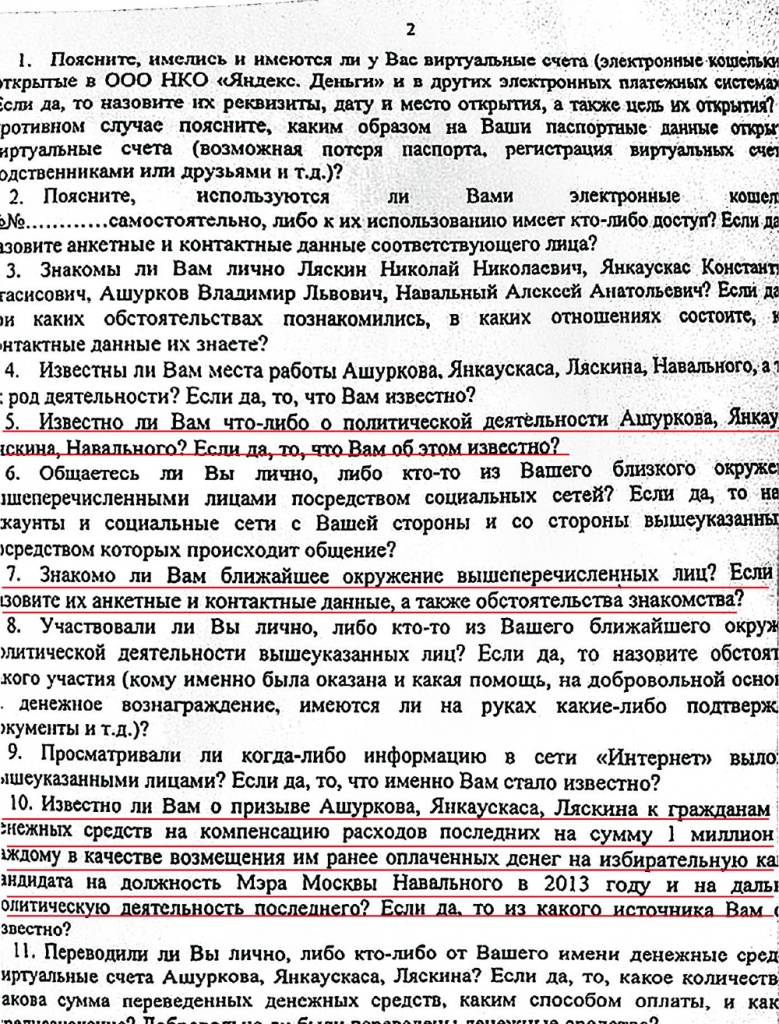
Photo of one of the pages of the questionnaire with whom the police come. Published on June 9, 2014 on the website Politota.d3.ru
Causes and consequences
Why did SK take up the supporters of Navalny right now?
The persons involved in the case are called several reasons. Lyaskin, in an interview with The New Times, allocated two main ones: firstly, twisting the nuts after the events in Ukraine, and secondly, the exclusion of opposition candidates from the elections to the Moscow City Duma-both Lyaskin himself and Yankauskas were going to run to the capital's parliament.
In addition, investigative actions, the ally of Navalny believes, also strikes a strong blow to the fundraising system for collecting money in Russia. “After the police came to these donors, other people will think a hundred times whether it is worth transferring money to Navalny at all, his fund for the fight against corruption or someone else,” says Lyaskin. “The authorities always wanted to control all financial flows, and of course she never liked these voluntary donations.”
By the way, the election campaign in Moscow started on June 11 - on the same day that the supporters of Navalny were charged. From this day and within a month, candidates can submit documents for registration in the Moscow City Economic Council.
| *** The opposition had only two options to go through the registration procedure: either go self -nominated (in this case, they should collect 3% of the voters of their areas, and this is about 5 thousand), or to move from any registered party, which in the last parliamentary elections gained more than 3% of the vote. There are only five such parties - “United Russia”, “Fair Russia”, the LDPR, the Communist Party and “Yabloko”. |
Nikolai Lyaskin was going to run for the capital's parliament in the 20th constituency, Yankauskas-in 31-live ***. Both of them were ready to begin the collection of signatures of the inhabitants of their areas. But Yankauskas now, like Alexei Navalny, not only cannot leave his apartment, but also use the phone and the Internet - what is the collection of signatures.
According to Olga Gorelik, the wife of Yankauskas, investigators, petitioning for the arrest of her husband, justified this by the fact that, firstly, he, as a municipal deputy, “possesses ties and can put pressure on witnesses”, and secondly, passes “under a difficult article, and his crime is directed against the constitutional rights and freedoms of citizens”, and thirdly, does not live at the place of impregnation. “Kostya is registered with his parents, and we live with his grandmother a 15 -minute drive,” Gorelik explains. She explains the difference in the chosen extent of suppressing her husband and Nikolai Lyaskin like this: “They sent my husband under arrest, and Kolya gave a subscription to set up the defendants of the case against each other.”
However, both defendants are not going to abandon their political plans. Nikolai Lyaskin has already addressed the Communist Party of the Communist Party with a request to nominate them with Yankauskas on the lists, as the Communists have so much stated that they were ready to cooperate with the opposition in the elections to the Moscow City Duma. On June 17, the Moscow branch of the Communist Party will consider this issue. If they refuse, they will have to collect signatures - according to Olga Gorelik, on behalf of Yankauskas, documents for registration in the Moscow City Economician will submit his lawyer, and supporters will begin to collect signatures.
When the correspondent of The New Times spoke to Gorelik on the phone, from somewhere far there was a voice of the Yankauskas: “I, too (that is, from my own person.-The New Times) I turn to the Communist Party of the Communist Party ...”-“Yes, you can’t handle it personally, you are under arrest!” - the wife answered.