
Translated material
Reading modernism
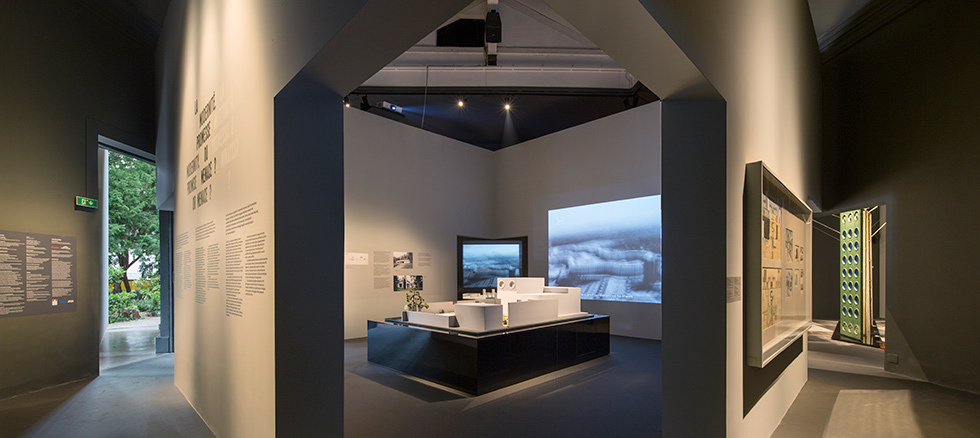
To watch (more precisely, read) the Biennale , where both the main project and the national pavilions curator Rem Kolhaas focused on the study of the main architectural experience of the twentieth century - the experience of the global modernity, materialized in the international style - from any place. Say, from the pavilion of the Dominican Republic: “Modernism in the Dominican Republic is determined by historical and modern, night and daytime, formal and informal, political and leisure, and these binary oppositions make it clearly Dominican” - this is how the explication that accompanied the history of the Dominican modernization construction, shown through the connection with political and natural (here There are often hurricanes) cataclysms of this area. But the same binary make modernism clearly English, Norwegian, Soviet, American, Chilean, Croatian, etc. The more than general principle specified by the Dominican text contains the key to the entire exhibition: the listed contrasts outlines the main problem that any “national” is faced with, that is, related to the specific history of a particular area, modernism trying to realize himself, and any critic trying to decide how to relate to this heritage. For example, for the Czech Republic (former Czechoslovakia), the experience of the architectural modernity was mainly the experience of a small national state, which falls under the influence of one and the other hegemon: the study of the Czech pavilion was built around the history of housing construction from socialism to capitalism, each episode of which became the answer to the question of the relationship between the collective and individual in production and everyday life: to live collectively and work collectively in collectively in 1920s, live individually and work individually in the 1990s. But the memory of modernism is not at all equivalent to blind hatred for the heritage related to the Soviet “colonization”: this is a productive reflection that is trying to use the ideas of planning and a socially oriented approach to the housing issue as a source of an alternative in a situation where wild private development is surrounded by a dense ring, and the role of the architect was almost completely leveled. In the pavilions of the northern countries, a study of typical prefabricated projects of schools and hospitals was exhibited, which Norway, Sweden and Finland were built as a help to young socialist regimes in the 1960-1970s in Africa. The curators of the Kuwaiti pavilion show how architectural modernism came to the country simultaneously with the opening of oil in 1946 and ended in the landslide of the market in 1982. This “period of modernity” was associated with the transplantation of modernism into the territory with which everything that was “outdated” was previously erased - the previous urban development was demolished, and at the same time the National Museum of Kuwait was erected: everything that was “before oil” could now exist only as a museum past. For America, the history of modernism is a history of massive expansion of the capitalist modernity and ideological hegemony through architecture. The US pavilion is arranged as a center for the study of all American projects built in the twentieth century abroad, and their typology alone can tell a lot: network hotels where the Americans would feel at home, began to be built around the world in the 1930s, with the emergence of a flight international aviation; several waves of the construction of embassies (after 9/11 they began to be designed like impregnable fortresses on the outskirts of cities); Expo buildings built on the money of the American state in third world countries to promote capitalism during the Cold War; Military bases and indistinguishable from Florida residential villages in the deserts of the Arab countries for employees of oil companies.
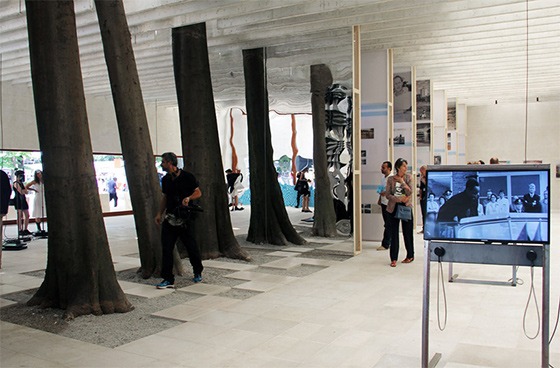 © Designboom Pavilion of the Northern countries
In fact, on the territory of art, such Case Studies of architectural modernism as on the one hand is a social alternative, and on the other, hegemony, artists have been dealing with at least ten years, and the political question about the role of modernist heritage has been raised since the early 1980s, just since the postmodernists have written off modernism in the murmures. The first topic was aggravated by Jurgen Habermas in the famous text “Modern-an incomplete project” , responding to the program of the 1st Architectural Biennale of 1980 “ Present of the Past”, which is considered to be triumphant postmodern. And most of the curatorial projects of this year in Venice looks exactly as the “progressive” Artistic Research of modernism with black and white photographs of concrete structures and endless texts and timelines looks usually. But nevertheless, the idea to set the unified theme “ absorbing moodernity” for all national pavilions was the main success of Kolhas: having achieved critical mass, these stories of modernisms suddenly highlighted the fact that in one national pavilion after another a purely discourse problem of judgment, or rather, the very possibility of judgment on modernism as a global and universal. The designer, the same in his tectonic and spatial elements and different - in how he lives and is instrumentalized in each individual case. Such a difference can be called the principle of modernist individual, that is, the process of manifestation of an individual structure within the universal language: and now, against the backdrop of conservative turns of all types, the special value of such an individual is that it suggests talking about architectural and social history and the future of an individual country, without resorting to conservative archeology, occupied by the phrenological identification of “national” features.
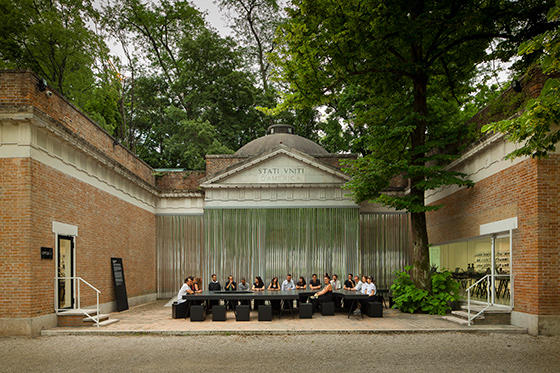 © Kara Meyer US Pavilion
A massive background for these modern individuals sets by Remom Kolkhas the main project of Biennale - Fundamentals . But he himself just looks like a radical rejection of any judgment. To say something about modernism in the USSR or about social construction during the Welfare State in England means, undoubtedly, to talk about the social ethics of architecture and urbanism. Kolkhas, on the other hand, takes a position as if universalist, decomposing the social and historical body of architecture into “fundamental” elements. And the result of the two -year efforts of Kolkhas and students of the Harvard Design School, although called Research , looks more like Surf , that is, as if a search on Google , improved at the expense of all those resources that are spent on the main project, became able to give out immediately physical objects that are then installed in the exhibition space and are simultaneously displayed in books (everyone The hall with the “element” corresponds to a book made by the famous Dutch graphic designer Irma Bom). As a result, the battered “stories” of the walls, windows, escalator, bathroom, roof, pussuar in all types and ideological variations hint to someone who wants to choose something from these variations that there is a stunned dictionary of the international architectural language, and which phrases will be composed, they will serve as good or evil, which Kolkhas, obviously, is not intended to solve. He simply dumps a set of episodes, things and descriptions on the viewer, falling out in his powerful search engine at the corresponding request. Thus, the escalators “thanks to their ideological flexibility”, as written in the “escalator” section, serve equally successfully both capitalism and socialism (the realized, true, like Stalinism) - they, say, can offer you to the Stalin statue (in the project of the Stalin Stadium metro station), and can embody the hedonism of the consumption society, getting off to four comic comic comic steps in Japanese malls. The selections of objects (walls, windows, roofs, stairs of all and all kinds, technologies, times and countries), resembling a fantastic construction market, are interspersed with a video in the spirit of Christian Marklei with a cutting of frames from films where, say, a bath or window is involved. You can look out the window, you can wash it, break it, you can have sex on the windowsill, or you can throw it away. In this total exposition, the greatness of the monetary and labor costs that it demanded cannot be felt-but at the same time the spirit of the beautiful equalization of elements withdrawn from unequal contexts: in essence, it is a multiculturalist spirit of the 1990s, when Western artists and architects enjoyed the infinite diversity of the world, access to which economic prosperity and developed technologies were enjoyed. At the same time, this elementary “laying out” of social integrity returns us to existential phenomenology of architecture, which was so popular in the 60s: all these elements were served as an individual subject, and the whole colhas seems to be about this-somewhere in the accompanying texts to the project, he would not be a balcony of his parents, he would not have Kolhasa.
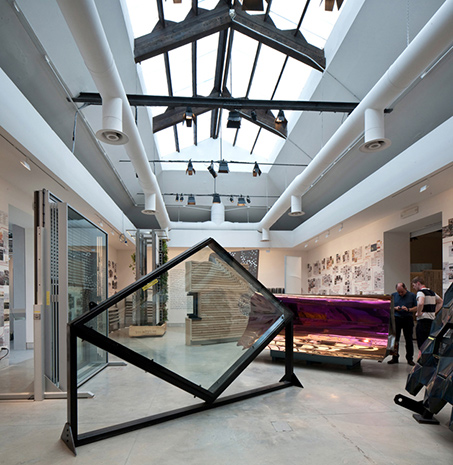 © Theblogazine.com The main project of Biennale Fundamentals
The same boy from the balcony (or rather, from the kitchen of the parental house where his first exhibition took place, which was immediately visited by the best people of Switzerland) looks like Hans Ulrich Obrist, who was splashing carelessly in the waves of infinitely diverse modernity, including all the achievements of the past. He oversees the Pavilion of Switzerland, and with Colhas it is connected not only by a collection of conversations, but also by the general relay by modernity as a field of boundless (for these two) capabilities, technological and financial, thanks to which they brilliantly flange on the surface of civilization. Both of them are fascinated in the entire enterprise of modernism precisely what the postmodernism in their most conservative version is then.
The Swiss project is called the “Walk along the Palace of Entertainment” ( A Stroll Through The Fun Palace ). A virtuoso producer of speech, a virtuoso, continues a long conversation in it about his favorite moment of modernism - the Englishman Cedric Prisa, who remained on the Palace of Funny, remained on the Palace of Fun. This synthetic machine for the entertainment of the masses, the mobile Gesamtkunstwerk without an architectural body, composed of light and mobile structures, belongs to those uncritically fascinated by the new state of the technologized mass society to the projects of the 1960s, from which pop art was hatched and then postmodernism. Again and again, turning to this project in the 2000s and 2010s, the obstructure reproduces the very paradigm of the “hysterical elevated” museums of late capitalism, which at the level of architecture is manifested in the creation of hypnotic and fluid total media, completely absorbing a cultural consumer, which cannot cover them with either reason or feelings. The fact that the “Palace of Fun” remained a utopian project gives the outbuilder the opportunity to endlessly continue his conversation; He builds a palace from speech so vastly that it excludes the possibility of covering it and eloquing. And in this space of empty speech, no question can arise.
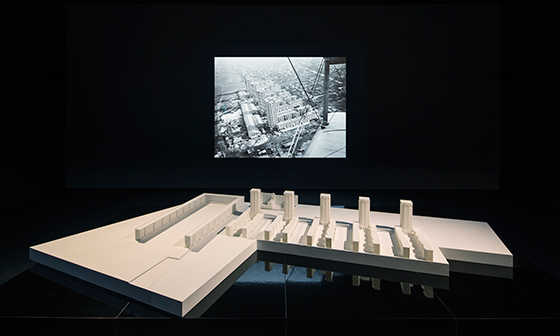 French pavilion
Meanwhile, in those pavilions where a modernist individual is comprehended, materialized in the buildings of the actually incident modernism, the issues arise with all the rigidity and, as a rule, precisely in the form of “or-or”. The reasoning of the implemented modernism is inclined to rest against binary: successful or failure, humanistic or totalitarian, capitalist or socialist, private or social, collective or individual, market or planned. And it is clear that politically these “or” are attached to the line that, most of the century, divided the world in two, and not only geographically, between social and captlock, but also between the social democratic projects of post-war Europe and America and then- the rejection of them and the widespread decline of Welfare state . And since this question is for the most part political, the debate about modernism can be very fierce-it is worth recalling the legendary story about the explosion of the social housing complex rutt-aigo (this myth pops up on the Biennale here and here). It was the demolition of the prod-Aigo Jenx who appointed the end of modernism, who claimed the whole century to use the architecture language cleared of decorative ideologies not only to abstract or cover the existing order, but also to restructure social reality. The discussion about whether the final fiasco of the viability ambitions of modernism was the final fiasco or still should not blame the architecture in the failures of the inferior social policy, usually leads opponents to an unsolvable confrontation. It’s not that it was possible to replay the results of this match, rather there is a need to recontectualize supplanted values. And for this you need to turn to those “or-or” from which the fall of modernism began-not in order to revive it in unchanged forms, but rather to hang a judgment about it and get out of a barren dispute, whose dichotomies inevitably lead to a dead end. Such a suspended judgment is the most important thing that can be taken out of this Biennale. The metaphor for it is the standard concrete block with a window suspended in the pavilion of France. Actually, the French project (curator of Jean-Louis Cohen) is all structured through insoluble "or-ora." It is called - “modernism: promise or threat” and, in turn, breaks up into binary stories: “Jacques Tati and his Villa Arpel: the object of desire or the comic machine”, “Jean of Pruuve: constructive imagination or utopia”, “Block structures: growth of performance or monotony” and, finally, “Large housing complexes: saving heterotope or place of imprisonment”.
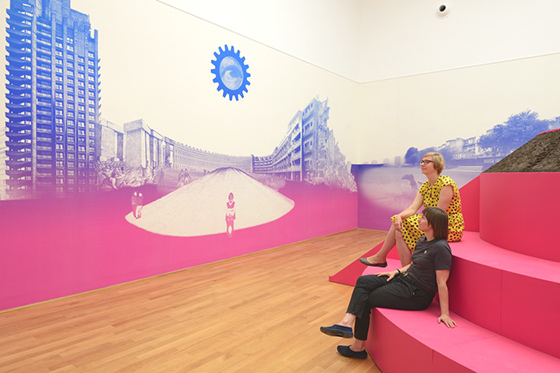 © Cristiano Corte for the British Council English pavilion
In the center of the exposition is the mock of the villa Arpel from the comedy of 1958 “My uncle” Jacques Tati, which is immediately broadcast on the monitor. This is the building in which, how its owners boast, “everything is connected,” the real embodiment of modernity. But- Oh, The Irony -the villa turns into an idiotic "palace of fun", where the ultramodern technique mocks its own owner-bourgeois, putting it in ridiculous provisions. Meanwhile, the next hall, meanwhile, tells a more gloomy story about multi -storey apartment complexes that were built on the outskirts of Paris before the war as centers of a happy life for families who do not know the need and unemployment: one of them, Cite de la Muette , was converted into a transit prison for Jews, from where they were sent to German camps. And in the same years, the photograph of the quarter appeared in the book of Jose Luis Cert "Will our cities survive?" As an example of exemplary residential architecture for the future collective modernity, which may come after the war.
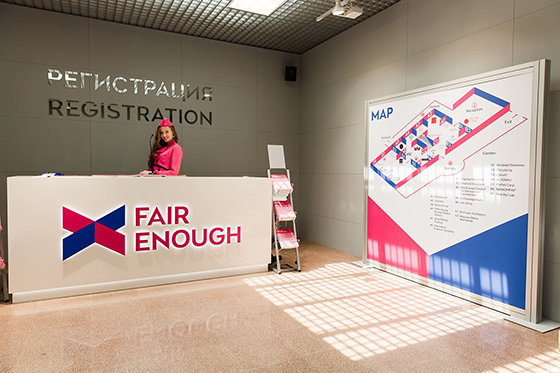 © Strelka Russian pavilion
It is in this exposition to the stage (suddenly for always more than serious modernism) that irony comes out, fundamentally different from the one that Jenx spoke about the 1980 postmodern Biennale. The irony of postmodernism of the beginning of the 1980-1990s made it possible to create an environment where, as a result of semantic depreciation, signs of different orders could mix-and after that formal and ethical stress, which was required by international style with its purism and moralizing sociologism, mixing historical quotes, elements of vernaccular architecture and modern constructure should have brought pleasure to architects. in half with relief. The irony through which modernism is shown in the French pavilion is dialectical, that is, it is not associated with pleasure from the performance of empty meaners, but with the living and living history, which affects the direct interests of the viewer. Such an irony does not arise as an equalizing depreciation of the contents that once provoked the struggle, but as a distortion arising between intention and the result: however, no one is in a hurry to say that the damage was already laid at the level of idea. Using the same dialectic irony, the project of the Fat Architecture and Crimson Architectural Historians in the English pavilion was built. It is called “Clothing Jerusalem” - a hybrid of heavenly Jerusalem and “Clothing Orange”, the ironic dialectics of fantasies about a better life and what came of them. But, as in the case of France, this is too intelligent exposure to simply jump on the bones of utopia again: the judgment of modernism is suspended here on the thread of irony precisely in order to go from hopeless “or-oru” (a state plan or a market, collective or private) to go to the next, productive, phase. The starting point for all comparative rows, more precisely, the cycles here become a ruin taken as the basis of English architectural imagination. Stonehenge or London destroyed by bombing becomes a reason for the reconstructive fantasies about the social space of the life of a modern mass person who can fail (like a Hulme Cresscent complex, recognized as dangerous for families and turned into a giant one) and, in turn, ruin, but only so that these pathos concrete ruins of the state of the universal благосостояния, вечно дающие повод для насмешек над самой возможностью реализации социалистических идеалов, стали почвой для нового витка социально-архитектурного воображения, инициировать который стремятся авторы экспозиции.
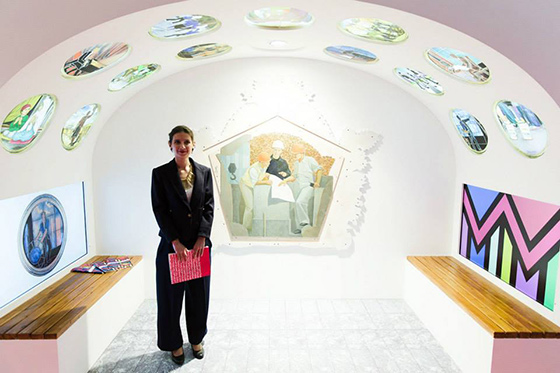 © Strelka Русский павильон
Ироничность — то, что в первую очередь отмечали в русском павильоне, сделанном командой Strelka (кураторы Дарья Парамонова, Брендон МакГетрик, Антон Кальгаев) как бойкая сатирическая стилизация под строительную ярмарку, где выдуманные фирмы торгуют актуальными идеями русского модернизма и вообще-то антимодернизма: скажем, фирма «Эстетика» занимается национальными особенностями в виде русской резьбы, а павильон ретроактивного девелопмента продает опыт по воссозданию точных копий снесенных памятников. Благодаря энергичной подаче идеи должны прежде всего произвести впечатление на мир, а мир, как известно, приходит в виде покупателя. В проекте под названием Fair Enough: Russian Past Our Present (что звучит весьма похоже на Presence of the Past 1980 года) исследование понято как синтетическая театральная постановка, на которую были брошены силы графических дизайнеров, известных режиссеров и модельеров. Тут сделана ставка на ударную репрезентацию и почти скандальный хайп: промо-герлз в розовых пилотках и уважаемые архитектурные критики в роли менеджеров по продажам, промоутирующие актуальность концептов Лисицкого, Чернихова, Никольского, блочного строительства, циркуляции, дачи, китчевой эстетики и прочего. Это чисто семиотическое предприятие в духе постмодернистского иронизирования 1990-х годов: оно устроено как экстракция «идей» из их реальных социологических контекстов и помещение их в пародийное ультрарыночное пространство. Тут возникает забавная путаница между исследованием, подразумевающим конкретный кейс, и презентацией концепта как абстрактной ценности, которая сама по себе может участвовать в рыночном обмене, принося прибыль. Скажем, круглые конструктивистские бани Никольского, иллюстрация концепта циркулярности, выставлены как красивый прозрачный макет, который можно даже покрутить, — но любой, кто захочет побывать в этом довольно популярном у ленинградцев заведении, выяснит, что циркуляция в нем как раз страдает: доступ в круглый бассейн есть только в нижнем отделении, вход в которое стоит дороже, чем в верхнее — без бассейна; но даже дорогое отделение работает через день для женщин и мужчин. Можно попробовать продать концепт циркулярности иностранцам, а можно выяснить, почему циркуляция оказывается нарушена в реальности, — и это два очень разных подхода. Да и вообще самое интересное в этом павильоне — именно то, что остается за скобками, то есть, например, то, каким именно образом радикальные коммунистические идеи русского авангарда могут быть трансплантированы в неолиберальную реальность: кто станет их заказчиком, спонсором и потребителем? Но роль российского павильона, спонсируемого «Газпромом», очевидно, не в том, чтобы слепо следовать скользкой дорожкой artistic research , которая может вести к самым неожиданным выводам. На Fair Enough все дышит хотя и ироничным (и предупреждающим таким образом критику слева), но все же оптимизмом в отношении будто бы только что открывшихся рыночных возможностей. Похожие проекты с фирменными стилями несуществующих компаний, торгующих ментальными абстракциями, делали в самом начале 1990-х короли постмодернистской иронии — группа Fenso , но тогда свалившийся на голову художникам рынок был чем-то, требующим осознания. Сегодня подобный режим иронизирования говорит о несколько параноидальной ситуации, в которой худшим вариантом кажется выглядеть скучно в глазах мира, а лучшие силы и способности уходят на репрезентацию — и очень мало на то, чтобы понять что-то для себя. Конечно, любая реальная интроекция выглядела бы унылым пораженчеством, ведь проблемы слишком велики; да и зачем быть Латвией, Чехией или Кувейтом, когда можно быть Россией, грандиозной и неповторимой. Но тут-то и пригодилась бы не пустая, а диалектическая ирония — ирония, которая помогает без морализаторства увидеть траекторию собственной модернистской индивидуации со всеми ее провалами и возможностями.