
Translated material
Lectures and conversations: a new place
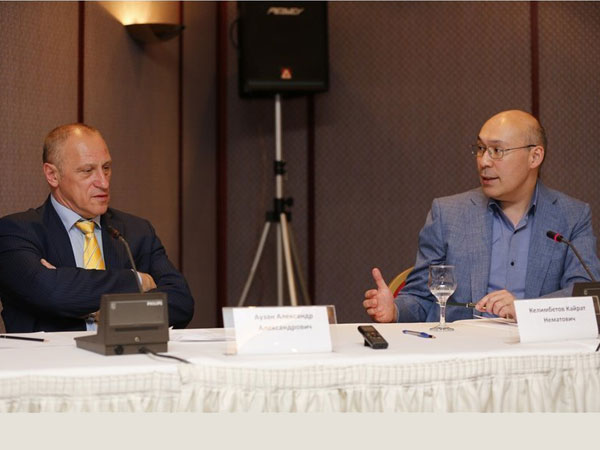
Public lectures, so familiar to the readers of Polit.ru, will now be held in Kazakhstan. More recently, the project “Conversations of the Economics and not only”, which the National Bank of Kazakhstan and the Economic Department of Moscow State University, have planned and implement the Moscow State University, have been planning and implementing. The start of the project was quite starry - it was opened by the dean of the Economic Faces Alexander Auzan and the head of the National Bank Kairat Kelimbetov.
By the way, when 5 years ago I heard from someone in Moscow “we conduct public lectures”, I presented the following picture: Anatoly Fedorovich Koni, Korney Chukovsky and Alexander Blok come out of the stage-in the capital or in the province-in the hall is full of people, “on the heated” some young Mayakovsky. For lecturers, this is a kind of tour, the opportunity to meet with the reader face to face, look at people, and earn a little. And for those sitting in the hall - this is a real chance to touch the beautiful and high. Firstly, not everyone can buy a book or hear the performance of the same horses in court or at the university. Secondly, this is the opportunity to spend leisure time interestingly and with benefit ... But this, nevertheless, the 1910s of the twentieth century! Neither TV, nor radio, nor, moreover, the Internet ... In short, something has changed since then.
However, it turned out that public lectures really exist quite at the beginning of the 21st century. They are read by a variety of people: scientists, public figures, politicians, people of art - everyone talks about their own, everyone has their own audience - among writers, and mathematicians, and ministers. Polit.ru came up with an updated format of public lectures, and since 2004 to this day, Muscovites and guests of the capital gathered for Public Lectures Polit.ru. In some ways, they continue the tradition of lectures of the 1910s, someone compares them with the lectures of the Knowledge society, or with the TEDH project, but still they have their own format and their own task-to enlighten and entertain the audience, involve it in discussion and thinking, and be sure to fix it-in publication-what happened, i.e. The lecture lives longer and is discussed wider. One listened, the other read - and so in society an interest in the topics and issues that go beyond life and everyday life are quietly formed in society. And the lecturers have their own interest - to run up new ideas on a wide audience, to hear how their word, so to speak, will respond.
Today, the fashion for spending its leisure on self -education has firmly rooted in the world and in Russia and is called the fashionable word “editainment” (by the way, the network English dictionary claims that initially this word designated a computer game with an educational slope). Around the lectures are gathering clubs in interests-not all the same to drink and walk in clubs, as in the 90s! “Polit.ru” gradually went beyond the boundaries of the country, initiating the “Polit.ua” project in Ukraine, and many other lecture platforms were opened in Moscow - on the basis of the media, in theaters and libraries ... Someone even began to sell tickets for lectures, like our colleagues from “direct speech” - and people who were already accustomed to such an exquisite “food” as intellectual conversations willingly pay and listen.
But back to Kazakhstan. The project “Conversations about the economy and not only” has their own goals and features. First of all, as speakers in Almaty (“conversations” are based there, because it is there the National Bank is located) will fly professors and graduates of Moscow State University. And among the listeners there will be many people who graduated from the same university. Why is it so, why is this university a bet in Kazakhstan? Alexander Auzan, in his lectures on the mission of universities, retells the conversation with one of his graduates, a high -ranking Kazakhstan official: “About 10 years ago, he asked me the following question:“ Alexander Alexandrovich, we are sending children to study at Harvard. Tell me, is that what they teach there is generally applicable somewhere? " I replied that Harvard does not set the preparation of people for the Kazakhstani economy, for Kazakhstani administration. Therefore, what they teach is 90 % applicable in the Harvard area by 70 % applicable in the Oxford region, by 30 % applicable in the Tokyo area and 7 % applicable in the Republic of Kazakhstan, in the Astana region. ” Why? Because there is the layer that neither Harvard nor Oxford teach, but which is necessary in order to move any economy (by the way, this applies to European economies in the same way as Asian) - a layer of informal institutions. ”
Here, just Alexander Auzan as a specialist in the field of institutional economy, understands a lot of things about informal institutions in the post -Soviet space, and his colleagues, too. So, it turns out that Moscow State University, whatever one may say, is “closer to the body” in Kazakhstan in common. Especially in the economy.
Of course, as the name can be seen, the conversations will be conducted not only on economic topics. And yet - the economy is a priority. That is why the first lecture, which was held on May 25, just on the eve of the signing of an agreement on the creation of the Eurasian Economic Union, was read by the “founding fathers” “conversations” - Auzan and Kelimbetov (graduate of Moscow State University!). (By the way, I can’t help but recall that in Polit.ru, Auzan was one of the first, and in Kiev the lecture “Polit.ua” began with his performances, now in Almaty Auzan spoke a pioneer - a good sign) spoke of new world challenges and the search for non -standard solutions (a complete text of the lecture can be foundhere ).
Both economists talked about which world we ended up today, and what the main challenges, in their opinion, are in this world. By chance or not, but the practice and the theorist came out 4 calls. Kelimbetov called volatility the main modern challenges (when the “storm” of the economy of all countries), uncertainty (no one knows how to build forecasts, what to count on), the complexity of the configuration of the world economy, Identity and inconsistency (when they are trying to “drag” and “not to let you go” at the same time). Alexander Auzan spoke about the “cast of globalization”, a value shift (old values are leaving, new ones are formed), a shortage of high-quality human capital (qualified and brainwood) and “success tragedies” (when people began to live, thanks to medicine, up to 80-90 years, and work only up to 60). Each of the interlocutors outlined the paths and opportunities to solve these problems. Several difficult questions were thrown from the audience - work went!
It was the work that went, because Another important distinguishing feature of the project is “Conversations about the economy and not only” conceived not only as a performance of speakers, but also mandatory discussions and discussions, a kind of “brainstorming” in a group dilated to the number of lecture listeners. The initiators of the project are sure that they will be able to bring out the most important ideas that sounded at lectures in a practical plane. Kairat Kelimbetov outlined this: “This is not just a lecture program. These are meetings, during which we will discuss our issues with representatives of not only the scientific community, but also with people who have practical experience in the Government of the Russian Federation and the Central Bank of the Russian Federation and of course with the participation of Kazakhstani economists and experts. We will discuss our coordinated monetary policy with invited lecturers together, since now we will be in the Eurasian economic space from the next year, and the Central Bank of the Russian Federation is our closest strategic partner. ”
From these words it follows that there will be a lot to discuss finances and loans, but not only - the plans and conversations about the development of regions, and conversations about education, linguistics, culture, the structure of modern cities ...
Among the listeners of the first lecture there were many top managers of the National Bank. And this causes respect - and the head of the National Bank is publicly, enters into a discussion, answers questions, and calls for his employees to study. Those. These are also master classes, trainings for bank employees! The country's main bank forms a young and effective team and uses the very fashionable “editism” mentioned above.
The moderator in the project was Serik Akhanov, a famous economist, financier and politician. And it turned out wonderful, despite the fact that it is more often that with status speakers the status moderator burns the event, "pulls the blanket over itself." In Almaty, everything turned out differently - and Serikmetzhanovich held the conversation witty, subtly and at a high professional level.
Yes, a couple of days before the lecture, another joint project of the National Bank and the EF of Moscow State University - “Econlab Moscow State University” - a closed platform as part of the Astana Economic Forum - there were exchanged views by leading Kazakhstani and Russian economists, representatives of the banking and financial sector. But this site will work once a year, and “Conversations about the economy and not only” will be held regularly, with the exception of vacation summer months.
In a word, the start was a success, it would be nice not to slow down. It seems that the residents of Russia and Kazakhstan will have something to talk about for a long time - it is important that the format of conversation be a format of a friendly and substantial conversation.
On June22, Alexander Auzan will perform with the theme “Cultural Codes of the Economics” in Moscow as part of the Proscience Theater.