
Translated material
"Unbelievers" in Moscow
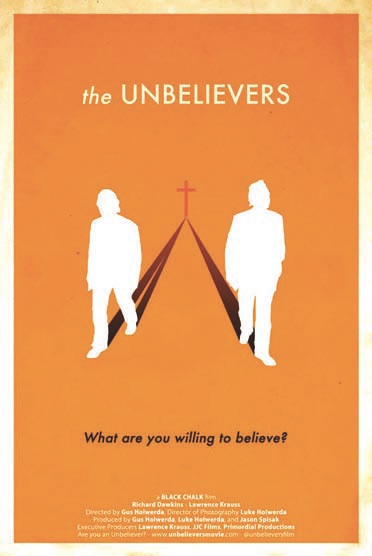 It so happened that on June 7 I was a guest at a very unusual and interesting event. About 150 people gathered in the Moscow Sakharov Center to watch the film "unbelievers" in the original voice acting of the Vert Dider translation studio. Among the guests were Alexander Markov (one of the most famous popularizers of science in Russia), Asya Kazantseva (popularizer of science, author of the wonderful book “Who would have thought!” About our thinking), Mikhail Lidin (leading skepticism on the sofa), Vitaly Frolov (widely known in narrow circles) and several more people. I was very pleased to be in such a company. The premiere in St. Petersburg was attended by academician Yevgeny Alexandrov, where he read a fiery speech that broke stormy ovations. The show of the film collected a full house in St. Petersburg, in Odessa, in Tyumen, Tomsk, Krasnodar and twice in Moscow. And this is impressive, given that such an event is held for the first time.
The film itself can be seen on the website of the translation studio: [1]. The film is not so much cognitive as inspiring. He shows that not everything in the world has mired in the swamp of “spirituality” and the lack of critical thinking, that there are wonderful smart people who are not devoid of a sense of humor and defending science and mind. In addition, these people have serious support in society, the scale of which you did not even suspect.
I would like to share a few thoughts that were expressed during the discussion of the film after the show. I would not want to forget them.
1. Vitaly Frolov expressed the idea that I wanted, but still could not formulate. One of the reasons why religion is such a popular phenomenon is that religion contributes to socialization. Especially somewhere in the USA, where people regularly go to church. People get together, perform rituals, communicate. The unbelievers have no rituals, they have no events that could unite them.
I think that we are not talking about the fact that the unbelievers will begin to kiss the book “selfish gene” by Richard Dokinza, to catch up with the holy scientists-martyrs, there is cookies symbolizing the DNA of Christopher Hitchens, to dip the children with distilled water to protect against obscurantism, to bow to Sam Harris, pray Dennet, in chorus to sing songs by Tim Minchin or testify to the miracles of James Randi. But to watch and discuss the film in a friendly intellectual environment - why not?
The show of “unbelievers” was an event that, of course, contributed to socialization and rally. People met, talked, discussed cinema, shared their thoughts. I believe that more such events are needed, and I express my great gratitude to the organizers.
2. Asya Kazantseva shared the experience of working in the media. We often scold the media for showing any pseudo -scientific nonsense like the film “The Great Secret of Water”. Sometimes it even seems to us that there is a conspiracy to powder the brains of the population. But most often, the media simply chase the rating. And if the people like to watch about the memory of water, they will be about the memory of water. And if it turns out that high-quality science broadcasts have become in fashion, they will be. In this regard, it turns out that we greatly underestimate the importance of likes and reposts. It is likes that advertisers will look at the likes.
If a popular science article has more likes on the website of the magazine than an article about homeopathy, you can go to the authorities and report: you see! Let's publish such material! It is profitable! And each of us has the ability to put “likes” what you like.
3. Alexander Markov expressed an interesting thought about why in Russia there is a gradual return to religiosity. There is a reverse correlation between GDP per capita in the country and religiosity. Of course, the correlation does not mean that there is a causal relationship. But still: the richer people live, the fewer the proportion of religious people in the country. The United States and Russia are significantly falling out of the trend: the USA is a more religious country than could be expected on the basis of the aforementioned pattern, and Russia (at the moment) is less religious (due to the atheistic past). This may turn out to be an important social factor that leads to the fact that in the United States we are observing the spread of atheism, fashion for enlightenment and the extraordinary popularity of enlighteners like Richard Dookins, and in Russia we see the path to the revival of “spirituality”.
4. Nevertheless, as already noted, the show of the film everywhere gathered a full hall. This suggests that in our country there is a huge audience of sober people. In Russia, the growth rate of popularization of science is huge. There were almost nothing ten years ago, and now there are a lot of popular science projects. And this inspires optimism. Once again, thanks to the organizers, translators and authors of the film.