
Translated material
John Warsha: "Now everything is real"
A week later, in St. Petersburg in the State Hermitage, a manifesto nomadic from the city opened from the city to the city of Biennale of Modern Art. Over the past year, since it became known that the current Biennale will be held in Russia, this is Manifesta's decision Foundation has been repeatedly criticized. Several times it was proposed to boycott the exhibition. Many artists refused to participate in Biennale: for example, the group "What to do?" . Against the exhibition, petitions and articles were published , to which the curator Biennale Kasper König, representatives of the Manifesto Foundation and the Hermitage, responded with oncoming petitions and statements. The main claim to the “Manifesto” was that the political climate in Russia, to put it mildly, is adverse for such artistic events and that the Biennale will become, like the Olympics in Sochi, a beautiful facade for the policy of the current authoritarian regime, the most striking “achievements” of which, starting with the homophobic law and the end of aggression against Ukraine, were at the center of petitions. At the same time, the artists did not forget about institutional questions for the "manifesto". Polish artist Pavel Althamer, who decided not to participate in Biennale, said Colta . Ru , that the main complaint against the “manifesto” - especially now, when it functions in conjunction with the Hermitage - is that it is too bureaucratic, hierarchical structure, insufficiently open and democratic. The Ukrainian artist Alevtina Kahidze, on the contrary, decided not to refuse to participate in the Manifesto, despite the calls of her colleagues and friends for the boycott of the exhibition. She is going to talk about her understanding of the boycott within the framework of Biennale.
John Warship, curator of a public program - the most interesting part of the “Manifesto” in this context, ”said Colta . Ru about his views and tasks, about boycott and participation.
-You stated that you are going to make a public program “Manifesto” in close contact with a difficult sociopolitical situation in St. Petersburg.
- To be honest, for me the only reason for working on the public program in the current political atmosphere of Russia was the response to the political crisis. Otherwise, why do I need this? After the annexation of Crimea, the artists and I faced a classical political dilemma - to participate or not to participate, stay or refuse? We asked ourselves whether to continue the work and if we continue, then under what conditions, what consequences would have this decision and what are our goals. As we noticed in recent years, numerous Biennale reacted differently to political instability. For example, the public program of Istanbul Biennale was mostly canceled . Our decision to continue work within the framework of the “manifestos” is based on the faith that since art is believed to give rise to pluralism and critical thinking, produces distinction and political subjectivity, then it is more than necessary. Therefore, I am sure that Biennale should take place, but not as something serene, not as if nothing had happened.
If I believe in the political role of art, then this is just the situation when it can be checked in practice.
Another reason is that all artists participating in the public program are immigrants from post -Soviet countries. In my curatorial concept, I take on the basis the schedule of trains of the Vitebsk station, the oldest in Russia - their routes are leaded to Tallinn, Vilnius, Riga, Chisinau, Kyiv, Warsaw, etc. And I decided to invite artists from these cities, in a geopolitical sense associated with St. Petersburg. Christina Norman, Deimantas Narkyavichus , Pavel Brail, Alexander Pirich, Alevtina Kahidze and the Slavs and Tatars group will work in this city. They are all from afar, but close enough to join the situation. Since the public program is quite ephemeral in nature, it will be the most mobile part of the “manifestos”, which will create projects that are a statement about and the reaction to the situation in Russian society and neighboring countries. And in connection with the political crisis, the projects became very complex and, unfortunately, gestured.
- You said that you will work only if there is no censorship. Have you really not encountered censorship?
- It would be an illusion to believe that there are countries where there is no censorship. It is always present, although it takes various forms. In conditions of neoliberal capitalism, it is delegated by the artists themselves, turning into self -censorship in the name of political correctness. I realize that fear and distrust in today's Russia are intensifying and someone can simply close the exhibition to prevent the implementation of a project or so that no one knows about it. But this is only part of the wider context of our work. We must be ready for this. However, in general, I did not feel some obvious censorship, as well as attempts to soften the content of projects, which, I hope, can prevent.
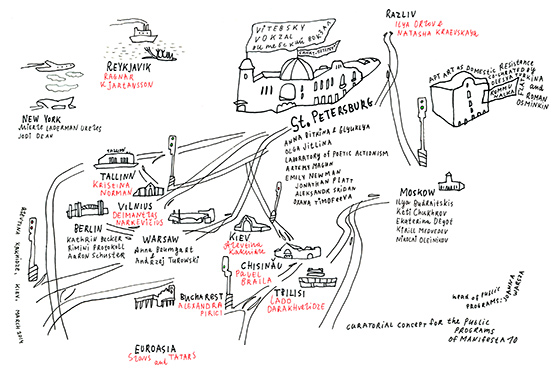 Curatorial map, Fig. Alevtins Kahidze
-Nevertheless, there was a statement by the curator of the “manifesto” of Kasper König, where he outlined his vision of this biennale and opposed what he called the “cheap provocation”, which gives “only a chance to make some political statements.”
- This was an unsuccessful expression in his first statement. Kasper has such a Pankovsky approach, and then he spoke like that. But after that, many artists turned to him, talked with him or wrote letters, and in the subsequent press release he changed his position. For example, the Georgian artist Ladovvelidze told König that he may not understand that he is now “Russian legislation” that changes every day, and that in Russia legality has turned into law management. And Casper König is very sensitive to the opinion of artists. It is interesting that he - following Harald Zeeman and Jan Hut, is one of the creators of curators as a profession , but at the same time the opinion of artists is more important for him than his own. But I would not want to explain the position of Casper, he does it much better.
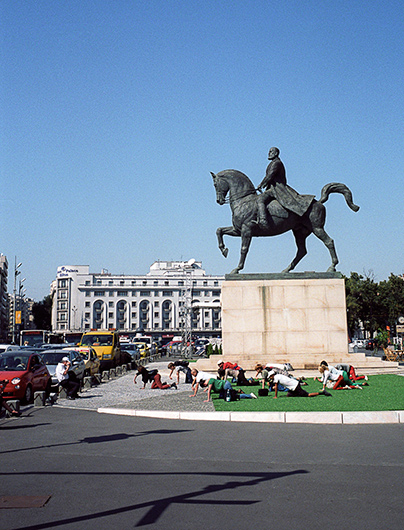 Alexandra Pirici, If You Donat Want Us, We Want You, 2011. Intervents in Public Space, Bucharest. Courtesy of the Artist
- However, you like it or not, his statements strongly affect your public program.
- Yes, of course, I act in a specific context: on the one hand, Kasper König, who creates the overall frame of the exhibition, the “vertical of power” of the Hermitage - on the other and, finally, the “manifesto” with its desire for large brands. This is definitely not friendly, not critical, not the left circle, where we could speak with the already “turned”. I knew where I was driving, but in addition, it seems to me necessary to take advantage of the enthusiastic opportunity to turn with my ideas to a wide audience, which does not necessarily consist of like -minded people. I said to myself: if I believe in the political role of art, then this is just the situation when it can be checked in practice. And yes: even if a chance is small - why not take a chance?
I am sure that Biennale should take place, but not as something serene, not as if nothing had happened.
-You oversaw the Ruzinsky pavilion at the 55th Venetian Biennale , which was called "Kamikadze-Lojia." It talked about the socioeconomic situation in Georgia and, in a sense, about the post -Soviet space as a whole. Now you invited artists from former socialist countries to St. Petersburg, and, apparently, you are interested in the same issues as in Venice?
- Yes, it is. Maybe only more political topics this time ... When I invited artists to take part in the public program, I asked myself the question: maybe “post -Soviet” is a kind of Christmas fairy tale? Suddenly this is only an outdated, expired concept? But now, after the capture of Crimea, the escalation of violence in eastern Ukraine and return to Soviet rhetoric, this concept has become extremely appropriate. Participant of the public program Kristina Norman - half Russian, half Estonka. For many years, she studied the Russian community in Estonia, and now she does the opposite - he is studying Estonians in Russia. Deimantas Narkyavicius is preparing a concert of the Cossack choir, which will perform “sad songs about the war” - Russian and Ukrainian. He turns to the very core of self -awareness of Cossack culture, and to its current simplified forms, symptomatic in a conservative turn in Russia. For Kievan, Alevtina Kahidze, art will become art in the conflict. My conviction that you need to continue to work on the program, is based on the fact that I believe in the power of these projects, by virtue of the positions that artists occupy.
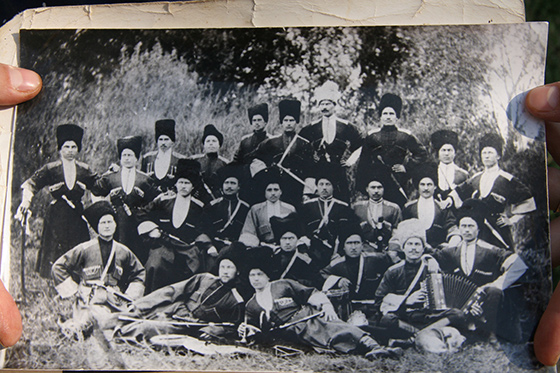 Deimantas Narkyavichus, sad songs about the war. Photo of the Cossack ensemble, the end of the XIX century
- As a curator who worked in different countries of the post -Soviet space, can you say that this region has something in common in cultural plan, or are we dealing with completely different contexts?
- Yes, and no. I think the region is one in skeptical and critical attitude towards Russia. And Poland first of all (John Warship was born in Poland. - Ed .). In fact, one of the reasons why I believe that now you need to be here is that I am a gas pressure that was subjected to my Polish colleagues who called for refusing to participate in the Manifesto. Moreover, I, of course, are critical of the Putin regime, but I think that the attitude of my colleagues gives out a kind of sense of superiority and the desire to show that, as the West Slavic people, we are definitely part of the West and look at Russia down. This is the reason why I want to work with Russian artists, curators and in general in Russia. As Christina Norman recently told me, in our own interests to maintain pluralism of opinions and critical dialogue. Russia will always be nearby.
I am for those projects that will understand the audience who are not versed in art.
As a group of artists and curators, we act as agents producing critical statements, being simultaneously from afar and from the environs. But, however, the situations are different. For example, the native language of the Ukrainian artist Alevtina Kahidze is Russian, it has grown in the east of Ukraine and belongs to Russian culture, but now, of course, it looks at it in a completely different way. I really respect her for a bold decision to continue to work on the project, despite the increased pressure on it. She is trying to use her biography and her position as a way to join in the Russian-Ukrainian dialogue, to explore the meaning and history of boycotts, to participate in the intra-Ukrainian debate-is it possible to do something adequate in the unsuitable conditions of the Hermitage?
- Within the framework of the public program, discussions with curators and artists will be held. About what?
- There are topics that we would like to discuss now. For example, participation or non -participation, as well as the meaning of such a political tool as a boycott. Are the calls to the boycott "Manifesto" give any institution or the Biennale is political in nature or not? We will conduct discussions monthly on this subject in a special hall in the building of the main headquarters. Boycotes were used differently in various situations-for example, during an apartheid in South Africa. What kind of boycott does it make sense like a critical gesture, and which is not? What is he leading to? We have no clear answers, but these questions themselves are closely related to how artists see their projects. The SLAVS and Tatars group will hold a seminar where it will discuss such a phenomenon as Soviet orientalism, which can be analyzed in the post -colonial perspective, through relations between Russia and the Republics of Central Asia, Muslim cultures, including Crimea as a place of orientalization and cultural exchange between the Slavic and Eastern worlds. And during discussions and in art projects, we want to raise questions related to today's realities, but we also want to be interesting. The language that we will use will be a cross between the extremely radical, extraordinary Russian art, on the one hand, and, on the other, that faith in the artistic “ivory tower”, which can also be detected in Russia. We want to find the middle ground - a complex and at the same time critical path between these two poles. One of the projects - artist Alexandra Pirich, who represented Romania in the last Venetian Biennale , is called Soft Power . Alexandra organizes several choreographic numbers, “sculptural interventions”, which will be tied to the most “sacred” monuments of St. Petersburg, such as a copper horseman, a monument to Catherine the Great, a monument to Lenin at the Finland Station. “Reading” each of these places, it adds a human dimension to them, fragility, attractiveness, domesticates them. These are the possibilities that gives a radical imagination. I believe, this is what is needed today in art.
 © Rustam Zagidullin Apartment art as home resistance. Curators Roman Osminkin and Oles Turkina
- And what can this public program give to the audience?
- I think it depends on the audience - what they can take. But I am for those projects that will understand the audience who are not versed in art. It is important for me that these projects involve the inclusion of the audience. Artists create some of their worlds, offer certain situations, but this is not a sealed discourse of the history of art. We would like to challenge the understanding of "high art" that was common in St. Petersburg. Every evening, local theaters and cinemas are filled with spectators, but there is no critical art. There is a kind of cultural life in the city, but this is for the most part dead, not a critical culture. I hope the public program "Manifesto" will be able to change the situation. I am also interested in the problem of missing protest. Obviously, this is the legacy of the Soviet past. I am interested in whether the art can become the tool that would politicize us, formed a certain collectivity - in a short -magnet, subversive and intellectual way.
- Will it look like Berlin two years ago?
- Rather, the opposite. During the 7th Berlin Biennale, everyone was afraid that art was not enough, but there was too much activism . Here the question is posed differently: too much art, but perhaps there is not enough activism. In addition, that Berlin Biennale was largely the artistic project of her curator Arthur Gmievsky .
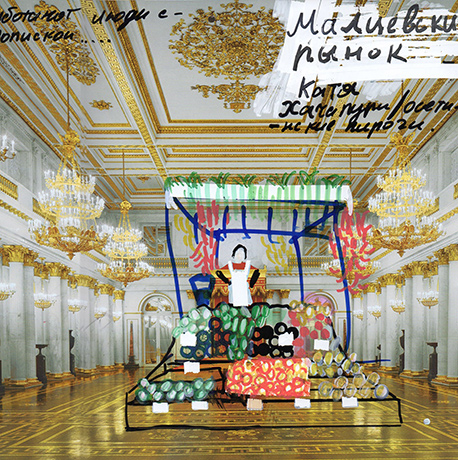 Lado Darajvelidze. Transformers of St. Petersburg, 2014. A project sketch for Manifesto 10, St. Petersburg. Courtesy of the Artist
“ But then you were also in the curatorial team of Biennale.”
-Yes, I was a souvenist, along with the Group "War" from St. Petersburg. But actually, Manifesta 10 and 7th Berlin Biennale has something in common. The question that was asked in Berlin is how art can respond to political events is unexpectedly became the main thing for today's public program. True, Arthur Zhmievsky is now one of those who tells me not to participate in the “Manifesto”, to which I answer him: listen, I will participate, because I think that the time has come to answer the same questions that we asked in Berlin, with only one difference-Berlin was a safe place, and now everything is real.