
Translated material
Spain: The change of monarchs
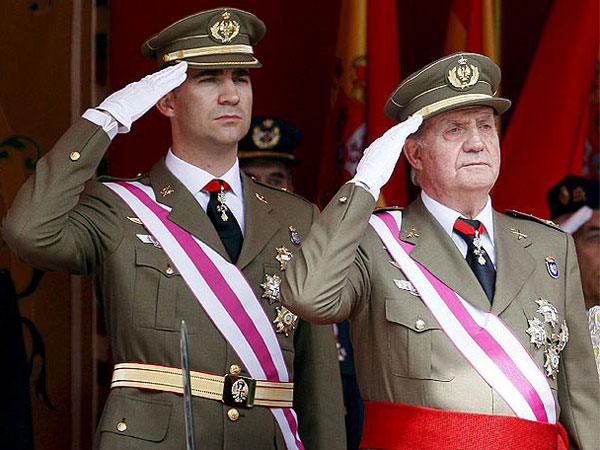
The new King of Spain Felipe, the son of the Juan Carlos I, who renounced the throne, will be officially oath on Thursday. He will have the name Philip VI.
From the moment Juan Carlos I announced on June 2, the intention to renounce the throne in favor of his son and heir Felipe, the Western press in great details discusses the Spanish monarchy, the attitude of Spanish citizens, generally modern European monarchies and recent precedents of renunciations, the prospects for preserving this institution and royal privileges in the conditions of the current context.
Now in Europe 12 monarchies: Andorra, Belgium, Vatican, Great Britain, Denmark, Spain, Liechtenstein, Luxembourg, Monaco, Netherlands, Norway and Sweden. Last year, from the throne with the same motivation as in the case of Huan Carlos I - to give way to a younger and more likely to the progressive heir - two European monarchs renounced: the Dutch Queen Beatrix and the Belgian king Albert II. The British newspaper The Tele Graph also recalls the abdication of Benedict XVI on this occasion in February 2013. The situation in the case of Belgium and the Netherlands, comments on the American newspaper Washington Post , differed from the current one in that the change of monarch did not cause the relevant countries of such a massive rise in republican sentiments, as in Spain. In Belgium and in the Netherlands, it was "nothing more than ceremonial formality."
Juan Carlos I distinguishes from most European monarchs the moment that he at one time was a really significant political figure. “Being a descendant of the Bourbons associated with the centuries of the imperial tradition, he contributed to the transition of Spain from the dark era of the Franco dictatorship to democracy. Unlike his other relatives who collaborated with security forces and huns, he did not resist the changes and opposed the military coup in 1981. ” “There is no doubt that King Juan Carlos played a key role in the transition of Spain to democracy and later remained a respected figure who could speak on behalf of his citizens abroad and, if necessary, at critical moments to be an impartial mediator in a political polemic in his homeland,” another American newspaperNy Times adds to this.
Nevertheless, Raphael continues Minder ), NY correspondent Times in Madrid, his renunciation immediately caused the Spaniards a lively interest in the question of whether they needed a monarchy at all. According to the Minder, separated and many other authors, two factors contributed to this. Firstly, the fact that the country is in a state of economic crisis, and property inequality grows in it; Secondly, the recent financial scandals in connection with the frauds of Inyaki Urdangarina, the wife of the Infanta Christina, who undermined the reputation of the royal family and looked especially outrageous against the background of the general situation in the country. The Telegraph on this occasion emphasizes that, unlike Juan Carlos, Felipe was not discussed in connection with corruption scandals.
The image of Felip in the press is formed mainly in comparison with the figure of Juan Carlos. Unlike the latter, more restrained and less talkative (rather in the Anglo -Saxon spirit - Telegraph ), but at the same time, again, he can speak with speeches. What is more important, from the point of view of the future fate of the Spanish monarchy, when he entered the throne, he will have significantly less power than his father, whose powers were reduced gradually.
The Telegraph , in this regard, gives the results of the survey conducted by the Left newspaper En Pais after Juan Carlos announced his plans. According to this survey, the majority (62%) of Spanish citizens are convinced that it is necessary to hold a referendum, following which the question of whether Spain will remain the monarchy. In the case of a referendum, according to the same survey, 49% of citizens agree to leave the monarchy, led by King Filip, and 36% will be awarded to become a republic. However, in fact, there should not be a referendum in the foreseeable future: Prime Minister Mariano Rahoy referred to the fact that the abolition of the monarchy through a referendum requires preliminary amendments to the Constitution.
Minder also quotes several Spanish analysts who express their interpretations of what is happening. Thus, the conservative political commentator Jose Antonio Zarzalejos expressed the opinion that the renunciation of Juan Carlos and the coronation of Felipa is the right way to smooth out the antimonarchist rise in the country: “The republican movement would just win if King Juan Carlos insisted on his stay on the throne, but now we say About the new king, who will have his own completely new strategy that meets the problems of our time. ” The editor-in-chief of the newspaper El Mundo Jorge de Esteban, in turn, noted that "to renounce the throne would be wiser three or four years ago, when the scandal did not tarnish the Spanish crown because of Urdangarin."
The reaction to scandals by the royal family was the introduction of more transparent expenses. Although data on the value of assets, as well as on household expenses, as in the case of the budget of the British royal family, which publishes reports in large details, still remain closed. According to Brussels analyst Herman Matthijs, the change of monarch is a good reason for modernizing and detailing the reporting system, as well as the regulation of expenses on the model of monarchies in the Scandinavian countries and the Netherlands.
Meanwhile, The Telegraph notes that in Britain, after the abdication of Juan Carlos, former deputy prime minister John Preskott, referring to precedents in the person of Pope Benedict XVI and already three European monarchs, called on 88-year-old Queen Elizabeth to follow Prince Charles. And she herself would remain in the status of the "Honored Queen."
The Economist notes the emotional upsurge in the Spanish media, the accompanying monarch’s change, where this event was characterized as “the advance of the new era” and “the second transition” (after the first from the dictatorship to democracy). The author notes that this is partly perceived symbolically: in the country that has bogged down in corruption and unemployment, changes are possible.
Juan Carlos himself, who in his public speech expressed regret that he had lost popularity among citizens due to recent scandals, “fell victim to his own success. When Francisco Franco gave him the throne and appointed him his heir, his goal was to restore democracy and restore the monarchy, overthrown 44 years earlier. What is characteristic, he achieved both of them. ” At first, this resulted in a compromise: the king refuses most of his powers in favor of democratic management, and for this no one bothers him within the privileges that he had left.
However, as Spanish democracy strengthened, this deal gradually lost convincing. Hence, this contrast between traditional and previously accepted as due to opacity and new civil expectations. Actually, the problem was that Juan Carlos ignored these changes for the most part. An eloquent example is his trip to Botswana to hunt elephants in 2012, at the moment when Spain was exhausted by economic problems.
“The renunciation means,” the author sums up, “that the Spaniards will probably forget the scandals and remember the contribution that Juan Carlos made to the history of their country. They can also feel some economic rise. At an organized publication of The Economist, the meeting in Madrid, Prime Minister Mariano Rahai all the time returned to the topic of record pace of unemployment in May. Luis de Gindos, Minister of Finance, announced that loans were less, because demand and lending within the country began to grow faster than expected. However, the unemployment rate is still 25%; Years will pass before the country reaches a state close to the pre -crisis. Luis Garikano from the London School of Economics says that the recent surge of imports can push Spain back to the deficit, because of which it had previously become so vulnerable. Among the political problems that the future king is faced with, we can name the rise of anti -capitalist and antimonarchic left movements, as well as Catalan separatism. All this can also hit the country's economy. Thus, the wind of change may not be the most favorable. ”