
Translated material
"There was an opera where I had to freeze even more"
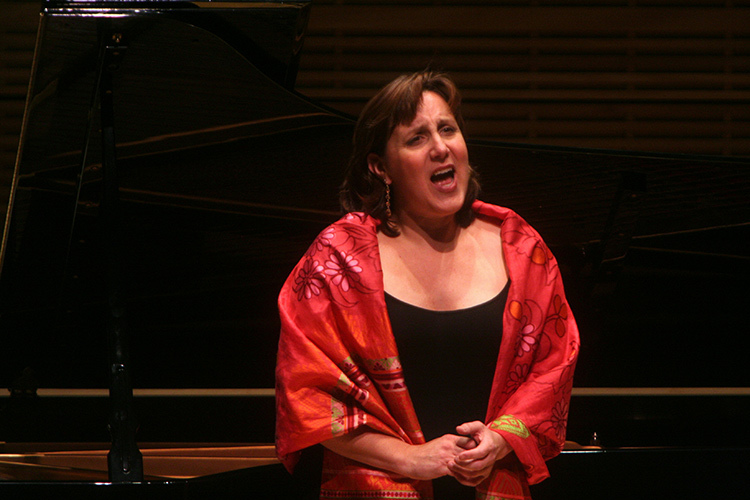
For the first time in Russia, an outstanding American singer Don Apshou performed in Russia; Accompanied by the symphony orchestra of the Bard-College Conservatory (New York, USA) under the control of Leon Bottstayna, she performed the vocal cycle of Vitold Lutoslavsky “ Chantefleurs et Chantefables” (“Chants and Songs”). The repertoire of Don Apris has practically no boundaries - from Baroque to the music of our days. Henrik Guretsky (1992), sold by more than a million circulation; Before that, her records were twice awarded the Grammy Awards and then three more times. For the first time, the apshou performed several dozen works, among which Kayi Sarariajo, one of the best operas of our time, occupies a special place.
-It is a little strange that your Russian debut is accompanied not by any team with a name, but by a student orchestra.
- It doesn't seem strange to me. I began to tour less and I am very happy with this. Moscow is one of the places where I have not yet been, and it is not so important to me, with the name orchestra. The main thing is to make music with wonderful young musicians. I know them well, albeit not everyone by name, since I am engaged in chamber music with many: in the conservatory of the Bard College, I head the two-year vocal course, and Leon Botstin invited me to take part in this tour and sing with the orchestra. I proposed the Lutoslavsky cycle, I love it very much. There are not so many who know him ... And Leon has already built a program as a whole, adding the fifteenth symphony of Shostakovich.
- You didn't have to sing Shostakovich?
- Quite a little. I sang twice - very long ago - romances with a piano trio ... Yes, "seven poems of Blok." And more, perhaps, nothing. I love to sing the "children's" Mussorgsky, one of my favorite cycles. I did not sing “Songs and Dance of Death”, but I love it very much. She sang Rachmaninova , although not too much. Tchaikovsky never sang. I would really like to sing Shostakovich.
- In your repertoire there is another composer from Russia: Vernon Duke - the pseudonym of Vladimir Dukelsky, who wrote light music under one name and under the other - academic, for which he was reproached with Sergey Prokofiev, with whom they were friends. How did you come to him?
- Dukelsky - two -faced Janus! In America, he wrote amazing melodies, organically joining the American tradition and enriching it with wonderful songs, often very original. Suddenly for the Russian composer, you must agree. He worked perfectly with English, which was not his family for him. How did I come to him? Producer Tommy Krasker - with him we worked on other projects - invited me to think about Vernon Duke. "About whom?" I asked. “Well,” says Tommy, ““ Autumn in New York ”,“ April in Paris ”is all he.” Of course, I knew these songs, not knowing who their author was. So we decided to record them. I think Prokofiev was not quite fair to him ... I sang only “five poems of Akhmatova” at Prokofiev, I admit, I don’t know this repertoire very well.
- We know you as a specialist in modern music, although it is clear that you were not born with the name of Kaya Saariaho on the lips ...
- (Laughs.) Yes, I did not grow in the classics at all, especially not on modern. But in college I met a teacher who believed that it was not only necessary to perform the music of our time, but completely natural. And until I came to New York to complete my education, it never occurred to me that not everyone liked new music; For some reason, it seemed that all academic musicians seek to fulfill the works of contemporaries, as it were for centuries. It’s so exciting-to plunge into the music of your time, communicate with composers, to imbue fresh ideas, try to express anything about the world where we live!
- You have come to sing a lot of new operas, including Kaya Sarariho, the Great Gatsby, John Harbison and others. Do they have a chance to become repertoire?
- It's hard to say when little time has passed and you are inside the process. But “Love from afar” has already withstood several productions, although I don’t know if it has been put in recent years. In America, the Osvaldo Golikhov “Ainadamar” (“Tint Fountain”) was also put a lot, I was even surprised.
- I was gnawing curiosity: was it difficult to sing in the final of “love from afar”, lying in the water?
- ABOUT! (Laughs.) It was cold. In some cities where the production was going on, especially. Worst of all-in Santa Fa, an evening performance in the open air. The evening was very cool, and I, as soon as I touched the water, caught my breath - but I had to immediately sing on! However, the visual effect was so strong that I did not mind Peter Sellars. I don’t know if it was really so necessary, but a very beautiful production. After watching the video, I agreed that the appearance of the heroine in the water makes a strong impression. There was an opera where I had to freeze even more - “Saint Francis of the Assisian” Messian; She was also staged in Salzburg. She walked on the stage of a riding school, and I sang barefoot on the stone floor! Even worse than in the water.
- Please tell us more about working with Peter Sellar.
-I heard, he put something in Russia, somewhere in Siberia, is that true?
- Yes, he put the "Queen of the Indians" of Persella in Perm.
- That's right, one of my students participated there. There is another new ensemble that they talk a lot about ... Peter played a very important role in my life, his production taught me a lot in part and music and playing on stage are the highest points of my work. Our first production was “St. Francis” with the premiere in Salzburg - Messian died a few months before the start of rehearsals. We have never met, to my great regret; I like to sing his works and I want to expand their circle. The next work with Peter was the “theodore” of Handel, then - the “adventures of the hang” Stravinsky and “Fragments from Kafka” by Kurtag. Kurtag is the best in my memory what Peter did, I really hope that the production will be released on the video. Peter built this thing designed for concert performance as a series of vignettok - episodes from the life of a housewife. They are all very short, they are separated by small pauses; At the beginning of each on the screen, a translation of the text is given and then - a certain visual image illustrating the text. It was very beautiful! Peter also put Golikhov’s “Ainadamar” for me, Kantata No. 199 Bach and recently - one of George Kram's vocal cycles “Winds of Fate”, based on the songs of the Civil War.
- Have you ever met Kurtag? He is known for a particularly strict attitude to the performers, tries to attend rehearsals and control the entire process. And even immediately after the concert it can criticize without any condescension.
- Oh yes, I have heard! (Laughs.) However, we did not meet. I am completely not sure that he would like our performance. Perhaps he would criticize us, for someone it can be an Oblom, for someone, on the contrary, an incentive. It is also difficult for composers, I worked with many, it often seems to them that the performer does everything wrong.
- Meetings with which of them are most important for you?
- It is difficult to single out - they are all so different ... For example, I worked with a composer named Earl Kim, he is no longer in the world. Incredibly meticulous, you can’t imagine! He did not indicate in the notes of many details, which he nevertheless demanded fidelity. It was not easy for us to understand each other. And there are composers who give enough freedom and understand that each performance will differ from another: Oswaldo Golikhov, John Adams. Say, when Adams worked on the Opera-Oratorio El Niño , dedicated to Christmas, he sent me fragments before the score. I replied that not all of this would be easy to sing, and he remade without objection. Kaya Saariaho usually almost did not make comments. Yes, she is serious about her work, but she is not a dictator. Esa-Pekka Salonen It is also very open to various interpretations of his works, without these unnecessary severity. I love him, he is a very sunny person, with an excellent sense of humor. In general, it is not surprising that in Finland there are so many excellent composers: in the countries of Scandinavia a magnificent education in all areas of arts. With the level of musical education in my country and there is nothing to compare. I could only dream of that we support the music so much.
- What are the most expensive of the executed prime ministers?
- The composition of John Harbison “Simple Daylight” to Michael Frida. There we are talking about parting from the point of view of the one who decided to leave - and not from the point of view of the abandoned, as it happens more often. I think this is one of John's best works - for voice and piano. Another composer is Maria Schneider, we only work together recently. She has little in common with the academic tradition, she is from the world of jazz.
- You received Grammy for the recording of her composition “Winter Morning Walks” .
- Yes, right. You have completed your homework well. It's nice. The music is very unusual for me, but it is also very close to me - it reminds the music on which I grew up. To record this essay, Maria invited real jazz musicians. Grammy was a surprise ... very joyful. We performed this composition in several rounds, and I really liked it - not that I usually sing, but I am happy to sing and this, making my world richer.
- You also have Charles Ives in your repertoire. He has excellent songs, but they sound quite traditionally, little to say, what a nugget was Aves ...
- Do Iveza know in Russia? Do you like him? I'm so happy to hear it! He has many songs, more than a hundred. Among them are quite simple, but there are completely outstanding ones, such as “Tom Sails Away” , quite complex and rich. It is very touched by what you called him - he has so many songs from which I sang only a dozen two. And I certainly want to sing more. I was very lucky - my constant pianist Gilbert Kalish brilliantly performs Ives. Have you heard his record "Concord"? This is stunning!
- Your discography is growing - more than 30 names. How does it make sense to release new discs today, when they are buying less and less?
- It seems to me that the work of musicians should be rewarded: almost everything can be downloaded for free, and this is sad. For ten years now, I have not think in such categories as “releasing a new disk”. When you have a contract with a label and you have to produce a certain number of records, other superstars publish three, four, five discs a year, but I am not interested. Fortunately, this business is not too interested in me. Usually for me a record is already the result of work on the composition that I do for some time, the opportunity to fix a successful performance when it has matured.
- What premieres will come to you in the near future?
- The new composition of Donnahi Dennehi is the second that he wrote to me. The first one, “Night Come” , I recorded a few years ago - it was a cycle of songs, now it will be an essay for a voice with an orchestra, the premiere will be held in October (I also sang the premiere of the original version of the essay, which can be heard here . - I.O. ). It is called "hunger" and dedicated to the great hunger in Ireland 1845-1849. - A story on behalf of an American woman who helped starving. I will soon be 54, and the voices may be enough for six more years. Not so much. I can imagine what I will do in the next two years, there are four more left: there is time to think about what and with whom else I would like to do. However, with the Australian Chamber Orchestra, I am ready to sing almost anything. This is one of the best orchestras on the planet, they play like a good string quartet. Musicians are collected from all over the world - the best. There, everyone gives the whole soul to the game, and how they listen to you, how they fulfill all your desires! I definitely want to learn and sing a large “Harawi” cycle Messian for voice and piano.
- What awaits you after a concert in Moscow?
- Two festivals - in Banf and in Tanglwood. I will sing and teach on both. Then, for several months, I have many solo concerts with my permanent pianist Gilbert Kalish and several chamber programs. Sometimes I sing with the orchestra, I haven’t appeared on the opera stage for some time, it’s hard to interest me now - too much should coincide: the director, conductor, casting, production. I have already spent so much time on it that I no longer want to, and I am happy with what I am doing. I began to engage in the opera less when the children began to grow up. While they were small, I took them with me, but later it became more difficult, and I did not want to be too long. Now they are already adults - they are 24 and 20 years old, respectively.
- In your biography it is said that in your childhood, Bob Dylan, Joan Baes and so on, often played in your house. Did she affect you, are you listening to her now?
- Not only this music influenced me, but also the fact that my parents were involved in civil activity, the struggle for human rights, participated in rallies and processions. I grew up in this, and the music was an important part of what was happening, it seemed that it could change the world. In this sense, its strength is higher than that of classical music, although this is my profession. The texts were an integral part of the music - Bob Dylan and especially Joni Mitchell. She is a wonderful poet, from time to time I still listen to her songs. Bob Dylan, too, is in the mood, sometimes he sounds still topically.
- The topic of the struggle for human rights is now very relevant in Russia.
- Unfortunately, I know not so much about this and I am sure that from the news of the whole truth you can’t learn. I was afraid of whether the bard college orchestra had problems with the trip here, with receiving visas, but they were not there. And you better tell me about the situation in Russia.