
Translated material
Ed Handley from Plaid: "This is not a balalaika"
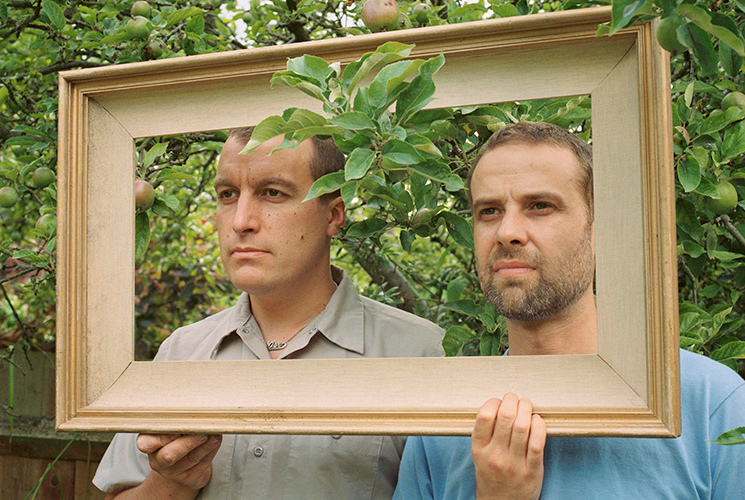
On June 20, the Moscow Club of Strelka will host the next party of Selector Live Beefeater Sessions , where British musicians will perform Plaid , King Midas Sound and ElePhant. In the mighty pile of musicians of the famous English label Warp , 25 years ago to stunned the world with new electronics, the Plaid duet stood out with its melody. The music of Plaid , who had recently released the 10th album, bewitched with her crystal chime, as if the duet played at the magic harp of elves, and not at all on bulky synthesizers and computers. As it turned out in an interview with one of the duo participants Ed Handley, modern musical technologies have reached what the elves never dreamed of, Plaid can now extract silver ringing of stones and chairs.
- How do you make music together? Divide who to write a batch of drums, and to whom-a melody, or somehow differently?
- Exactly not like an ordinary group. We begin to write tracks separately - each in its corner. Then we meet while working on the production, and then joint creativity begins - we discuss the existing blanks, exchange ideas. We have no division into role. Both of us like to do everything - BIT, and BAS, and a melody. Actually, this, in my opinion, is the beauty of electronic music: its author has endless possibilities.
Plaid - "Matin Lunaire"
- Work on production takes place in the studio or are you working on the network?
“It is better to work face to face and shoulder to shoulder - you better understand what your partner wants, what he thinks and feels. It happens that we are making production on the network - now there are several opportunities to work on online projects. For example, in the Logic program that we use, there is the opportunity to work in real time via the Internet. Honestly, this is a rather strange experience: you don’t see what your partner is doing, but you see only the result. Discussion is still present. Therefore, we prefer to meet in our London studio - and we do it quite often.
-Just released the new album “Reachy Prints” , the 10th in a row. Did you assume when you released the first Plaid plate, what would you reach the tenth?
- No, definitely not. When we started making music, we did not treat this as a career and did not assume that Plaid was for a long time. We both had daytime work - I programmed the databases, and Andy was engaged in import and export. We made music simply because we liked it. They wrote in the evenings-it was something like a friendly pastime. Much later, we began to treat this as a profession. And you know, we believe that we are damn lucky, because writing music for our pleasure is one thing, but to promote it and selling it is incredibly difficult. It was always hard.
Using computer programs, you can do such things that no synthesizer, analog or digital synthesizer are capable of.
- And what has changed? What, in your opinion, is the difference between being a musician now and 25 years ago-you can compare?
- If we talk about technology, then computers and electronic sound are now used everywhere. Even classical music is now recorded only using a computer. That is, the techniques and techniques that we once used one of the first became the mainstream. There was a transition from analog technology to digital - and a whole studio fits into a laptop or even iPad . Now, in order to start making music, nothing is required except desire. 25 years ago, investments were needed to buy equipment - albeit not very large, but tangible. And most importantly - it was necessary to have a place where to store all this equipment. It was necessary to start a studio. On our days, music can be made during the trip - literally on the go.
And the most important changes, of course, relate to the models of the distribution and sale of music. There used to be a large number of labels that produced 12-inch plates with a circulation of 500 to 1000 pieces. They diverged, and their sales allowed musicians and labels to feel economically self -sufficient. Now the era of streaming and services like Spotify has come, they pay musicians and labels much less, it is becoming increasingly difficult to survive. The environment has changed a lot, but, fortunately, the musicians and labels managed to adapt to new conditions.
Plaid - "35 Summers"
- By the way, about technology. Two groups of electronic musicians can be distinguished: some are fanatics of all the most new, mastering the latest programs, equipment and interfaces, while others prefer analog synthesizers and an analog approach. Which group does Plaid belong to?
- To both or not one. We do not chase the latest technological innovations, although we follow what is happening, and constantly learn to work in a new way. At the same time, we do not experience any nostalgia for analog synthesizers, since we have extensive experience working with them in the late 1980s and 1990s. We are very well aware of the wealth of software opportunities. Using computer programs, you can do such things that no synthesizer, analog or digital synthesizer are capable of. Especially over the past 10 years, the capabilities of the PO have grown incredibly - in proportion to an increase in computing power of computers.
The ideal situation, perhaps, is when you are skillfully controlled with capricious analog devices and at the same time use all the power of the programs. I understand that it attracts people to an analogy sound: it really has some kind of warmth-well, and a nostalgic effect, which, oddly enough, has a greater impact on young musicians. We love old equipment and new programs, but we use the latter more. We made our choice in favor of Sofwhwar and gradually got rid of a large number of devices purchased from the beginning of the 1980s.
Oh, this is always the most difficult to describe your own sound.
- What programs do you use besides Logic ?
-We work in the Max/MSP software environment, use Max for Live -this is a kind of visual programming language for music. We use National Instruments Reaktor a lot - this is a virtual studio of modular synthesis. Recently, Reaktor has released several cool synthesizers - for example, Razor . He has a very interesting new sound - it seems to me that this is a new word in additive synthesis. In a word, we try to try all the innovations that we can afford. Such close tracking the development of software tools also has the reverse side - a huge number of plugins that you rarely use are accumulating. So we try to limit ourselves and limit.
- Plaid has a very recognizable sound that you can’t confuse with anyone - how would you describe it?
- Oh, this is always the most difficult to describe your own sound. I would say that, unlike many electronic musicians, we are always gravitors to traditional harmony and melodic moves. One of our tracks contains the same sequence of chords as Hotel California - just imagine. This is not on purpose, I myself was surprised when I found out about it. We also have inexplicable sympathy for the ringing of bells and bells.
- Yes, and to the sound of the harp.
- Exactly. I myself do not understand where it comes from.
- By the way, in the final of the first track from your last album, “OH” , the instrument that reminded me of the balalaika is terribly. What is this? Do you even know how the balalaika sounds?
- Of course I know. This is not a balalaika. This is played by our good friend, guitarist Benny Walsh. But, by the way, I think that Balalaika and Mandolin are not very distant relatives, so you were almost not mistaken.
Plaid - "OH"
“Could Plaid release an album with a sound that no one expects from them,” for example, suddenly play trap or diploma house?
- We often talk with Andy that we are, in a sense, hostages of our own style. Of course, we could easily write down the album of something sharply, such: “Bams, well, now we love this,” but it would be dishonest. Nevertheless, Plaid music, although easily recognizable, but not the same - we changed over time, added new elements to the music. It is always interesting to try something new, we did it-we added strings, performed with Gamlan, tried new tools, changed the approach to live performances. Sometimes we do not release our own experiments on the records. But the search does not stop.
Joint performance Plaid and South Bank Gamelan Orchestra
- How is Plaid now standing alive - will you play in Mandolin?
“Benny will come to Moscow with us, but will play the electric guitar.” We will also have two computers with Ableton and a bunch of different controllers. We also use a new device called Mogees - it can be placed on any object and used as a musical instrument. A very simple idea is a contact microphone that reads vibration coming from any object, then analyzes it and turns it into sound as a simple synthesizer. Connects to the iPhone . The thing is that you can turn any object into a musical instrument - say, a chair or a house. During a tour, we experiment with him - we attach it to completely different subjects. We listen to how a stone or metal sounds. Very interesting.
Plaid + Mogees
- Clash Andy said that your new album “Reachy Prints” is “Fighting Music” ( Fighting Music ) . What did he mean?
- I am not sure, of course, maybe he meant that there is a lot of energy in this music. That it has a fighting spirit. That it is incentive: they say, do not give up, life is a struggle, continue to fight, develop, strive for something. In short, this is the music of the struggle in a philosophical sense, and not the soundtrack for hostilities.
- I guessed that it was a metaphor. But further in an interview, he mentioned that in the early years, electronic musicians, including Plaid , had many real skirmishes ... with landlords.
- (Laughs.) These skirmishes are still ongoing. The musicians have unstable income: in one month you can pay for the apartment, and in the other - no. So we fight for survival. But I don’t remember any concrete fight.
-A few years ago, the news went that the entire Warp Back Catalog burned during a fire. Plaid suffered from this incident?
-Yes, some children burned the warehouse of a distribution company in North London-there were records of not only WARP , but also other labels. The financial WARP was not very injured - the company was insured from fires. The dead albums later reprinted-the masters were preserved. But the records are sorry - as far as I know, there were valuable. Including ours.
Plaid - " Dead Sea "
- Are you collecting vinyl?
- Yes, and I, and Andy. Of course, we buy most of the music in digital form online. But if you can take vinyl somewhere, we are for vinyl. Andy still plays with records-during the Plaid DJs, we use both plates and a number. Our active gathering time was in the 1990s, so the most part in my collection vinyl from this time.
- What is the greatest value in your collection?
- WARP album tests, of course, are especially early. We have a lot of them. They are now highly appreciated, but I think that we cannot part with them: after all, they are part of our history.