
Translated material
The President of the Czech Republic "does not see the reasons" to impose economic sanctions and isolation of Russia from the EU
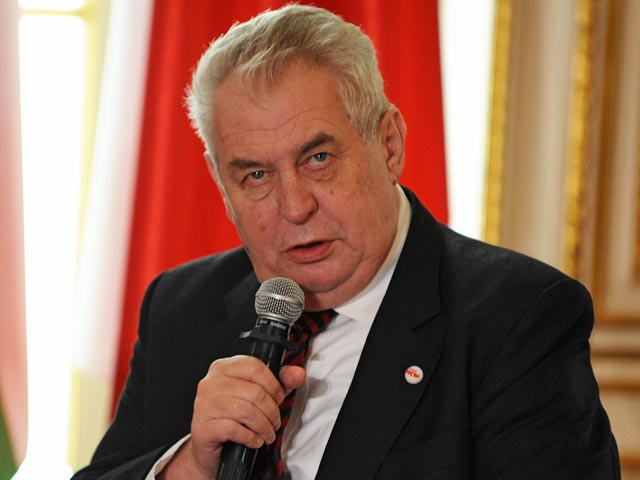
Czech President Milos Zeman opposed the imposition of sanctions against Russia. According to the Czech leader, there is no reason for the isolation of the Russian Federation, the head of the Czech Republic said in an exclusive interview to the First Deputy General Director of ITAR-TASS Mikhail Gusman.
"I see no reason why it is necessary to isolate the Russian Federation from the European Union, why talk about sanctions, about the blockade, about the embargo," Zeman said.
He noted that "the isolation in no case still led us to luck, but led only to the fact that there was no mutual understanding, there was no complementarity, and this is bad." According to Zeman, there is a chance to increase the level of cooperation between countries and not talk about sanctions.
He also urged to cancel entry visas to the Czech Republic for Russians: "It is necessary to eliminate visas, for example, with Russia. Why engage in such a bureaucracy that is associated with visas?"
Previously, Zeman already spoke out against economic sanctions against Russia, believing that the NATO forces of an preventive action of intimidation will be more useful in order to force Moscow to abandon military intervention in the situation in Ukraine. In case of further expansion of the expansion of the Russian Federation to the east of Ukraine, he, in particular, proposed to the Alliance to place troops in the territory of this country. At the same time, Zeman called on the European Union to come to terms with the loss of Ukraine Crimea, which became Russian.
At the same time, the Czech Republic itself previously opposed the placement of NATO contingent in the country. According to the Minister of Defense of the Czech Republic Martin Stropnitsky, the Czechs negatively relate to the presence of any foreign troops in the country, ITAR-TASS reports.
Zeman’s position is relatively inadmissible to imposing economic sanctions against Russia by the Prime Minister of the Czech Republic Boguslav Sobotka. According to him, breaking all commercial ties with Russia due to the Ukrainian crisis, "it would be very unreasonable," reports Prague Telegraph .
The publication notes that the arguments of the head of the Czech government are easy to understand: according to statistics over the past year, Czech firms took out products in Russia in the amount of 116 billion Croats (more than 4 billion euros). Moreover, over the past ten years, the export of Czech companies to Russia has increased by 10 times, and the Russian Federation has become the largest foreign trade partner of the Czech Republic outside the European Union. And for Czech companies such as Skoda, Alta, PPF Group, etc., the Russian market is one of the key and most promising in the world.
In the spring of 2014, sanctions against Russia were imposed by the United States and a number of European Union countries. The West accused Russia of destabilizing the situation in Ukraine, despite the repeated assurances of the highest Russian persons about its non -involvement in the events in Ukraine, as well as ignoring the fact of the withdrawal of Russian troops from borders with Ukraine.
On June 19, the Australian Foreign Ministry announced the introduction of sanctions against 50 Russians and 11 companies. In particular, Russian Deputy Prime Minister Dmitry Rogozin, chairman of the Federation Council Valentina Matvienko and State Duma Speaker Sergei Naryshkin fell into the list. This decision was made by the Australian authorities also in connection with the situation in Ukraine.
On June 27, in Brussels, the possibility of introducing the EU economic measures in the framework of the “third phase” of sanctions against Russia will be discussed. At the same time, the day before it was reported that, judging by the draft decision of the EU Foreign Council, it will not again affect the energy sector of the Russian economy. Despite the pressure of the United States, the EU believes that energy is not the best object of EU economic sanctions against Russia. “We buy Russian gas in the European Union, not the United States,” Gunter Ettinger, the European Energy Commissioner, said on the eve. In this regard, he noted that the EU is ready to "consult with the United States, listen to their recommendations," but they will make decisions on their own. “Gas and oil are at the very end of the list of possible sanctions and will probably not be among the nearest ones,” Ettinger assured (Quote for Interfax ).