
Translated material
In the mouth of Aida
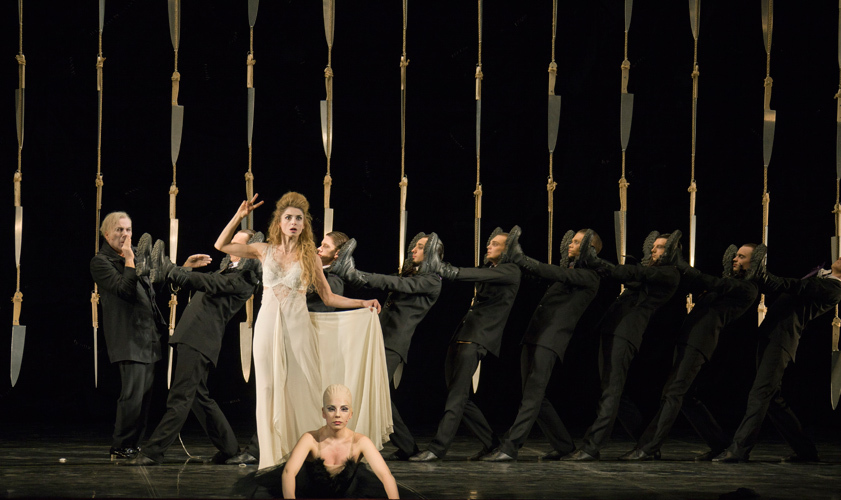
At the Perm Opera and Ballet Theater, under the direction of his chief Theodore Krentzis, one of the main events of the entire Russian season took place - the world premiere of the opera Nosferatu. This is a multidimensional theater installation, the creation of which, in addition to the Moscow composer Dmitry Kurlandsky, was a completely incredible team. The main star in it was the famous Greek-Italian artist Yannis Kunellis, one of the leaders of Arte Povera . The director is the master of the Greek Theater Theododoros Terzopoulos. Among the participants are Alla Demidova and the queen of "extreme vocals" Natalya Pshenichnikova. The “ordinary” opera singers in this opera are not provided, but the orchestra sitting in the pit and the choir located on the sides of the stall, as well as the artists of the Perm ballet troupe, participate.
Insisting on the musical uniqueness of what happened, Colta . Ru I collected comments of experts who came to the premiere, asking for two questions: 1) how radical the musical language is “Nosferatu”; 2) Is it an opera? Read the answers after the article by Nikita Safonov.
Text-collage
The Libretto Dimitris Yalamas in the Latin and Russian languages is a formal interpretation of the ancient Greek myth about the abduction of Persephone Aidom, which appears in an image borrowed from the mass industry and, at the same time, from a collective unconscious fear. This is Nosferatu (a vampire, a creature that transfers diseases, according to the Eastern European peoples) performed by actor Tasos Dimas.
The text is glued from fragments, scraps and linguistic finds, borrowed from the surrounding reality. These linguistic objects distributed between the performers create a complex sign system full of connotations, and build semantic production lines. Corthia (Alla Demidova) reads something resembling excerpts from the apocalypse. Three grains (in one person - Natalia Pshenichnikova), elements of the chemical composition of the blood are listed. The mirror of the three Gray (Elenenia-Lidia Istanell) pulls out of the book lists of medicinal and poisonous herbs. Persephone (Sofia Hill) pronounces traditional recipes from anemia, while she is consistently deprived of all feelings before the wedding underground. The choir voices the names of the imaginary locations of the underground kingdom, deadly diseases, as well as frankly vulgar ditties translated into Latin. All this creates a dense fabric, a kind of detailed map of the death space.
 © Alexey Gushchin
Coffins, knives, books and static procession
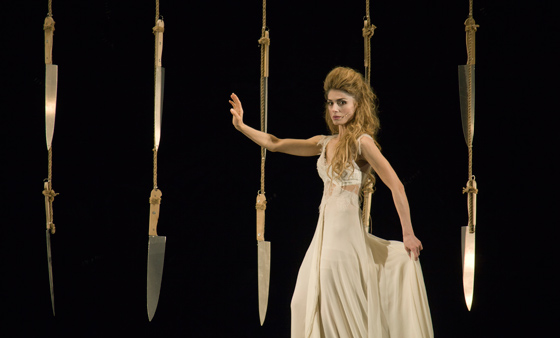
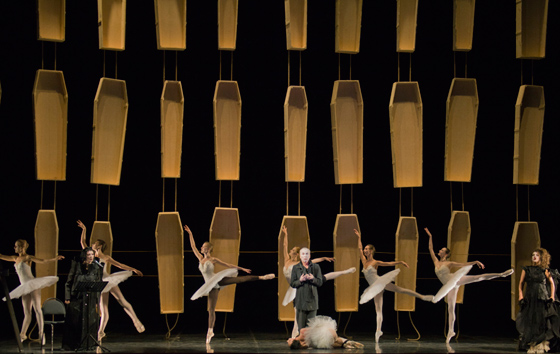
Kunellis’s decision is minimalist, but at the same time massive: these are three curtains, alternately cutting the stage space, and the cave set in the depths of the scene with a height of its entire opening, sewn from elements of clothing. The curtains represent the installation hung face to the hall: from a huge number of coffins, then - knives and then - books. In a personal conversation, one of the founders of Arte Povera insisted that this was not a scenography. This is an attempt to create, through the simplest specific objects, also borrowed from everyday life, stage plans, a kind of vertical projections, an exhibition of actions.
The knives that open the body, letting the rivers of blood, books fixing the movement of history become static screens that are ready to speak. The devastated human bodies, revealed in countless costumes, folding in the depths of the scene of the AID set, is the mass of the Kingdom of the Dead, looking at living spectators in the hall.
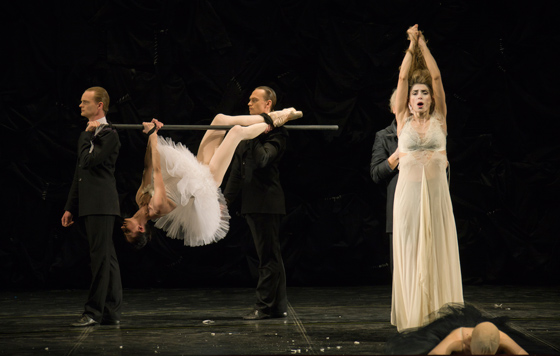
The main characters, whom the Terzopoulos leaves almost without movement before the curtains of Kunellis, resemble the classic characters of the ancient tragedy - these are sculptures, stone heroes. Against their background, long, repeated ritual processions from fictional half -people pass. Bestiaria from distorted human forms (and at the same time defile of the fashionable Greek designer Lucia) moves, emphasizing the rituals - deprivation of the Persephones of all feelings and its wedding in Aida.
The birth of sound from the silence of speech
The score of the opera is an experimental study of the capabilities of the respiratory apparatus and at the same time - its testing for strength. There is a birth of musical speech from total silence. The acoustic field is woven from sighs, wheezing, as well as from sounds of saws, knives and foam of matter. Specific noise objects turn into a landscape environment from clashes, intersections and gear. The audience is placed in a space of thin, usually barely noticeable sound threads. The choir, located on both sides of Benoir, closes the spatial composition of the production. It becomes clear that all the elements collected by different authors are added to the installation of the Aida oral cavity. This respiratory glossolalia is very difficult to perceive, the sound waves besiege the audience that needs to configure the hearing to the almost inhuman level of distinguishing between fragments. The only way out for the listener is to start separating these microwaves, to move through the systems of the nodes, reading your personal situation in this sound space. The same musical text can be read an infinite number of times. And at the same time, he is a mathematically verified system.
 © Alexey Gushchin
Olga Manulkin
Musician, music critic
1) As for the sound matter “Nosferata”, it is equally interesting to evaluate it according to the principle of both “from” from ”and“ K ”belonging. Perhaps even in a huge spectrum of modern compositional techniques and techniques, this solution can be called radical. But it is no less exciting to observe what tradition the author enters into, and, recalling, for example, the lamentations and twisting of the “wedding” of Stravinsky or the rustling and whistling spells of his “Oedipus”, to think that today the study of the sounds of speech leads the composer even further and deeper, to the pre -lane period.
But it’s even more interesting to think not even about this layer lying closer to the surface, but about the structure, measure of radicalism or tradition of which has yet to be found out. How did the composer do so that within an hour and a half of this prohibitive musical text, the voltage did not weaken (despite the fact that for me it was not fed as a theater spectacle, rather opposite, sometimes in opposition to him)? Some iron, inexorable musical logic of the composer of Kurlandsky, who all this colossus made of the quietest and the subtlest, scattering to dust or not yet born sounds, built and led for three acts works here.
By ear, the first time I could only feel this logic, and some sensations were confirmed. So, in the third act, my problems began: the next wave was suddenly interrupted by (musical) sound, a replica that Alla Demidova said. But this cliff did not enter the structure, on the contrary, broke it. Again the wave - again a cliff - again a replica and so on. Later it turned out that this decision, made in joint work on the performance, was not in the score. The organicity and strength of the structure of the “Nosferatu” is evidence that this opera exists as an independent, whole musical work, as there are great operas, no matter how theatrical ones they are.
2) You just need to agree on what opera is in 2014, whether it lost over the past half a century to the “Music Theater” or has let into its many options. If the opera is arias and recitables, then the answer is “no”. If the opera is Dramma per musica , then, of course, yes.
Vladimir Rannev
composer
1) For the modern world opera process, this is not radical. For the provincial Russian opera Theater - radically. For the current Perm Opera and Ballet Theater - not radical. For my neighbor in a chair, a stylish metropolitan lady, is radically. For me personally, it is not radical. At the same time, both Perm and Moscow guests applauded the opera standing, regardless of whether it seemed radical or negligent to them. Bottom line: This criterion does not characterize the opera itself, but the theater, which took on it and proved that opera products of any degree of radicality can be successful in the viewer of any degree of preparedness.
2) Yes. There are two criteria that distinguish the opera from neoper.
A) Opera is a musical form invented by the composer, and in the case it differs from Neoper, where the music is subordinated to the logic of dramatic action. The musical form in Kurland's Nosferatu is very integral, the logic of its development is repelled from the life of sound material.
b) the basis of musical material in the opera should be a voice. In the "Nosferata" it is. They sing (in the broadest sense of the word) constantly.
Both criteria for Courland are observed. So, Nosferatu is an opera.
 © Alexey Gushchin
Lyudmila Kovnatskaya
musicologist
2) First of all, this is an opera, because the composer called her that. He thought about the opera when he worked on this composition, he wrote the opera. The composer concludes such a convention with us, and I do not see anything that could refute his idea, given the experience of the world opera. How does it sound? Like an opera. What does it look like? As an opera and ballet, plastic action with theatrical and dramatic elements. By the XXI century, such mixtures exist in many.
1) There is no radical novelty. It's all about combinations and relationships. A sensation of radical novelty is born from a combination of previously incongruous. Here, in this score, I hear the traditions of spiritual music. Music lives in the space between Dies Irae and De Profundis . And it's not only about the text. That is - not a letter, but the spirit of tradition. I hear Ostinato polyphony as a spatial polyphony that lives in the twentieth century. The latter, oddly enough, interferes with the location of the performers: if they were tier above, the acoustic effect would be more obvious. There are passionate processions, and in the last of them, the final one, I mentally involved the entire hall.
The overall impression of the music of the “Nosferata” of Courland is strong. At the same time, it seems to me that the impression would be even stronger if, after the first act, where the order of things is established, the ratio of different plans for the polyphony of musical and stage, in the act of the third after the general climax (physical sealing of the texture, powerful tempo shift), angry music “spat out” the extra -language speech - dramatic replicas - and it would have absorbed everything - irrevocably, irrevocably, irrevocably, irrevocably, irrevocably, irrevocably, it was irrevocable, it was irrevocable. irrevocably.