
Translated material
Blockade reading lessons
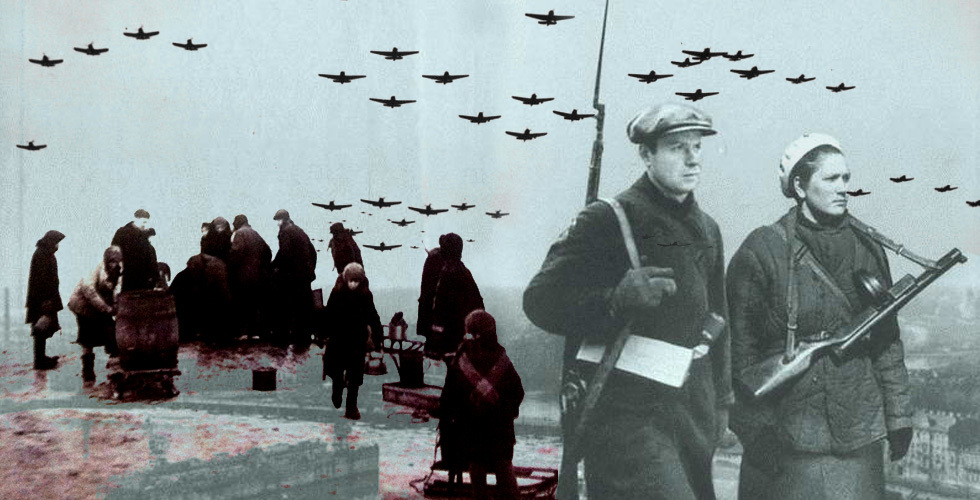
"Closed mouths and clenched teeth"
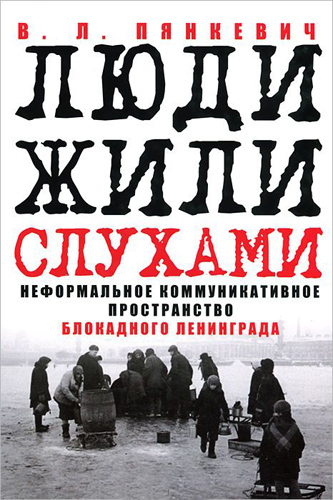
V. Pyankevich. People lived in rumors. Informal communicative space of blockade Leningrad. - St. Petersburg: Vladimir Dahl, 2014
In one of the most difficult blockade documents that have reached us, the diary of Olga Bergholz, we read the record of September 22, 1941: “My God, my God, I don’t know what is more in me - hatred for Germans or irritation, frantic, nimble, mixed with wild pity, for our government. <...> I saw how the gap between the people and the state is growing, how two lives diverge further and further: real and official. ”
In this review, we will talk about two recently published books on this abyss - between the life of the real and official. The book of Vladimir Pyankevich tells how the blockers used “informal” methods of communication, that is, rumors, in order to understand and overcome the blockade everyday life, to get into the gap between the radio survey that had nothing to do with making pressing decisions, and the flows of “street” conflicting information. Sergey Yarov, whose book is considered below, speaks of this everyday life in the format of the encyclopedia, setting himself the task of overcoming today's distance between the unprofessional, even the most well -intentioned, the user of history imagines the blockade day after day, and how these days and nights were actually proceeding - outside the protective lenses of many propaganda layers that covered the blockade from September 8, 1941.
People rush in an attempt to understand what, in fact, is going on, rush to friends and strangers who, they hope, can know more of them, while fearing that the interlocutor can be a provocateur or an ill -wisher, gradually get used to the idea that it should not categorically trust official sources. We are talking about the first days, weeks, months of the blockade of Leningrad. Almost always the most accurate analysis of the situation we find with Lydia Yakovlevna Ginzburg: “It was terrible greed for information. Five times a day, people fled to the reproducer, interrupting any business. They rushed at every person who was at least one step closer than they, to the front, either to power, or to the sources of information ... They wanted to know how it happens when the war, how it would be <...> this ignorance was the most characteristic feature of those first days when a deadly, reaching physical pain for hours, walked around the room for hours. This ignorance was in a strange way connected with long -term preparation ”(Ginzburg L. Passing characters. - M., 2011, p. 208).
 © Vladimir Dal
If only residents of the city could not have to know, not to foresee the future, but to “just” to know in their present that food supplies in the city are minimal, that Nazi troops are rapidly marching from the West, that one can only hope for themselves - probably the history of the Leningrad epic would be different. About this - about the tragedy of ignorance, says the book of Vladimir Pyankevich recently published in St. Petersburg. The author analyzes hundreds of evidence of eyewitnesses, inviting the reader to make an idea of what was fraught with the inaccessibility of information well -organized by the city (as well as the central) authorities - and as the population of the besieged city plunging in hell of the winter of 1941-1942, tried to separate the lie of comforting propaganda from contradictory and fear of social knowledge of real knowledge.
Rumors, speculations, memories, insights - all the methods, all sources were used, everyone decided for himself in a situation where Comrade Zhdanov was entrusted with the decide for everyone (the very comrade, who, when viewing in the spring of 1942. Winter newsreels would ask with irritated surprise, observing on the screen, as endless “curly shoes” are wound: “and where are they taken?”).
Any historical parallels can distort our perception of today's situation - but irony is that in order to understand what is happening, the subjects of history often have to resort to them.
"I have not met experienced starving"
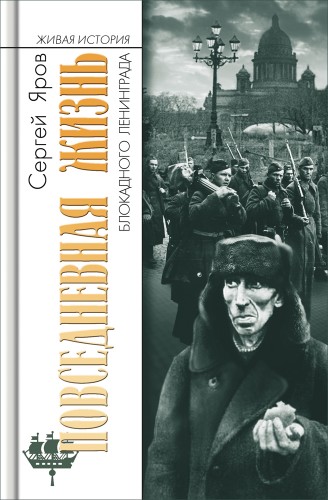
S. Yarov. The daily life of the besieged Leningrad. - M.: Young Guard, 2013
The task that Sergei Yarov sets himself in his new book, a paradoxical nature is to talk about disaster as everyday experience with his routine, rituals, and its special civilization. The triple structure of the book describes three phenomena: the functioning of the blockade city, the functioning of the blockage death and the functioning of the special creature, which we call the “blocked person”.
All these phenomena had little in common with the good reality. Huge assimilative efforts were used by society to create an excess in the conditions that the philosopher of homicide Georgio Agamben calls the minimum life , the systems that replace them with previous social systems. So, for example, the blocked death of the first winter, whether it was death or bombing, had little to do with the way the townspeople died earlier: no one mourned it very often (the ability to grieve was back much later and was perceived as a true return of life), the rite of “normative” funerals often came down to the fact that the body of a loved one was delivered (or paid to those who could deliver the dead - but also often The bodies were left on the street or next to them until better times. Death - their own and a stranger - ceased to be afraid (a dystrophic personality is extremely economical in emotions), and only the visitors were shocked by the fact that the streets of a marvelous city were covered with corpses.
The time has come for the most radically possible to remove ourselves from an official point of view on an official life - in order to gain freedom of working with an archive that would allow us to approach a real blockade life step by step.
Death could also serve the townspeople - a significant number of cases when the bread cards of the dead saved the living, not to mention cannibalism, which today in a blockade context is better to talk less often than more often when the specific task of the study, and not the melodramatic or polemic needs of the speakers.
Along with the blocked death, the blocked city was an incredible evidence and the achievement of human desire to survive: he demanded from hunger, cold, lack of vehicles, and a good bombing of the townspeople of a tense reaction - it was necessary to find new ways between ruins and snow rubble, to decide whether to go down in the bomb shelter and what exactly could serve as such. The city turned into a monstrous survival machine, where - here it is, the inevitable truism - the strongest were supported and won. One of the most effective and conflicting systems for supporting urban survival was the city Black Market: he was given to him by a special head of Yarov, Pyankevich previously wrote about him. This topic is not in vain attracted by researchers: it is acute, complex, while it is documented - in the archives of the city (first of all, we are talking about the archives of the detective and supervision organs), various documents have been preserved, from which you can find out who, and to whom it sold on blockade interpreters, which were required and searched for speculators who counted the expanding and dying apartments of the city.
 © Young Guard
This topic then caused and continues to cause sharply polar ethical grades now. The buyers in anger squeamishly called the grave worms et al. Yarov begins the corresponding chapter with the words “hardly the market could provide significant support to the hungry blockade”, with which the author of the real notes does not agree - from diaries and letters we learn that the black market was a serious help and saved life, which did not work for official structures.
Vladimir Pyankevich, talking about how the population of the blockade city was removed by radio receivers, expresses an opinion that the author is also not inclined to divide - that it was a necessary and correct measure to combat German propaganda (thus, the blockers remained entirely in the power of Soviet propaganda, telling about the triumphs of Soviet troops from the very beginning of the siege). In my opinion, the time has come for the most radically possible to remove ourselves from an official point of view on an official life - in order to gain freedom of work with an archive that would allow us to approach a real blockade life step by step.
However, the most important impression that I have from reading these books are gratitude for the opportunity to find out and gratitude for the opportunity to disagree. The apparatus of both books is wonderful. Before us are two strong examples of collecting and reading, two experience with historical sources - published and waiting in theham in the archives, personal diaries and memories, press and special delusions. Both the sociologist Pyankevich and the historian Yarov meticulously, devotedly and tactfully open to us the range of the blockade archive, accessible today by both the researcher and any reader who cannot be pleased with the current flat-commissioned point of view on the events of the war and the events of the blockade. Attention should be paid to the created delicate situation: over the past decade, a significant number of blockade sources have been published and commented on (although even more remains unpublished), however, obviously, the habit of a mass (that is, corresponding to the sizes of the disaster) of the reading of these sources can not be developed, so that users of history can make conclusions and build their interpretations. I would like to hope that the monographs of Pyankevich and Yarov - these are two more convincing steps towards changing the situation of the deficit of the careful and demanding reader of the blockade archive. Because the blockade should not have other readers.