
Translated material
Bismarck does not know
In Germany, the information war for Ukraine takes place in the spirit of the "active events" of the Soviet KGB during the "struggle for peace" in Western Europe
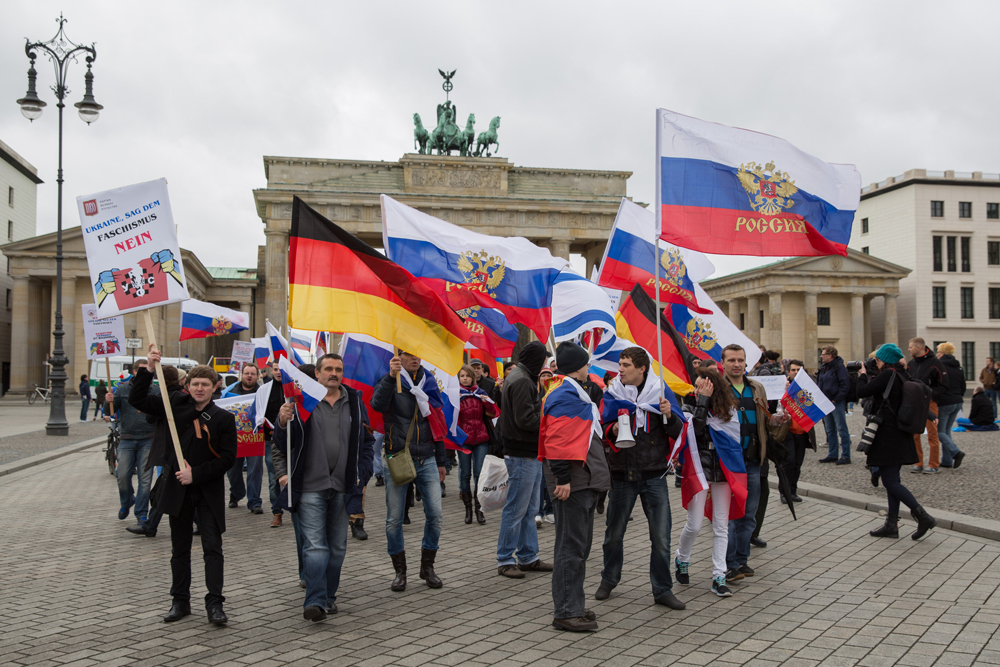
The action in support of Russia in Berlin. 60 people came to the demonstration, March 16, 2014 /Photo: ITAR-TASS
Before showing in the Russian House of Science and Culture in Berlin, the gathered audience was carefully warned that the film of Ukrainian journalist Alena Berezovskaya about the Maidan and the events in the Crimea was “copyright”, that is, it was not shot for money and not based on “Russia today”. The vote of Berezovskaya was voiced by the phrase of Bismarck, which became the super -bomb of the whole presentation: “The power of Russia can be buried only by separating Ukraine from it. It is necessary to divide two parts of one people and set them on each other, watching how the brothers kill the brothers. ”
The iron chancellor, of course, had a vivid gift of foresight. You can even assume that Bismarck, not a special admirer of the Russians, really translated the Maidan, Crimea, the gas war and all that we have now. And if Otto personally von Bismarck uttered such a phrase, then Germany, as the authors of the film probably thought, should unequivocally support Russia's position. However, they did not take into account one thing: the Germans respect the Chancellor of Prussia and are very scrupulous about his heritage. Therefore, they found out in a matter of days: Bismarck never said anything like this.
"Spontaneous" and "mass"
The quote that was supposed to be the leitmotif of the film turned out to be a fake. The fact that she was invented was the first to doubt the Der Spiegel magazine and made a request to scientists-historians from the Fund. Bismarck. Scientists, discouraged by their own illiteracy, rushed to the Annals and - oh horror! - They did not find anything. So the fake really became a bomb: in Germany, a violent discussion began about the methods of presenting information by Russian and Ukrainian media.
However, Bismarck, by and large, only added oil into the fire. The Union of German Journalists, the leading media in the spring, is in alarm: in the tough information war, which is waged by the Kremlin during the Ukrainian campaign, Germany is assigned the role of an important bridgehead in Europe. Judge for yourself:
March 8 - pro -Russian demonstration in Hanover.
March 16 and 24 - demonstrations at the Brandenburg Gate in Berlin.
March 30 - again a protest in Berlin.
March 31-Frankfurt, a group of civilian activists conducts a demonstration against the "intervention of Europe in the affairs of Ukraine."
April 14 is another action in Berlin.
April 27 - Frankfurt, Central Square Roomer, a demonstration in support of the policy of Russia and Putin, against NATO and its expansion to the east.
May 10 - pro -Russian demonstration in Wipetal.
May 20-Berlin: During the rally, a verbal skirmish of demonstrators with the head of the Ministry of Foreign Affairs Francom-Walter Steinmeer occurred.
May 29-Aachen, a demonstration with pro-Russian slogans against arrival in the city of Prime Minister of Ukraine Arseniy Yatsenyuk.
“Both Russian and German media wrote that all actions are spontaneous. But firstly, there are no such number of pro-Russian demonstrations in any other European country, although far from one Germany, citizens are afraid of a new war in Europe, ”the German journalist V. argues in a conversation with The New Times (he asked not to indicate the name). -And secondly, many demonstrations had high-quality posters and banners, mock-ups and dummies-this is impossible to make “spontaneously”. All this needs to be ordered and paid in advance. ” According to V., usually the organizers of the protest themselves declare themselves. However, "in Aachen and Frankfurt, activists sent me for information to each other, and I soon realized: no one wants to say anything."
A little more talkative was a civilian activist named David (see photo), who arranged a sedentary picket in Düsseldorf in mid -June with a like -minded person named Anna. Listers with the following text were heard passers -by: "Germany, which went through two world wars and the horrors of Nazism, should be the first to resist the Ukrainian Nazism, which the West is patronizing." To the question of The NEW Times, whether one of the citizens of Russia or Ukraine helped him in the organization of the action, David, not without pride, noticed that he had “strong ties” with the Russian embassy (in Germany). True, he refused to disclose details.
But, according to historian Alexander Formozov, a graduate of Moscow State University and Humboldt University in Berlin, former GDR citizens who have been using old ties that remained since the Soviet times are engaged in the organization and conduct of such demonstrations: “I have met people several times who expressed their solidarity with the position of Russia before the Russian embassy. This is a very strange audience. There is, for example, a club of friends, which used to be called "friends of the peoples of the Soviet Union." There are many offended former citizens of the GDR in such organizations "
According to Formozov, there is no need to talk about the “mass” of such actions: “There are several dozen people who seem members of some extreme left-wing parties there. And once I even spoke with a group that does not recognize the German constitution. ”
However, the reproach of Reality The interlocutors of The NEW Times from among German experts are addressed for the most part of the German media. In their opinion, German publications such as Spiegel, Zeit Online, Süddeutsche.de, the ARD television channel, also often submit their reports so that mass support by the inhabitants of Germany is Moscow position. For example, the ex-commissioner of the Human Rights Government, now vice-president of the International Liberal Union, Liberale International, Marcus Lenoning believes that "Russian propaganda does not have the greatest influence on the population, but on German media." “German journalists are not even trying to critically evaluate the information coming from Moscow,” Lenoning remarked in a conversation with The NEW Times.
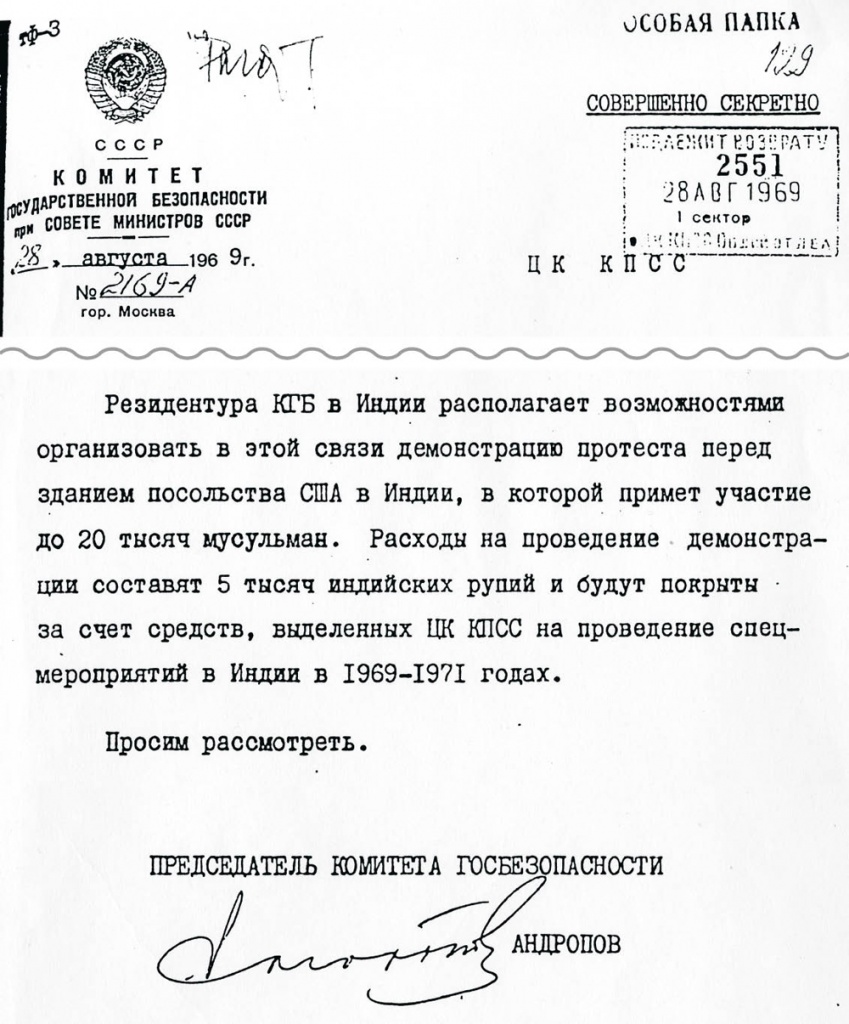
“Active events” - the so -called propaganda actions that the KGB of the USSR held around the world. In this document - the preparation of "Activa" in India in 1969.
In the footsteps of trolls
Do you want to be hated? Write on Facebook a post with condemnation of the Crimean campaign of Russia. This conclusion was reached by the Süddeutsche Zeitung newspaper, whose analysts investigated 138 megabytes of information collected on Twitter, Facebook and German social networks. The Russian side is convinced of the newspaper’s editors, manipulates information, creating an extensive system of paid trolls and bots: “They are found on labor exchanges, their duties include writing comments in favor of Moscow. Each comment is paid separately, and its presence should be confirmed by a screenshot from the Internet. ”
Süddeutsche Zeitung began its own investigation, after a whole array of information about the Cremlin created by the Kremlin, the system of paid Internet trolls published-at the end of May-the blogger of the Shaltai-Boltai, who calls himself a press secretary of the hacker group “Anonymous International” (see The New Times No. 20 dated 16.07.2014 G.). In turn, the Vedomosti newspaper found out: Russian bloggers-expanses in Germany, India and Thailand are taking part in Internet trolling, the American online publication Buzzfeed came to the conclusion that trolls on average support for six accounts on Facebook and ten accounts on Twitter, and The Washington Post found them in the comments on the articles on her website (as well as on The New York Times, CNN and the largest online publication The Huffington Post).
In Germany, everything goes according to the same scheme. According to the expert of the German Fund. Nauman Sasha Tamma, “jammers” of unwanted information for Moscow arise on social networks surprisingly synchronously and the same thing: “This is clearly noticeable when you write something positive about Ukraine for a blog on a social network. Suddenly, evil comments appear in which the essence of the problem is not addressed at all, but there are personal and even insulting attacks. ”
When asked whether this is definitely all the comments of pro -Russian trolls and bots, Tamm answers unequivocally: “I have to admit: I am familiar with many trolls personally.”
"
“One troll began to threaten me with a tribunal, and I declared him to the police: they found out that he was a former citizen of the GDR”
"
The most famous “victim” of the troll campaign of Diffamation, insults and threats is journalist Boris Wright Shuster, many years of Focus magazine in Moscow. His uncompromising attitude to Russia's policy, the critic of Vladimir Putin is well known, and some time ago, due to threats, the journalist had to return to Germany. With the beginning of Ukrainian events, a new flurry of dirty comments and insults fell on Boris.
According to the Wright Shuster The NEW Times, people with fake accounts that are registered in networks are regularly appeared on his website and “wall” in social networks only in order to make comments. Discussions, according to the journalist, always take offensive forms, and comments usually begin with the question: "How much do you pay for it?"
“One troll began to threaten me on the network with a tribunal, and I announced it to the police,” says Wright Shuster. “They found out that he lives in Germany, literally twenty kilometers from me, and he is a former citizen of the GDR.”
The Wright Shuster himself does not familiarize with his trolls and destroys almost all the comments, because "he does not want to collect this dirt even for history."
The Wright Shuster intelligently complains that trolls never respond to arguments, and their comments, as a rule, ends the statement that "there is America behind everything."
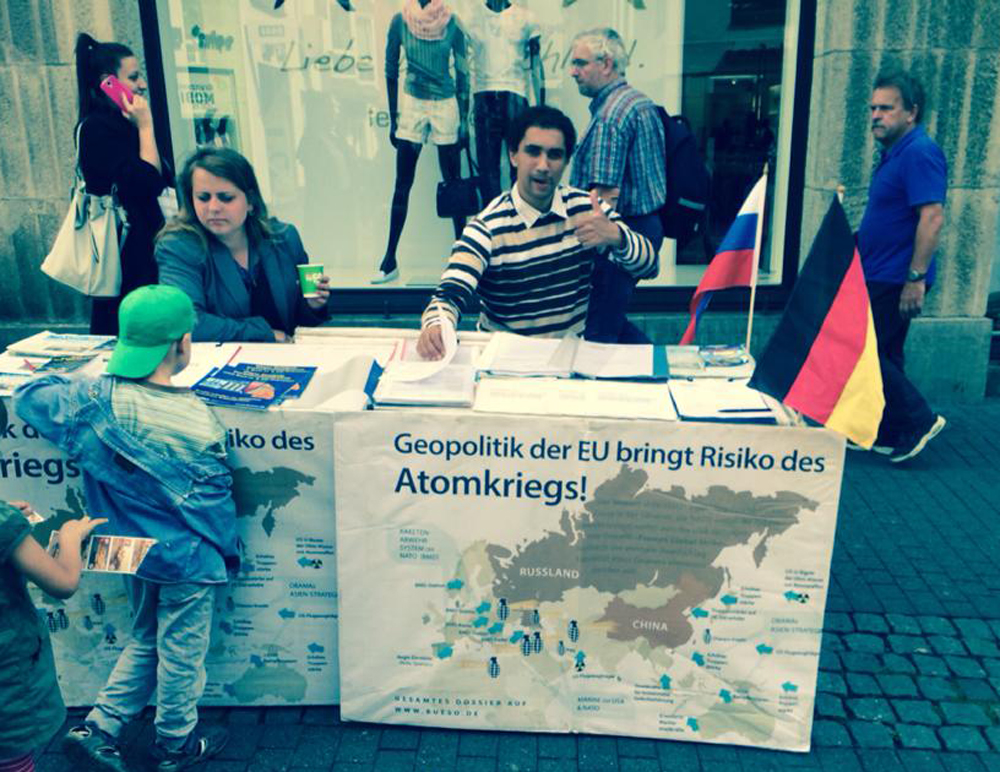
Sitting picket in Dusseldorf. “EU geopolitics is fraught with atomic war” - says a poster, June 2014 /Photo: Movsun Gadzhiev
Liberal? WAS IST DAS?
"Are you familiar with the word" liberal "and can you explain its meaning?" - asked The New Times Marcus Leung. In response - long silence:
"No, I do not know the meaning of this word ... Something bad, probably?"
It is difficult for the Germans to deal with the latest word formation in the Russian media. And if the words “fascist” and “Bandera” in Germany are understandable by definition, then no one can clearly understand that (or who) is such a liberal.
And in early June, the answer to this question was printed in the editorial column Die Welt. “Google gives 141,000 links when searching for a given word“ liberal, ”the newspaper writes, complaining that their computers can not cope with the Cyrillic alphabet and therefore the editors are not quite sure of the correct writing of this word. However, the authors say: the first references to this word in the Russian internet appeared in the distant 2000, and even then it received a negative color, implying the uncleanness of everything that, one way or another, is associated with liberalism. Now the frequency of mentioning this word has grown significantly and, comparing the density and context of its mention, the editors made its conclusion. “By this word, you recognize Putin's propaganda,” Die Welt said.
Cool lobby
However, in the struggle for German public opinion, Marcus Loning states, Russia has achieved certain successes, and you should not write off all the efforts of trolls, bots and other conductors of “hard methods”. Germany is a third dependent on Russian gas, in Russia a highly reliable business of 1200 German firms, the annual bilateral trade-about є80 billion, direct German investment-є20 billion, and thanks to all this, more than 300 thousand jobs were created in support of the positive image of Russia, primarily German political and business elite, which it does not miss the occasion remind. Finally, only in Germany can Moscow count on upholding its positions with influential and authoritative politicians-such as, for example, ex-chancells in Germany, Gerhard Schroeder and Helmut Schmidt, Lenoning emphasizes.
Sasha Tamm also agrees with Lenning as a whole: “In Germany, there is a fairly large circle of people who in vivo occupy a pro -Russian position in the Ukrainian issue.” However, in his opinion, Russia in conflict with Ukraine “in Germany is pushed not so much by Russian radio or Internet, but primarily German journalists, German bloggers, politicians, in general, those people who themselves“ eat ”Russian propaganda, and then take it into the German information space.” This is primarily about those sharks of the pen, in whom, according to Tamm, "lives latent hostility to the European Union." One way or another, Russia has a strong pro -Russian lobby in the information space of Germany, while there is practically no pro -Ukrainian lobby, "sometimes an interview with the writer Andrukhovich, and that’s all."
PS, meanwhile, according to Berlin, with reference to the Voice of Russia, the information diverged that there are already German volunteers, ready to fight weapons in their hands against the “fascists”, and the “Ernst Telman battalion” is already being formed and those who want to fight ...
It’s good that Bismarck did not hear.