
Translated material
"Rock" Alexander Barash
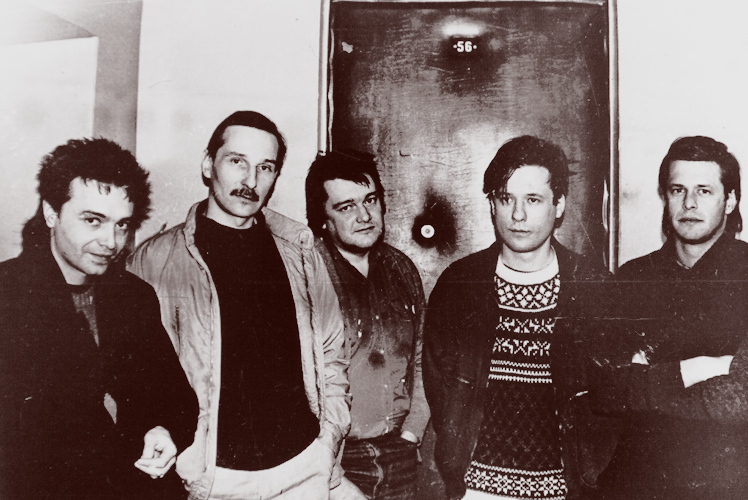
The New Autobiographical Book of the poet and essayist Alexander Barash has just published the “UFO” publishing house, where the author of the texts of the Megapolis and the publisher of the literary almanac “Epsilon-Salon” recalls the stormy unofficial life of the Moscow 1980s. COLTA . RU with the courtesy of the author publishes one of the chapters of this book, “Rock”, which transfers us to the BG apartment and the concert “Sounds Mu”.
“We have recently popped in the“ Blue Bird ”with the UB40 group. Well, they have their own music there - reggae ... And we also have ... our reggae ... a muddy ... crystal muddy ... "
Peter Mamonov, 80s
Once, in the winter of the 86th year, it seems that I closed the series of telephone calls about where to hold Boris Grebenshchikov’s home concert. He suggested - with me.
The dwarf hallway (two steps to the side is considered in the toilet) of a two -room apartment on the edge of the Golyanovsky forest was overwhelmed with sheepskin coats ... Forty people gathered in a twenty -meter room. The old, lonely and non -Soviet Dog Rombick yawned with horror. The only guest with whom he exchanged a friendly grin was Dmitry Alexandrovich Prigov. A tense young man of those who came with Andrei Makarevich persistently interested: "Is it possible to find a place for Makarevich?" I had to shrug with my hands: places on boards laid on chairs and stools were not regulated by status.
Grebenshchikov sat on a large table with a green cloth by the window overlooking the white sky above the Golyanovsky pond, his bass player fucked on the side, at the door on the balcony. Acoustic concert with a length of hour with a small one, without interruptions and communicating with the “public”, was devoted to entirely meditative reflection: “Each of us knew that we / have time to be late and be late, / but go out to victory on time. / And everyone knew that it was time to take a place ... ”,“ The sky is getting closer ”,“ Sitting on a beautiful hill ”,“ Ten arrows ” by ETC. This was probably the time of the highest quality glory of Grebenshchikov, the star hour of Russian rock music-it seemed that the most lively and exact sense of style and era had settled in it. But from these songs there was about the same feeling that one school friend of my school friend was formulated with teenager brutality, after the television concert of Alla Pugacheva at the peak of her first fame: “Everything is like nothing, good, but not quite ... As if not to the end of pop and sali ...” What sounded like a dudochka Gammelnsky Red Corps for children of the Soviet intelligence, - MIX of cultural power (Bob Dylan, Leonard Cohen, etc.), Vertinsky, Celtic epic and Buddhism for beginners - it was interesting, exciting ... But at the same time, it crept out and twisted like a light bulb in the front door , a specific St. Petersburg monotony on the verge of bureaucracy ... which acted unconditionally - this is the brightness and freshness of the album The “triangle” of the 81st year, the moment of the initial “storm and onslaught”: “Mochalkin Blues”, “Old Man Kozlodoev”, “Sailor” ... The genesis of the Obirusia and social art is obvious-and accurate; Instead of the stylistic cripples of English-speaking rock music, mixed with a very familiar Russian youthful mourning (who I want to be, what is waiting in the future)-live urban jargon and St. Petersburg variation of the stake : snobbistic, evil-browning, quietly-wilase, with snake blood inside. “I want to butt all the washcloths, / clicking my foot on a powerful fuss ... / I want to tear it out of them soon, / to tear off the wig and on the platform is a fur coat ... / I am a cool man, I am the coolest of all men, / Give me any seduction ... / Just let me finish / Mochalkin Blues ...”
I said: “Thank you, Boris” - and held out the money. He grimaced sharply, dropping his eyes, and passed by.
At the end of the concert, a dangerous misunderstanding arose. It was, as usual for the stars of the rock anddegrand, about a paid concert. Not having other direct income from his work, an independent unofficial musician, having gained five rubles from 25-30 people from 25-30, received an amount equal to the monthly salary of a Soviet engineer or teacher for a concert-150 rubles a minus. Having worked out several “apartmentmen”, one could live their own life for another month or two. Money was collected by the organizer of the concert.
In the literary world of paid home evenings, as far as I remember, there was no. It seems that this is how the fundamental difference between rock music and literature was revealed-even in such an extremely cleansed of the "material" situation as underground. The show business, publicity, inseparable from direct reward, was then an organic part of the image of a rock musician. Probably, a model of stray musicians was preserved in the genesis. The literary performance did not require payment, apparently because, according to the high tradition, who was dead, “in popular” in the sub -Soviet mentality, literature is not a show, not a concert. And sacred ministry and teaching of life. Even if in reality everything is different - and a performance for three quarters, like a body with water, is filled with a “pop” element. Success, as a row, is measured in the golden currency of veneration, the cuts of betrayal, bronze of the providential monument, and not in a living wage. Home (in workshops) exhibitions of artists were also free. Also, probably, in view of the highest mission of art. Artists, however, could sell paintings. Nevertheless, at the literary evenings and at the shows of paintings in the workshops there were mainly colleagues and the circle of closest acquaintances, and not the general public. Thus, close to the club of "their" and/or to the "closed film order" ...
As for the “teaching of life”-a shift: it was rock musicians in the 80s, the heyday of rock music in the USSR, and set the formulas of behavior. The attitude to literature and painting froze to a large extent in the "hives of empty" old forms. The presenters of the attitude were rock musicians. According to them, the youth “made life with whom”, quotes from them lived ... Since the beginning of the 80s of rowers, Tsoi, and mammons-for a decade-“teachers of life” for the wide layers of youth from the middle class. For a relatively narrow circle of advanced (apparently, tracing paper from English, replacing the word “enlightened” ... which, also probably, tracing paper, only two hundred years ago), writers-Nabokov and Brodsky began to establish again from the late 70s-but at least a decade passed before the type of consciousness, personified in Brodsky, became a determining cultural code.
Grebenshchikov is our cocktail rock beautiful and glamority David Bowie and Celtic magic in the spirit of Lorina McCannitt.
In the meantime, rowers. The words of Henri Volokhonsky, variation on the themes of the Prophet Ezekiel and John the Theologian. The music is either the XVI, or the XVII century, or the stylization of the second half of the XX century. The initial genre-oriente is a spiritual song about heavenly Jerusalem, here is a nostalgic vision of something folklore:
Under the sky of blue is the city of gold
With a transparent gate and a bright star,
And in the city Tom Garden, all herbs and flowers,
Animals of unprecedented beauty walk there ...
And in the sky Blue is one star.
She is yours, O my angel, she is always yours.
Who loves, he loves who is light, he is holy,
Let the star lead you dear to the marvelous garden.
Curious rollbacks in the text - with a pre -revolutionary city romance “In one familiar street ...” (there, by the way, words and music are also not “folk”: the verses of the quite anthological poet Yakov Polonsky and the music of the completely “conservative” composer Nikolai Kazanli):
In one familiar street, I remember the old house
(With a transparent gate and a bright star)
With a high dark staircase, with a touched
window ...
But even stronger the strange similarity of the general intonation motive, the topic - with the story of Bunin with the same name “In one familiar street”:
Autumn Paris at night walked along the boulevard in the dusk from thick, fresh greenery, under which the lanterns glittered metallically, felt easy, young and thought:
In one familiar street
I remember the old house
With a high dark staircase,
With a hung window ...
- Wonderful poems! And how surprising is that all this was once with me! Moscow, Presnya, deaf snow streets, a wooden bourgeois house-and I, a student, some of me, whose existence is now no longer believed ...
There is a mysterious light
Up to midnight shone ...
- And there shone. And chalk, and the wind blew the snow from the wooden roof, fluttered it with smoke, and glowed at the top, in the mezzanine, behind the red chintz curtain ...
Oh, what a miracle girl
In the treasured hour of the night
I met me in the house
With a loose scythe ...
May 25, 1944
The date of writing the story is good, apocalyptic.
The first performer “under the sky of blue”, in fact, is the author of the connection of text and music, is Alexey Khvostenko, an emigrant in France, like Bunin. Autumn Paris at night walked along the boulevard ...
And then the rowers sang this song, nostalgia for nostalgia.
And further: it is installed on the pop film "Assa" and becomes the property of the masses - the anthem of the youth of several generations ... Crystal muddy mix.
When Grebenshchikov’s concert in my apartment ended, I took over the functions of the administrator - and collected money from the public. The gesture of hospitality, which cost known tension. And it was, I remember, the first and last time. (Just as the collection of money for school breakfasts a couple of years before: I served a literature teacher at school and for a couple of months I unsuccessfully tried to get into the role of a class teacher; money for breakfasts was immediately stolen from a teacher’s drawer.) With a pack of bills, I approached Grebenshchikov, who was standing in the middle of the living room. Some people left, someone swarled around ... I said: “Thank you, Boris”-and held out the money. He grimaced sharply, dropping his eyes, and passed by. I was stuck in bewilderment in the same place with an outstretched hand - but in which there was money. And after a few seconds, his bassist Dyush came up to me, affectionately thanked and took the fee. I was unpleasantly shocked by the behavior of the idol, it seemed to me, inappropriate snobbery and so on. Meanwhile, this episode contained completely different. Getting money for a concert was a moment of serious risk for an artist, such as a circus number, when music is silent ... Under Soviet laws, such earnings were considered a criminal offense.
One of my then close acquaintances when he organized the same concert of Peter Mamonov at home, then he locked himself in the bathroom, even before that he was slightly waiting for the greatest part of the public to be dispersed, and so he handed him the money ...
Mamonov took less from the public, as far as I remember: not five rubles, but three. But this was generally a different image. Human.
The same acquaintance who handed him the money in the bathroom after the concert in his apartment later said that Mamonov asked to show where the nearest wine was. They went out together, one by wine, the other for the traditional cake for tea for the guests left after the evening. We agreed to meet on the corner. Leaving 10 minutes later, the owner of the apartment did not find Mamonov in a agreed place. Entering the store, I did not find it there either. He began to look - there is no one else, although the Piglet is small ... And suddenly he saw: he squatted near the wall, as half the country sits after work in the area of wine shops and in squares.
Merged with the landscape.
Mamonov, of course, is not a "man from the people." In any case, no more than rowers. “A man from the people” would hardly have translated poetry from Norwegian - having received in this capacity a well -known professional recognition and printing them in the relevant anthologies. And he would hardly have known English “perfectly”, as they write in his biographies in different sources. The case is in the image.
If the rowers are our cocktail rock-beautiful and glamority David Bowie and Celtic magic in the spirit of Lorina McCannitt, then Mamonov, apparently, is correlated with the scenic way and plastic of David Burn and Tom Wayts style.
Waits seemed to have “destruction” of music and feelings, but when his same song is re -chanted - for example, “Trampled Rose” in the cover of “just beautiful” Alison Krauss (along with Robert Plan) or “Green Grass” in the version of the Brazilian jazz singer Sibell, it turns out that everything inside from the very beginning remained in their places, “Holded in the mind” and Wabets: love, and attitude to life, to death and art. As in a fairy tale, where it seems to be a monster, but in fact-an enchanted prince ... And in order to spell, you need a spell: understanding of codes of cultural sanity.
Mamonov took less from the public, as far as I remember: not five rubles, but three.
Or as in a sacramental example of a “postmodern” psychological situation, popular in the 80s: a modern person cannot pronounce this pathos-straight “I love you”, but only “as they say in the old days, I love you”.
I then tested this test for mutual understanding either in a more brutal or more advanced variation. The girl came to visit me, we sat on the couch, the “Brothers in Arms” swayed in the cassette, on the coffee table in the flame of the candle, Armenian cognac winked, BT cigarettes and Indian aromatic sticks were smoked ... And I said the following: “They say, the postmodernism: we can’t say“ I love you ”in our time, but only“ I love you before I put you, I love you ”... So: I want you.” In response, a brief and sweet, like life itself, sounded: "O'Kay." The codes coincided. And in my other story, close in time to this episode, a direct recognition of love caused complete distrust and non -deposit, for nothing that it was completely sincere ... that is, too direct and “direct”, “pathos”, and this “loads” ...
Collective concert in a recreation center. Intermission. Summer. The audience walks around the asphalt court in the rhythm of poplar fluff. Suddenly, howl and roar come from somewhere. Everyone freezes not that in fear, but in the shock of bewilderment: this inhuman roar is not threatening and terrible, but it seems to be summoning and jubilant ... oh, where is it from: some small side window in a concrete wall at the level of the third floor, someone is leaning out and wildly buzzing: “Wow!” - And waves his hands in welcome convulsions. Yes, this is the soloist of the "sounds of mu", like his ... Mamonov. Do you know what Troitsky seems to be called them? "Sound." Ha-ha. Everyone is happy and begin to scream and dance in response. The appeal came to the people. An unauthorized rally without words for the glory of unauthorizedness of anything took place.
On the stage with the sounds “because I became a peps”, he was engaged in the signature “sex with a microphone”, chewed him in a frenzy rapture. At a home concert, he poured and sprayed the surrounding space with saliva (having previously spread the newspaper in front of him on the floor) ... This postpank looked and was quite organic.
And at the same time, another image was potentially possible for Mamonov. According to external data, and on the background, and on some side of his inner world, Mamonov could well create an image, to “get fart” (according to Pasternak in the poem about Meyerhold) in a romantic handsome man, even with a mastic shade. High growth, honed, accurate facial features. Physical fortress, psychological rigidity ... According to the stories of acquaintances, Moscow hippies of the beginning of the seventies, he in their company was the main defender from aggression from the outside, a “bodyguard” ... episodically, occasionally, this image appears, “waves”, but the main role of another. The “romantic” or “power” image could provide a more massive - universal - success. But his choice turned out to be different. Something opposite to what happened to Grebenshchikov. To the extent that this is a choice, not karma.
And suddenly he saw: Mamonov squatting near the wall, like half a country sits after work in the area of wine shops and in squares.
The fact that Mamonov looked at the same time as a “simple” post -pack was gradually manifested as something more universal. And at the same time more organic-national, "ethnic". Mamonov, according to his own definition, is buzzing. But maybe - and over the years this manifests itself more and more, it is enough to look at his interviews that turn into sermons of Christian behavior - in this buffoon there is a impulse to the turning of the environment, which ideally could approach the practice of "blessed". They were the heirs of the Byzantine early Christian ascetics. And those, in turn, are the Old Testament prophets ...
There is a historical episode - an underestimated, in my opinion, did not take a proper place in cultural mythology. This is a story with the salvation of the inhabitants of Pskov in 1570 by blessed Nicola Salos. She is known, but did not become “system -forming”: “The king was returning from Novgorod, which he ruined on suspicion of treason. Everything indicated that Pskov was waiting for the same fate. When Ivan drove along one of the streets, Judge Nicola Salos emerged from the crowd. By imitating the children, he “saddled” a wand and portrayed a horseman. “Ivanushka, eat bread-salt, not human blood!” - He turned to the king. The close associates rushed to the “fool”, but Nikola disappeared in the crowd. That day, Ivan listened to the liturgy in the Holy Trinity Cathedral. Leaving the temple, he, still in the power of anger, ordered the main bell from the bell tower. At that moment, Nikola appeared again and began to call the king to him. The king obeyed: he followed the holy fool into a small closet at the base of the bell tower, where Nicola lived. There was a piece of raw meat on the table. "Ivanushka, eat!" - said Nikola. “I am a Christian and meat in the post!” — сердито ответил царь (стояла первая неделя Великого поста). “Ты делаешь хуже, питаешься плотью человеческой, — ответил юродивый и добавил: — Ступай отсюда, прохожий человек! А то скоро не на чем будет тебе ехать!” Вечером пал любимый конь Ивана. Царь предпочел послушаться грозных предупреждений и покинул Псков, не нанеся ему вреда». Наверно, один из самых впечатляющих перформансов в русской истории...
Что это там люди собрались? А, это «наш Петя». Грызет, сладострастно урча, микрофон на сцене и мрачно клекочет, пуская слюну:
Я ем на помойках,
я пью из луж.
Дождь меня мочит, дождь мне как душ.
И солнце...
Я самый плохой, я хуже тебя,
Я самый ненужный, я гадость, я дрянь,
ЗАТО Я УМЕЮ ЛЕТАТЬ!
(«Серый голубь»)
Этот герой — социально, по своему месту в мире — не тот же ли «маленький человек» Гоголя и Достоевского? Он там же в социальной иерархии, но пережил много мутаций... ломок и линек. Начал терять человечность и в себе, и по отношению к себе у Чехова и Сологуба... Вовсе потерял человеческий образ — стал просто псом у Булгакова... Потерял «право голоса» у Олеши... Резал колбасу на гробе жены у Платонова. Не говоря уже о «литературе соцреализма»... имевшей такое же отношение к реальности, как «Поднятая целина» к коллективизации.
В оттепель некоторые черты человечности были возвращены, но так, чтобы фундамент, не рассчитанный на подобную надстройку , не поколебался. От этого фундамент скособочился, а человечности прибавилось ненамного.
Странный это был эрзац, как ячменный кофе... Есть веселый рассказ-свидетельство о том, как бард Визбор вместе с женой, когда к ним приходили гости и хотелось попеть и выпить, а надо было гулять с младенцем, приспособились вывешивать ребенка в авоське за окно на мороз. Передовое know-how культовой фигуры советской интеллигенции. Борман, чо.
Но кто-то выжил, всюду жизнь ... И заговорил — у Венедикта Ерофеева. Обрел voice. Речь, соединявшую русскую классическую традицию с опытом своего поколения в большом мире: после Сэлинджера и Сильвии Плат...
Человек Мамонова (новоописанный вид, как лошадь Пржевальского) мал, но не умаляется. И грозно самоотделен. Как в хите «Союзпечать»: «Попробуй меня поймай — я всегда один», то есть в другом измерении... Или так:
Я уволился с работы, потому что я устал...
Ночью я лежу мечтаю, у меня есть одна мечта:
Чтоб всю жизнь под ногтями оставалась чистота...
Жаль, что мне не разрешают поселиться жить в музей:
Там бы на досуге танцевал я буги,
Плясал бы на досуге я с чучелами буги,
Танец буги...
(«Досуги-буги»)
Место таким разве что в музее (палеонтологическом? анатомическом? археологическом?). Но при всей тревожности, «нелепости» — неуместности в данное время в данном месте — нет и речи о том, чтобы измениться, мимикрировать... Это невозможно с такой органикой. Шаг в сторону от себя — смерть внутренняя... И за отмиранием своей жизни — вымирание, физическое небытие. But…
Герой Мамонова был витален до подростковой «подзаборности» и говорил об этом с провокаторской, освобождающе-здоровой прямотой: «Не верь, если я краснею, / Когда на тебя залез, / Не верь, если я краснею, / Просто это диатез!» ("Diathesis"). Психологическим здоровьем заражал отказ от ответственности в обломном манифесте «Ноль минус один»:
Вчера ты дала мне / И думаешь, я в долгу?
Вчера ты дала мне / И думаешь, я смогу / Простить тебе эту ночь? / Знаешь, что все это значит — / Вся твоя самоотдача? / Ноль минус один.
Не исключено, что это — ответ той стороне, которая с отрешенностью, но при этом очень настойчиво, даже требовательно поет из другого угла экзистенциального ринга заветное «Любви моей ты боялся зря...» «Та» сторона — не женская против мужской. И даже не пассивная против активной. Линия фронта не ниже пояса, а в голове... Неизвестно, кто здесь пассивнее и активнее: неподвижный паук или залетная муха. Война — между мирами сознаний. В условиях общей неотрефлексированности, путаницы, «вавилонского смешения» укладов и сознаний, застревания старых, недовхождения новых и т.д. — постоянно приходится выпутываться из разного прочитывания одной ситуации. И в первую очередь это касается «долга». Ты, советский человек, всегда всем и во всем должен. Даже когда никакого долга нет и речь вообще не о долге. Ну, а если поднять высоко-высоко руку... а потом резко опустить и проорать: «Знаешь, что все это значит? НОЛЬ МИНУС ОДИН!»
Блюз-роковая музыкальная «подкладка» усиливала, как хорошие колонки, эффект воздействия. Дух блюза — песен черных рабов в Америке, освобождающихся в пении, — обретал естественное пристанище в песне белых рабов СССР...
В сочетании «этнического» наполнения мамоновских песен с универсальным «саундом», общим для современников независимо от среды обитания, были большая свежесть и чистая радость. Смотришь с балкона своего …надцатого этажа на заснеженный пустырь с новостройками около кольцевой, жизнь просвистана, как высоковольтными сквозняками, пустотой и безнадежностью, в голове звенит: «Я самый ненужный, я гадость, я дрянь...» И вдруг как заревет, будто пикирующий бомбардировщик: «ЗАТО Я УМЕЮ ЛЕТАТЬ!!!» Ну, полетели…