
Translated material
Wit at an impasse
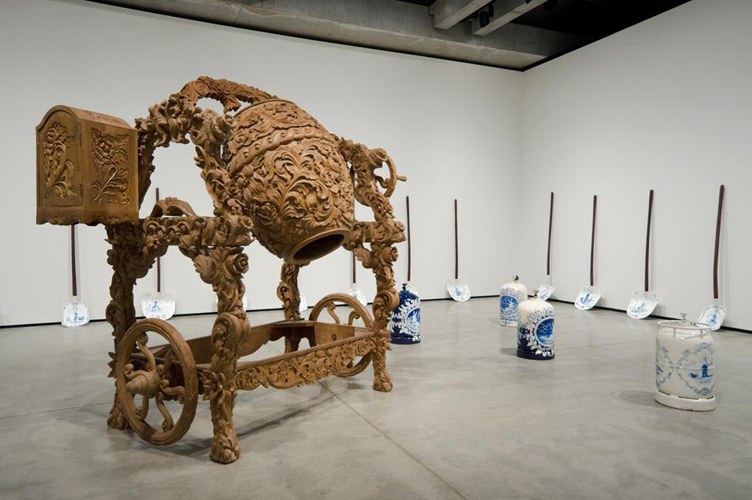
Substitutes can open a discussion, creating a new space with its mediation between different entities. But she can also close the debate of the discussion, fix the stuffy connection with everything with everything; The mediation between different meanings here becomes a statement of a dead end, a gesture of despair or cynicism. The ambiguity of the works of the Belgian artist Vim Delvois - the second kind.
Delvois was popular during the triumph of global capitalism, postmodernism and talk about the end of history: in the 1990s and 2000s. The wave of his glory reached Russia, where a detailed translation article of French critic Bernard Markade in the “Art Journal” was published about him in 1999, and in 2008 Delwois participated in the Moscow Biennale, in connection with which David Riffe interviewed him for the then Openspace . ru . And finally, this summer in Moscow two personal exhibitions will be held almost simultaneously-in the Gari Tatinsyan Gallery and in the Pushkin Museum -which, however, look already like an anachronism, more precisely, as an exhibition of the author, whose method belongs to another era: today-against the background of the economic crisis and the capture of the OCCUPY and capture of the Crimea by Russia-it is unlikely that anyone will be able to want a lot of people Reding about the end of history. Having re -read the interview of Riff and the article Markade, which I recommend to everyone who wants to know the details about the work of Delwois, I felt that all the interpretations are already given there, that everything has already been said - and it remains only to place the emphasis. And this is a feeling of the rapid exhaustion of interpretations of the seemingly paradoxical work of Delwois is very significant.
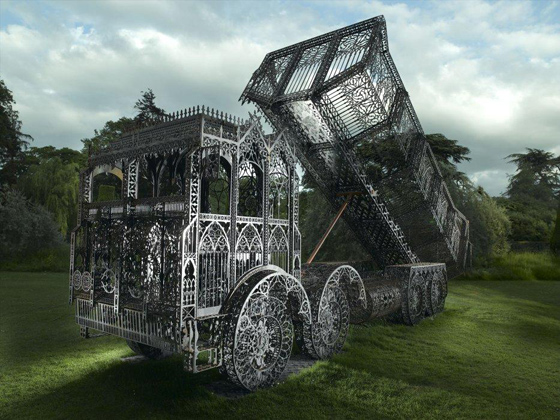 Vim Delvois. Samosval. 2006
Marcade writes about Delwois, operating with a set of stamps about the supposedly emancipating and urgent power of contemporary art. For example: “Turning an ironing board into a shield with a coat of arms, applying a tattoo on the skin of a pig or chicken, the artist does not just make a provocative gesture. These actions reveal new horizons of values, make the hidden meaning of forms and functions that have long acquired automatism. ” Or: “Thus, the artist turns inside out the now dominant economic logic: he deliberately enters his art in the formation/object of the world and the formation/world of objects. At the same time, each item is immersed in a stormy stream of images, materials and operations that shift the categories and hierarchical structures that determine the reflection of art: object/sculpture, craft/industry, man -made/finished object ... ”These conversations about deautomasics, provocation, reflection, destruction of hierarchies, etc. etc. You can, slightly corrected, address almost any work of contemporary art. Which does not mean that they are not true. However, it is their use to Delvua that reveals their internal exhaustion, inner boredom. Because, for example, I just can’t believe that Delvois opens such extensive “new horizons of meanings” or “turns inside out the now dominant economic logic.” Rather, he only brings to the logical end the “cultural logic of late capitalism”, taking advantage of the expression of literary critic and philosopher Frederic Jamison, to whom he characterized the situation of postmodern.
Jamison describes a postmodern as a situation when the globe is completely covered with circulation of goods and exchange costs and when the pre -capitalist methods of production that supported at least partially the autonomous existence of a use value are subordinated to this circulation, and the superstructure enters into production along with the basis. The combination at the same level of the basis and superstructure eliminates the opposition of exchange and a considerable value, which means and the designated and other gaps in binary oppositions, the voltage in which set the modernist paradigm. Global migration of images and collapse of hierarchy culture in Delwois works, in which the bulldozer appears to be a Gothic cathedral, and stained -glass windows are made of X -rays, fully meet this logic of fostering the maximum points of binary oppositions. It is significant that, as Markade points out, Delvois includes craft work in his art, hiring Asian masters to manually make some of their works, and thus states the integration of do -capitalist, non -industrial, non -playing forms of labor into a modern transnational economy.
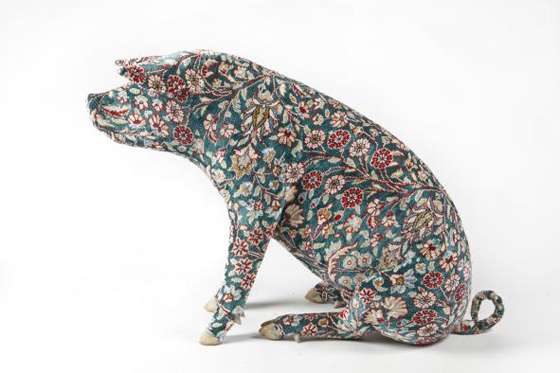 Vim Delvois. Kashan. 2010
As often happens with postmodernism, its smart ridicule does not imply any revolutionary increase in culture and no transcendence, but fits conveniently into the most conservative trends: in an interview with Riffa, Delwois glorifies the beauty of Gothic cathedrals as a contrast to the “primitiveness” of modernist architecture. You can talk about subversion for a long time, but the fact is what art is like that of Delvois is well sold and bought, including due to its conservative entertainment. And Delwois has many followers around the world - from Russian authors, they can include the Recycle group, which produces stained -glass windows from comics.
What was said at the beginning of the article about ambiguity can be said differently using the concepts of mediation (mediation) and medium (means of expression in relation to the coordinates of society and culture). The Delvois medium is completely immersed in the field, already destined for modern culture, and therefore his statements are so full -blooded, distinct and even redundant in their details. He only grewly celebrates the points on the routes already laid in the culture and completes the picture of the world. And here it is interesting to compare it with two authors, it would seem, close to Delvois by the method of assimilation of the “high” and “low”: Marcel Duchain and Arman . Dyushan Redi Mades-for example, all the same “fountain” (1917) are extremely laconic acts of art that outline the fortune-telling flash of new territories in relation to the coordinates of the modernist paradigm, but not closing this paradigm, but indicating an inexhaustible and vague space of dialogue. The mediation of the radiyas is the mediation of the pointing gesture, and the finger pointing out of nowhere from nowhere-one of the leitmotifs of Dyushan’s works, for example, in “TU M '” (1918) (This work and its interpretation we have already mentioned here and here . - Ed .). And Dyushanovskiy ambiguity continues to worry and appeal to interpretations.
 Vim Delvois. Art farm. 2008
In its straightforwardness and verbose, it would seem, closer to Delvois, and its metaphors are often hidden according to the same straightforward principle of assimilation of two extreme points of the opposition: utilitarian (for example, a chair) and an elevated (violin). Arman stands on the threshold of postmodernism. However, his work can also be perceived as sorrow in modernism, mourning of faith in technological progress as a source of a new good for humanity. The main theme of the Arman is the melancholy of the overproduction of consumer goods and their artificial obsolescence in the capitalist economy: about this of his sculptures from old machines, watches, and bags.
Delvua has no melancholy. He does not disturb the viewer with a vague opportunity to break the usual course of time and stable semantic chains, like Dyushan, and does not mourn hopes associated with such a gap that are a thing of the past, like Arman. Delvois states the continuity of history and collapse of time: the concrete mixer and the Gothic cathedral exist in a homogeneous "here and now." It can be said otherwise: the works of Duchan and Arman are trying to carry a paradox, a break, while the works of Delwois strive for complete integrity. This integrity, of course, exposes the culture into which they are so smoothly embedded, but such criticism is completely immanent in what it criticizes.
What Delvois does is the statement of the exhaustion of space inside the culture. The space in which the dialog could take place is collapsed. Thus, the French philosopher Jacques Rancier comprehends the aesthetic regime of the existence of art through the possibility of dialectical exchange of images in the gap between reality and autonomy of culture. The circulation of images in Delwois, however, can no longer be called a dialogue.
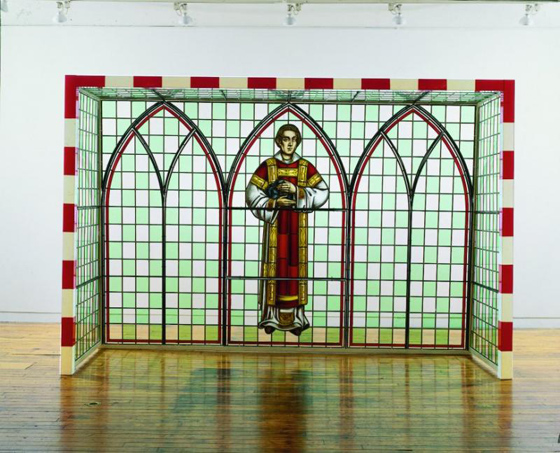 Vim Delvois. Saint Stefan I. 1990
You can also recall the book “Design and Crime” by the American art historian Khala Foster, where he, referring to the Vienna architect Adolf Loos and journalist Karl Kraus, opposing both the collapse of the culture in functionalism and the total aesthetization of Gesam t Kunstwerk Ar-Deco, states that “objective borders are necessary for creating a“ spaciousness ”, which ensures the“ spaces ”that provides“ The development of the liberal type of culture and subjectivity. ” Design crime, according to Foster, just in the abolition of these borders in the world of universal comrade. Delvois also ironically states a crime of design - but in fact he himself carries out it.
There may be several outcomes from this position. “Spacious”, which ensures the development of a liberal type of culture and subjectivity ”can be restored by the course of history, historical cracks and shifts. You can also think for yourself a different type of functionalism than a bourgeois, frightened Loos and Kraus, is the utopian functionalism, which was created by industrialists and constructivists. Although their goal was also the total integrity of the human existence and art should have dissolved in it, in fact the most interesting in their objects - it was the function of mediation, dialectical mediation within a certain gap: these are Alexander Rodchenko’s interactive objects in his “working club” or the dress of Lyubov Popova, which transition between the bourgeois and the new woman. This was written, for example, art historian Christina Kayer. One way or another, in order to preserve faith in the outcome, dialogue, in change, a dynamic backlash in culture is necessary - the backlash of horizontally, and not vertically: there is no talk of restoring conservative hierarchies. However, the works of Delwois are static fetishes that are not yet filled, but already intended niches of culture, and not creating a dynamic gap.