
Translated material
Around only "soldiers"
The "soldiers" of Bernd Alois Zimmerman (1918-1970) again walked around Europe. After the epoch -making performance of Ingo Metzmakher and Alvis Hermanis at the Salzburg festival - 2012 (a record on DVD has already been released) Caliko Biiteo put an opera in Zurich, and on June 15, the premiere of his version was held in the Berlin Comer of the Opera with Gabriel Falats behind the remote control. Another production was prepared in the Munich "Staatsoper" conductor Kirill Petrenko and director Andreas Crigenburg.
Three new productions in a row - hardly anyone could dream about such an opera in 1965. She passed five years later than the planned: then few believed that the “non-veteral” “soldiers” could be put at all someday. The Cologne opera, who ordered this essay, decided at first to completely cancel the premiere. Researchers argue today whether Zimmerman completed the work on time or, faced with opposition, stopped composing, postponing the last act for several years.
 © Bayerische StaatSoper
The performances in the Bavarian opera were expected with special impatience. Firstly, Munich was one of the few cities where the opera was set back in the late 60s, Zimmerman participated in the preparation of the premiere. Secondly, today the cult of Kirill Petrenko began to take shape in Bavaria. Enthusiastic reviews are competed with the enthusiasm of the public, which arranges the apparatus of Petrenko before the start of the performance-although it is hardly possible to find someone less similar to a cult object among first-class conductors than the ever-looking, shy workaholic of Cyril Harrievich. Even while working at the Comm. Opera, Petrenko showed himself a specialist in the German repertoire. Having become a musical director of the Bavarian opera in September, he released three performances during this season - “Woman without a Shadow” by Richard Strauss, “Mercy of Titus” by Mozart and “Soldier”.
Zimmerman, choosing a play by Jacob Michael Reinhold Lenz (1751-1792) as a basis for the libretto, did not change the plot and accents. The antimilitarian spirit of Lenza Zimmerman considered less important than the transfer of relations, the reconstruction of psychology that determined the behavior of people in 1775, when a play was created. (Six years later, the best playwright of the “storm and onslaught” left for Russia. He died in Moscow, falling on the street from exhaustion.)
 © Bayerische StaatSoper
The composer created a "soldier" on the principle of the "total theater." The action was to develop at several sites at the same time, the scene was likened to the rotating ball of the time, where the future threatened the past. In addition to the classic orchestra, a jazz quartet was also involved, and he played right on the stage (in the current production of jazzmen, they remind the Beatles something-a frank reference to the time of creating a work). The performance included ballet, videos and fragments that sound in the record (Zimmerman worked a lot for the radio, the tape film was part of the music for him). According to the author’s concept, the opera ended with shots with images of a nuclear explosion, symbolizing the violence of everyone against all. In the performance of 1965, staged by Harald Negebauer, they refused scenes with a nuclear explosion. Instead, in the final, the bright light blinded the audience, which, however, did not deprive them of the speech of them: the Cologne “bugs” for a long time and willingly.
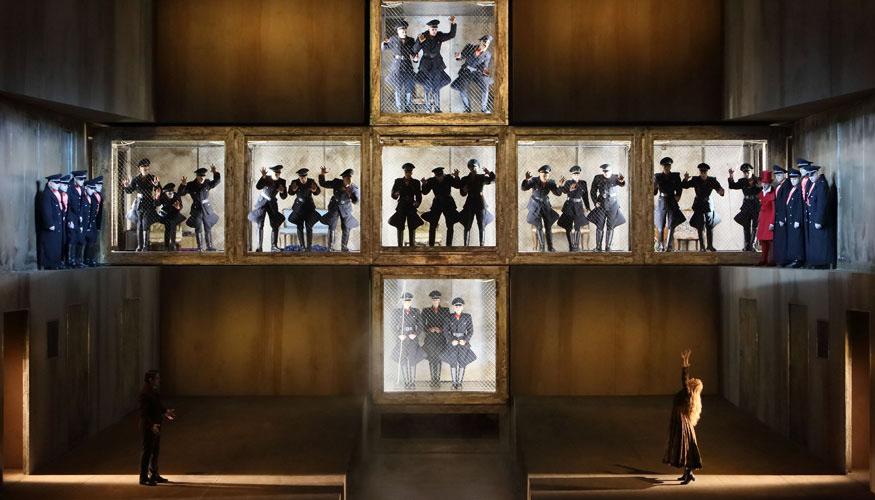
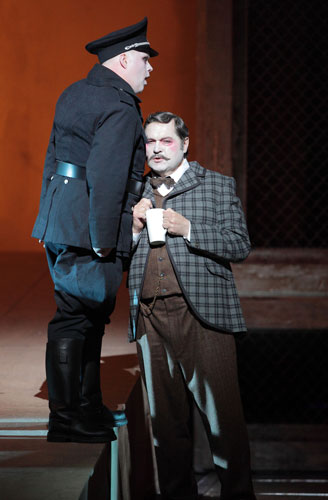
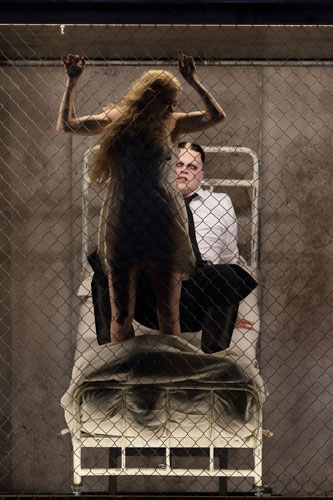
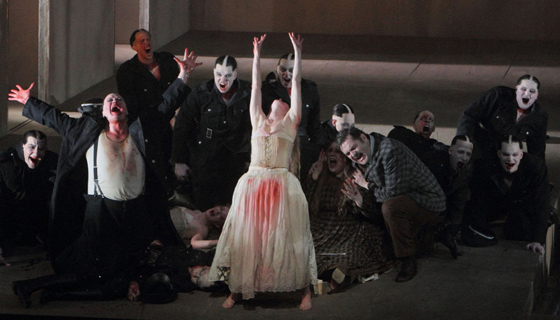
A pair of “boo” could also be heard to the director of the current production. He relied on dislike of the military. The scenes of sexual violence with the participation of people in uniform do not stop throughout the performance. The well -known monotony of poses is redeemed by the propagation of what is happening , the coercion scenes occur simultaneously in several cells. The artist Harald B. Thor built seven capables of claustrophobes of cameras, which are transformed into the brothel or the interior of the bourgeois house. The difference between them in the historical perspective is small, which is emphasized by the Munich performance.
 © Bayerische StaatSoper
Connected in the form of a huge cross, elongated in the length and width of the entire scene, these cameras are initially located in the depths. At times, they go to the advance and then return. A pair of long tables appears from the side, because of the curtains, this, in principle, is limited to the evolution of the visual. If it were not for the light, set by Stefan Bolelier, we could talk about the staticity of what is happening.
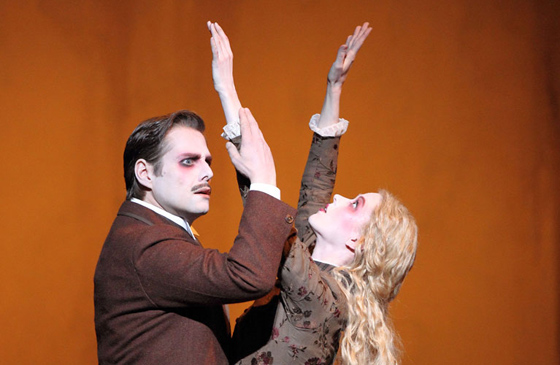
The heroes are dressed in a uniform, reminiscent of the SS, but there are no direct references to Nazism, and women's dresses are completely referred to the aesthetics of the early twentieth century (costumes - Andrea Shrad). It may seem that the director is important to the trauma experienced by Zimmerman during the war years (he served in the Wehrmacht). But, rather, he is not busy with Nazism, but by abuse of power. The movement here is inside the plot, in the relations of characters, whose ideas about the world are so different. Marie (Barbara Hannigan) appears not so much as a victim of circumstances devoted to his own father (Pavel Danilyuk), as a woman who refuses reality in the right to dispose of her. This is her cardinal difference from the sister of Charlotte (Oka von der Damrau), whose ideas about the surrounding are unshakable, like a cage rods.
Hannigan is one of the main decorations of the evening. Not a woman, but a dream! The modern repertoire is its horse, which does not cancel the Armida in the Gendelev Rinaldo. In fact, she was not only a singer, but also a conductor, performed, in particular, with the orchestras of Cologne and Gotyrog, and in the shaft she performed the “fox” of Stravinsky. A character from the series "Man-Orchestra", it falls into the image due to its amazing plasticity. Crigenburg makes her continuously move even in “alien” scenes, plastic Hannigan seems as hard as her voice.
 © Bayerische StaatSoper
The "soldiers" are staged in that strict, not leaving scope for the fantasy of the manner, which made it possible to focus on the music itself. In the version of Petrenko, it sounds brutally, which is helped by a huge orchestra (more than a hundred musicians - some even sit in the lodges of the stalls), experiencing the acoustic capabilities of the seemingly small Munich theater (nevertheless in the Zalzburg FestSpilhaus, Zimmerman was breathed more freely, but there Metzmacher also needed the second conductor for working with soloists). But Petrenko finds a balance between the massive parts of the orchestra, which allows music to remain sensual and even tender. It is not for nothing that the reviewers “Noah Zurher Tsaitung” and “Zyuddeche Tsitung” use one word: “Brilliant” to evaluate the performance.
In Munich, it becomes clear again why the “soldier” is listed among the main musical events of the twentieth century: their first conductor Michael Gilen in the book of memoirs “Unbeding Musik” puts the opera on a par with “Lulu”, “Votsek” and “Moses and Aaron”.