
Translated material
Epos and Tanatos
John Kits begins the poem "The Fall of Hyperion" with verses:
Fanatics has their Dreams, Whewith They Weave
A paradise for a sec; The Savage too
From Forth The Loftiest Fashion of His Sleep
Guesses at Heaven; PITY THESE HAVE NOT
Trac'd Upon Vellum Or Wild Indian Leaf
The Shadows of Melodious Utterance.
In one of the Russian translations, this sounds like this:
Schismatics in dreams are erecting paradise
For the elected lucky ones; And the savage
Guesses - in a pagan manner -
About heaven. And, the right word, sorry,
What to papyrus or hazharatya
None of them laid the singing lines ...
These lines are revolutionary in their own way, because, firstly, they are designed to contrast the “pagan” poem by Kits with the Christian epic of Milton, and secondly, they recognize the right of each people to their epic, that is, to self-awareness.
Indeed, there is no people who would not have their own epic, their legends and legends explaining the being of the people, their origin and their fate.
The epic, that is, a network of legends and stories about the fate of the people or its individual representatives, is inextricably linked with the history of the people who composed it, but is not identical to it. He can pretend to be history (as the Romans or the Jews) explain its individual units (like medieval military words and gestures) or even replace it (like the foggy legends of the maneves).
Although the epic is large, it may be secondary and incomplete in the center. For example, a small episode of the Trojan War, or a separate unsuccessful campaign of an insignificant prince, or even the loss of a curl. But this special incident is always exalted over the surrounding reality, from a private event, it becomes a collective property. It should turn into a universal answer, standard, instruction, sacred text, which primarily distinguishes us from them, distinguishes among other peoples.
The shape of the epic can be different. In a broad sense, the epic is a function, a certain set of qualities, and not an established form. Nowadays, the epic can be a poem, a classic novel or film. Even especially the film, since films, like books from the school curriculum, most often turn into a collective treasure.
It is not surprising that several films that may well be considered epics hit the MMKF program, which has always been distinguished by a striking diversity and resembling the shopping rows on a bazaar day. Indeed, if the MMKF is a bazaar, then where, if not in the bazaar, gather for rapeseeds and vagrant singers?
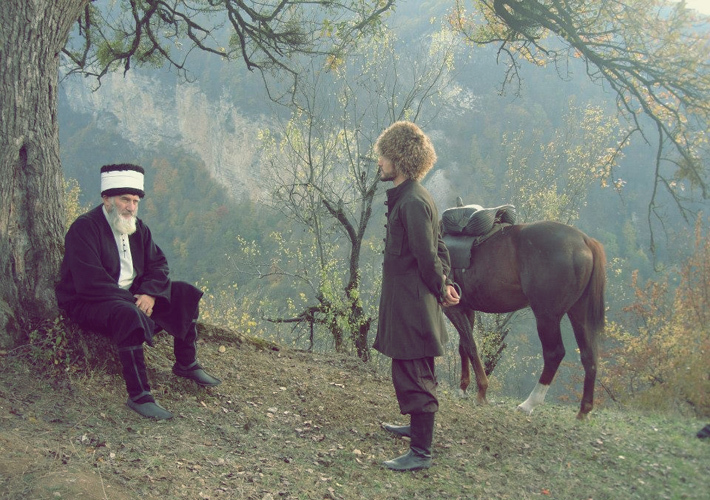
The film of Hussein Erkenov’s film “ordered to forget”, primarily known for the fact that the Ministry of Culture did not give the ribbon of cinema, and the Department of Cinematography, called the events described in the film “historical fake”, stated that his demonstration served as “inciting interethnic growth” turned out to be a very successful experience in creating the national epic.
Residents of the aul will be burned. Just because this is always the case in folk ballads.
Erkenov’s film tells about the incident, presumably occurring in the village of Haibach in 1944, during the deportation of Chechens to Kazakhstan. Then, according to some sources, the NKVD employees, trying to finish the deportation on time, burned about 700 people in the collective farm shed.
This event was actually or not - a discussion question. Sources are doubtful and confused in details, but there are almost no witnesses left. However, (as always in the case of epic legends), we should primarily be interested in not the truth of history, but the truth of fiction.
There are many complaints about this film. First of all, it was shot in the puppet style of the 1st and 2nd channels and at some moments it resembles the series in the spirit of "while the village is sleeping." In some places he is naive, even to vulgarity. However, Russophobia is the last thing you can blame Erkenov of. And how can you calculate the Rusophobic film, in which one of the main symbols of modern well-being is the triumphal entrance arch in Grozny, decorated with portraits of Putin and Kadyrov Sr.?
Truely following the modern Russian serial style, “ordered to forget” interprets the NKVD officers exactly as it interprets them “in the first circle” or “penal battalion”. Moreover, following the long -standing folklore tradition, the authors include the suicide of a noble officer who refused to fulfill the inhuman, in his opinion, order in the plot. Ordinary Russian soldiers are even shown with obvious sympathy.
Should the film be blamed for timid studs addressed to communism (Encavedeshnik from the locals - one of the main anti -Heroes - states that by nationality he is a communist)? But don't we restore our national roots either? And even the miraculous acquisition of the bas -relief of Vuchetich on VDNH will hardly change the matter. The ban on this picture rather indicates the irrational fear of officials before the Caucasus and, as a result, of the irrational fear of the manifestation of national self -consciousness of the Caucasian peoples. And in “ordered to forget” it manifests itself in full.
In fact, the authors were able to create a cycle of epic songs based on the very origins of mythological memory common to all peoples. Of course, one should not search for “ordered” to “forget” the stylistic references to the films of Parajanov, but there is something in the Erkenov method, which is related by his picture with the same “shadows of forgotten ancestors”.
But among the laughing faces, a formidable enemy lurked - an employee of the NKVD.
Erkenov is too fond of his narrative in order to look at the individual features of mountain life with fetish passion. Instead, he sprinkles with their generous hand, as if walking, which gives the narrative greater reliability.
Like all folk works, “ordered to forget” becomes an epic by accident, it tells of a very local event, which incorporates the entire cultural experience of the people that gave him. The authors do not just work with a certain mythological tradition, but feel like its immediate part.
Here is the growing up the hero. A faithful horse, a wise father who takes an oath of an oath from his son to never shoot people. Here is a beauty, delicate, like a flower. How she dances among her friends, how gently she looks at the hero! But among the laughing faces, a formidable enemy lurked - an employee of the NKVD, who was also seduced by the beauty of the girl and will now bring the hero’s family into the grave. Then other characters appear, no less important, and the bride of the protagonist will have a nightmare. And in the end, the son will make an oath given to his father in order to save the child, and with him - the future of his people.
The narrative is interrupted by inserting short stories. Here is the instruction of the holy man, here is the wise woman - the chairman of the collective farm - refuses to sign papers against fellow villagers, so the young man sings a sad song about the grief of the people. And then the annual cycle of mountain life.
And is it so important that in the middle of the film the main antagonist suddenly disappears, giving way to the general of the NKVD? This is unacceptable from the point of view of modern poetics, but if we consider it “ordered” by the cycle of epic legends - probably the oldest form of the epic - then there is nothing surprising that the defeated enemy is replaced by another, the evil, because both of them are usually embodied by one destructive force with which the hero is forced to fight on the path to establishing harmony.
Without even knowing the background of the film, we know that the inhabitants of the aul will be burned. Only because this is always the case in folk ballads in which the evil ruler drives the peasants into a large barn. The will of the character here obeys the laws of the traditional narrative. It only seems to us that we have before us Soviet citizens of the 40s. No, they are the creatures of folk fantasy that existed in all centuries.
And when the plans suddenly burst through the vulgar fuss, as if coming from the “departing”, I would like to forgive the film with all its many weaknesses. As if remembering the duty - to tell through one local event about the fate of the people, the camera seeks to turn the picture into an endless gallery of the types of the old Caucasus, it admires the faces of people: Burki and beards of men, the burning eyes of women who shine so brightly through their black scarves, the noble gray gray -haired old people.
And when you look at this strange canvas, funny and majestic at the same time, it seems that it is not so important whether the shown event was in reality. It is important that it was imprinted in folk memory, and the film is only a naive attempt to fix it. It is the power of this memory, this great tradition that is capable of making a miracle worthy of a fairy tale, which is able to turn not very good cinema - flesh from the flesh of modern streaming Russian cinematography - into something living, to give it a certain dimension of truth, which is more important than truth.
The writer with the most pious expression masturbates the old man, talking about the annual peasant cycle.
It is this magical transformation that all our soils from culture achieve, not understanding that the tradition cannot be invented from the head. About the same mistake is made by Ukrainian director Victoria Trofimenko, whose "brothers. The last confession ”even got into the main competition.
The film talks about two old Gutsula brothers who live on a lost Carpathian farm and patiently, with hatred and gloating await each other's death. By chance, a writer calls on the farm, composing spiritual Christian books. Forced to linger due to snow that had fallen in the mountains, she decides to understand the causes of fraternal enmity, simultaneously showing all possible forms of Christian mercy to them.
The confrontation of the two brothers, a beautiful woman, a dead child, even seems to be a struggle of raw and prepared - all this should be in all the lists of mythological plots, from the sulfur of Thompson to the lists of Borges and Poles. Yes, and the Hutsules are a people, since the time of Mark Donskoy and Parajanov, doomed to become a hero of epic legends.
And the “brothers” try to do everything to become an epic. The authors, it seems, deliberately put the film in a conditional, almost mythological space and time, leaving behind the brackets the entire world history of the 20th century and managing not to notice the Soviet government. The timid sprouts of reality break into the picture only in the part of modern scenes, along with an eternally vigorous announcer, which in the house of one of the brothers backdles talks about the events of recent months. This obsessive sound background is too seductive so as not to compare two infantile brothers, whose fault dies to their common (another mythological plot) son, with a society ready to break himself from the inside.
But the "brothers" try to be higher. They constantly dilute the liquid story with neat stories about the life of St. Christopher with an indispensable scene of the transfer of the baby Christ over the river. Keeping the slowness of the Scandinavian source (the film is a film adaptation of the novel “Bumblebee honey” of the Swedish writer Torogni Lindgren), the authors of the film take any opportunity to admire the details of the Hutsul life. Each thing in the frame turns into a thing, every event into an event that is intended to coffee with another event, forming a whimsical pattern that are usually on embroidery.
The abundance of mythological (primarily Christian) symbols is striking for the film, in which most of the screen time is almost nothing. The dying old man accepts the pose of the crucified Christ, the writer with the most pious expression masturbates the old man, while telling about the annual peasant cycle, before the fall of the heroine, we notice the ominous black spider on the window frame, St. Christopher enters the frame at every opportunity. All this is incredibly anthropologically, incredibly book, incredibly correct even.
And this is perhaps the main reason that prevents the film from turning into a real epic. The creation of such stories is not the work of the mind, but the “brothers” are most similar to a diligent child who does not very skillfully play a sipple play on the violin. Alas. Such a movie can take prizes at festivals, but it is useless during the construction of the nation.