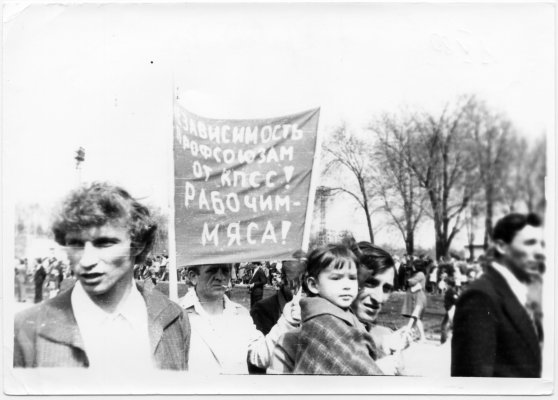
Pervomaiskaya demonstration of 1980 in Krivoy Rog. Photo from the archive of the International Society "Memorial"
The text of the document is given by electronic publication (see). Secretsk KPSS0275128 Jan The 19671th sector of the Central Committee of the CPSOMICTION of State Security and the USSR prosecutor’s office reports on the measures taken to suppress antisocial, politically harmful manifestations from individual hostile persons. As previously reported, starting in December 1965, Moscow had repeatedly attempts to organize various kinds of gatherings and provocative performances in defense of Sinyavsky and Daniel [1], then the “memory of the victims of Stalinism” [2], then with demagogic requirements for the revision of laws. In the latter case, January 22 S.G. A similar gathering took place on Sl. Pushkin, where a group of persons gathered in the amount of 15–20 people with posters containing the requirement to cancel individual articles of the Criminal Code and the release of anti-Soviet documents that were most actively detained from the CGB of the KGB by the CGB [3]. The antisocial actions of the indicated group were accompanied by shouts: “Down with the dictatorship”, “to cancel the anti -constitutional decree”, etc. The brothers, as a rule, are preceded by the spread of various kinds of politically harmful materials, including leaflets with demagogic requirements [4]. The action of gatherings are not random. They are to a certain extent inspire and are heated by those who, in the situation of the increased political activity of the masses and the measures taken by the party to strengthen and expand socialist democracy, hiding behind the false slogans of the struggle with the “consequences of the personality cult” and for “true democracy”, embarked on the path of demagogy and, in essence, set the goal of denouncing the democratic conquest of the Soviet The number of such people include: a researcher at the All-Union Institute of Scientific and Technical Information of the USSR Academy of Sciences A. Volpin, an employee of the Institute of History of the USSR Academy of Sciences P. Yakir [5], the working literary museum A. Ginzburg and some others. The politically ambiguous performances of a personal pensioner A. Snemov also plays a certain role in this [6], writers E. Genrei [7], L. Chukovskaya [8], B. Balter [9], A. Kosterin [10], historians of A. Nekrich [11], L. Petrovsky [12], as well as the unprinciplity of some prominent scientists and cultural figures who signed some politically dubious documents [13]. The result was a group of persons in the amount of 35–40 people who carry out their politically harmful activities by manufacturing and spread of anti -Soviet literature, and award Also organizations of various kinds of manifestations and gatherings. Participants in this group appeal to the Western press, which prints the materials they manufactured, trying to spread them in the territory of the Soviet Union. Recently, more and more often and more often they go to the foreign anti -Soviet organization of the NTS [14]; Her magazine “Glass”, using these materials in anti -Soviet campaigns, calls on the basis of them to active subversive actions, and NTS leaders send direct instructions to individuals of this group. It should be noted that some members of the group directly count on the support of the reactionary circles of the West. The prosecutor's office and state security against these persons were taken by preventive measures, conversations were carried out with many, and a positive impact on the place of work and through public organizations had. However, neglecting the warnings, they did not stop their criminal activity, and foreign anti -Soviet organizations, speculating on the humanity of the Soviet government, are taking further measures to activate their provocative speeches. Taking into account the state security committee and the state security committee in order to suppress hostile activities for the manufacture, distribution and transfer of anti -Soviet literature abroad, and Also for organizing and active participation in group actions that violate public order, they were arrested and prosecuted: Ginzburg A.I., born in 1936 [15]; Workers of the Literary Museum of Galanskov Yu.T., born in 1939 [16] and Dobrovolsky A.A., born in 1938 [17]; laboratory assistant Moscow State University Lashkova V.I., born in 1944 [18]; Technician of the Institute for the Design of Fire Metallurgy enterprises Radzievsky P.A., born in 1947 [19]; Kushev E.I., born in 1947, without specific classes, a member of the Komsomol [20]; Chauffeur Haustov V.A., born in 1938 [21], Bukovsky V.K. , 1942 [22], and Delon V.N. , Born in 1947, both without certain classes [23]; and high school teacher Gabay I.Ya., born in 1935 [24]. It should be noted that some of these persons suffer from mental illness [25]. The hostile activities of previously brought to criminal liability and released in connection with mental illness Grigorenko P.T., former Major General of the Soviet Army [26], and Volpina A.S., born in 1924 born [27], are also accumulated [27]. In relation to the latter, the nature of his connection with the arrested emissary of the NTS, a citizen of Germany Shaffhauser [28], who was driving Volpin, the anti -Soviet literature and the instructions of the Center for NTS. The fact that bringing to criminal liability of the indicated persons will bring a certain reaction within the country and abroad, would be advisable to entrust the department the necessary explanatory work, including the performances of party workers, authoritative propagandists, managers of the prosecutor's office and state security workers at enterprises, institutions and especially among student youth. Committee of state security and the USSR prosecutor’s office, for their part, have in mind the preventive measures at the place of work and study of persons allowing antisocial manifestations and lack of vital lack of vitality and lack of vitality experience. At the same time, it seems advisable to prepare a detailed message to the Izvestia newspaper with an explanation of the measures taken, as well as to entrust the USSR Foreign Ministry, the KGB and the prosecutor's office to inform our foreign representatives abroad. Semi-City R. Rudenko on January27, 1967 No. 162-s [1] rally on December 5, 1965 on Pushkinskaya Square. The first public opposition action since 1927. It is considered the starting point of reference for the history of human rights movement in the USSR. [2] Probably a demonstration on March 5, 1966 (on the day of Stalin's death). [3] The documentary collection “Justice or reprisal?”, Compiled by Pavel Litvinov, is devoted to this demonstration and the trial of its participants. [4] This refers to the “civil circulation” of A. Yesenin-Volpin with an invitation to come to the action on December 5, 1965 to Pushkin Square. [5] Yakir Petr Ionovich (1923–1982). Historian. Prisoner of the Stalinist camps (1938–1942, 1944–1952). Political prisoner (1972–1974). One of the leaders of the struggle against restalinization, in particular, in the first half of the 1960s often made stories about his father (repressed commander Iona Yakir). [6] Snegov Alexey Vladimirovich (1898–1989), party worker. Prisoner of the Stalinist camps (1937–1954). Deputy. Head of the Political Department of the Gulag Ministry of Internal Affairs of the USSR (1954–1960). It was considered one of the authors of the Khrushchev report at the XX Congress. In Samizdat, his anti -Stalinist speeches were distributed at the discussions of Prince. A. M. Nekrich “June 22, 1941” (1966) and the 3rd volume of the history of the CPSU (1966). [7] Henry Ernst (1904–1990), scout, journalist. Political prisoner (1953–1955). In Samizdat, his anti -Stalinist letter to I. G. Erenburg (1965) was widely circulated in Samizdat. [8] Chukovskaya Lidia Korneevna (1907–1996). Writer. A member of the anarchist “Black Cross” - the organization of assistance to political prisoners (1925–1926), political and political (1926–1927). She acted in defense of many dissidents. In 1974 it was expelled from the Writers' Union. This refers to the open letter of L. Chukovskaya Mikhail Sholokhov about his speech at the XXIII Party Congress, in which Sinyavsky and Daniel were mentioned (1966). [9] Balter Boris Isaakovich (1919–1974). Writer, front -line soldier. He defended Sinyavsky and Daniel at the Writing Assembly (1966). [10] Kosterin Alexey Evgrafovich (1896–1968). Prisoner of the Stalinist camps (1938–1943). In 1966–1967 he repeatedly performed at writer's meetings with speeches against restalinization. [11] Nekrich Alexander Moiseevich (1920–1993). The author of the book “June 22, 1941” (1965), who was subjected to sharp officiaificial attacks for criticizing the activities of I. V. Stalin in the pre -war and initial period of the Second World War. [12] Petrovsky Leonid Petrovich (1933–2010), historian. He participated in the discussion of the book of A. M. Nekrich “June 22, 1941” (1966). One of the active fighters with restalynization in the 1960s. [13] This refers to the “letter of 25” against the rehabilitation of Stalinism, signed by famous scientists and writers (1966). [14] The People’s Labor Union of Russian solidarists (NTS) is the Russian Emigrant Political Party. It was founded in 1930, changed the name several times (the current one is from 1948). The ideological basis of the party is solidarism. The bulk of the NTS members in the 1950-1960s are the emigrants of the “second wave”, although the NTS leadership came out, mainly from the “first emigration”. During the Second World War, some NTS leaders collaborated with the Germans. In the 1960s, he tried to establish ties with the dissident movement in the USSR. Some dissidents used its channels to transfer to the West and publish their works there. The accusation of ties with the NTS was often used by the KGB to compromise the dissident movement. [15] Ginzburg Alexander Ilyich (1936–2002). Journalist (Moscow). The editor of the First Samizdat magazine Syntax (1959–1960), the compiler of a documentary in the case of Sinyavsky and Daniel - the White Book, the manager of the Fund for Assistance to Political Personents and their families (1974–1977), a member of the Moscow Helsinki group (1976–1977). Political prisoner (1960–1962, 1967–1972, 1977–1979). Sent from the USSR and exchanged (1979). Lived in Paris. [16] Galanskov Yuri Timofeevich (1939–1972). Poet. Political prisoner (1967–1972), died in the camp. [17] Dobrovolsky Alexey Alexandrovich (1938–2013), worker (Moscow). In 1957 he created an underground “Russian National Socialist Party”. Political prisoner (1958–1961, 1964–1965, 1967–1969). After frank testimonies at the process of demonstration participants on 01/22/1967 (V.K. Bukovsky and others), the “process of four” (1968) became a person Non Grata in the dissident circle. Sentenced to 2 years of camps. Considering that Dobrovolsky is a recidivist ”is a year less than the minimum sanction provided for by the Criminal Code of the RSFSR. He lived in the Kirov region, called himself the Volkhvy Dobroslav and was one of the spiritual leaders of Russian pagans-neonacists. A number of works are recognized as extremist. [18] Lashkova Vera Iosifovna (b. 1944). Typist. She printed the “White Book in the case of Sinyavsky and Daniel”, “Chronicle of current events”. Political prisoner (1967–1968). [19] Radzievsky Pavel A. a few months after the arrest was released, a witness in the process in the case of Ginzburg-Galanskov (1968). [20] Kushev Evgeny Igorevich (1947–1995), poet. In September 1967, he was sentenced to 1 year of forced labor. Emigrated (1974). [21] Haustov Viktor Aleksandrovich (b.1938). Worker. Political prisoner (1967–1970, 1973–1978). Lives in Irkutsk, priest. [22] Bukovsky Vladimir Konstantinovich (b.1942). Biologist, public figure (Moscow). Uch. In the organization of informal readings on Mayakovsky Square (1960–1961), “Glasses Rage” (1965). He transmitted documents to the West on punitive psychiatry in the USSR. Political prisoner (1963–1965, 1965–1966, 1967–1970, 1971–1976). Extended to the leader of the Chilean Communist Party of Luis Corvan (1976). Lives in the UK [23] Delona Vadim Nikolaevich (1947–1983). A participant in the demonstration on January 22, 1967. Sentenced to 1 year conditionally. Member of the demonstration on August 25, 1968. Political prisoner (1968–1971). Emigrated to France (1975). [24] Gabai Ilya Yankelevich (1935–1973). Poet. A participant in the demonstration on December 5, 1965 and January 22, 1967, arrested, the case was dismissed. Political prisoner (1969–1972). I committed suicide. [25] Dobrovolsky and Bukovsky in the early 1960s were already arrested and sent for compulsory treatment. [26] Grigorenko Petr Grigoryevich (1907–1987), Major General (unclenched into ordinary after arrest), organized the “Union of the struggle for the revival of Leninism”, political prisoner (1964–1965, the Leningrad Special Psychiatric Hospital). He supported the struggle of the Crimean Tatars for returning to Crimea, in 1969 he was arrested in Tashkent, the investigation in his case was led by Berezovsky, political prisoner (1969–1974, Chernyakhov Special Psychiatric Hospital and White Pillars). Member of the Moscow and Ukrainian Helsinki group. In 1977 he emigrated to the USA. [27] Yesenin-Wolpin Alexander Sergeevich (b.1924). Poet, human rights activist. The organizer of the first public action of dissidents - a rally of publicity on December 5, 1965. Political prisoner (1949–1953, 1959–1961, 1968). Emigrated to the USA (1972). [28] Shaffhauser Folker Wilhelm (r. 1941). 3rd year student of Headelberg University. Political prisoner (1967–1969). In connection with his case, Yesenin-Volpin was interrogated.
"Buying and provocative performances" • OVD-Info • RIMA — Russian Independent Media Archive