
Translated material
The anniversary of the "peaceful atom"
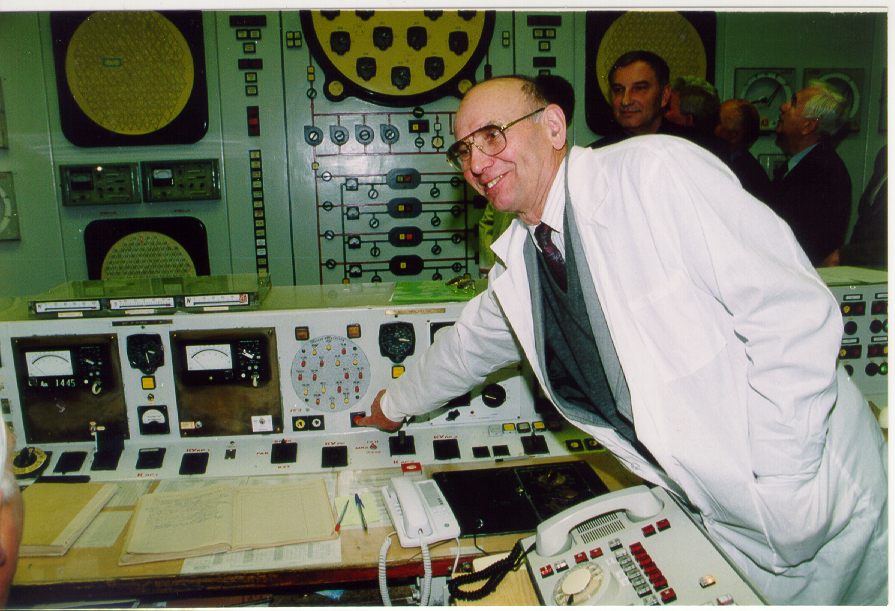
Lev Kochetkov on launching and stopping the world's first nuclear power plant in Obninsk
The 60th anniversary of the launch of the Obninsky nuclear power plant was officially recognized by the first industrial nuclear power plant in the world. Lev Kochetkov stood behind the remote control of the Obninsky nuclear power plant and on June 26, 1954 during the launch, and personally stopped its reactor 48 years later, on April 29, 2002.
- How did you get into atomic energy?
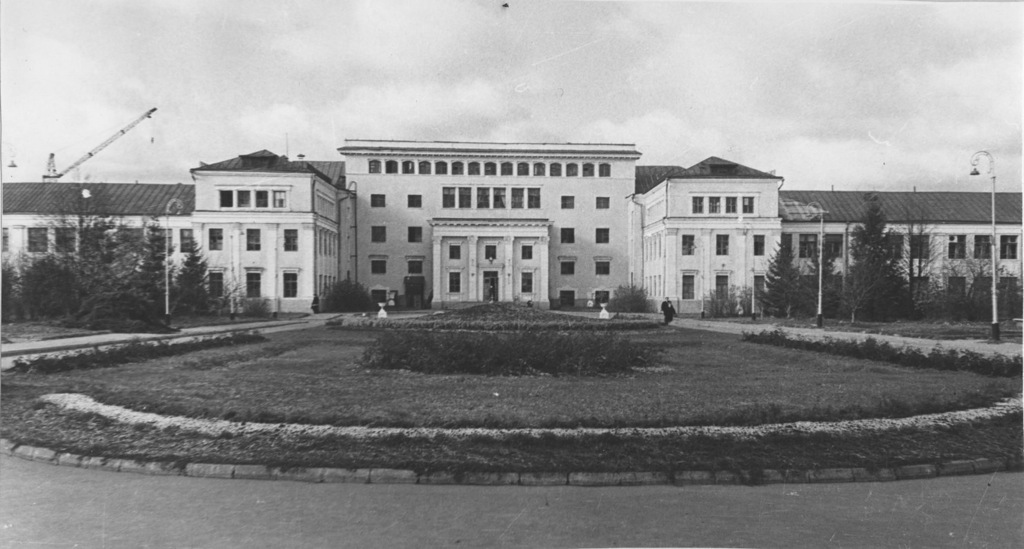
- I entered the Moscow Energy Institute, in 1945 a special faculty was formed in it, as it was called, faculty number 9. Students from the second year were recruited there, according to the results of exams of winter and spring sessions. Those who handed them to one fives were invited to the dean and offered to move to another faculty. They said, “It will be interesting there.” But what exactly "will be interesting" did not say. I was also called, and I agreed. It turned out to be really interesting to study, although it is difficult. The institute was led by the wife of Malenkov, and this was perhaps the number of number two in the country at that time. She gathered wonderful professors to our faculty, created a good experimental base. They prepared, as it turned out, reactor, experts in accelerators and devices. After graduating from the faculty, our reactor group was again invited to the dean’s office. They asked who wants to stay in Moscow, and who wants to go near Moscow, but not very far. Since I have already been in practice in the laboratory "B", as our Physical and Energy Institute was called before, I chose the Moscow Region, one hundred kilometers from Moscow.
- Wasn't it a pity to leave Moscow? After all, many sought to remain in the capital when distributing by hook or by crook.
- No, it’s not a pity. Firstly, my older brother remained in Moscow, he from our village the first moved to the capital and was a teacher there at the Air Force Academy. Well, then, I loved to take a seasonal ticket to the conservatory. So we were in Moscow all the time, especially in winter. And I liked living as a rural resident more in the forest.
- And in this forest, in the area of the current Obninsk, they began to build the world's first nuclear power plant. How was this decision made?
- In 1945, after the first two nuclear bombs were blown up over the Japanese cities, not only special faculties were formed in the country, like the one that I finished, but also a special committee led by Lavrenty Beria under the State Defense Committee, and in addition, the first main management under the government. Of course, at first it was mainly about the development of nuclear weapons. But under the First Main Directorate, the Scientific and Technical Council was, which included, among other things, Igor Kurchatov and Peter Kapitsa. At the meetings of the Council of Kapitsa, he constantly talked about the peaceful use of atomic energy, which should be started to develop the nuclear power plant. Beria from Kapitsa, as you know, eventually got rid of, but the latter had many like -minded people. In 1949, the first tests of the Soviet atomic bomb were held, and immediately PSU received an instruction - to prepare a program of peaceful application of atomic energy. On May 16, 1950, a government decree on construction was issued
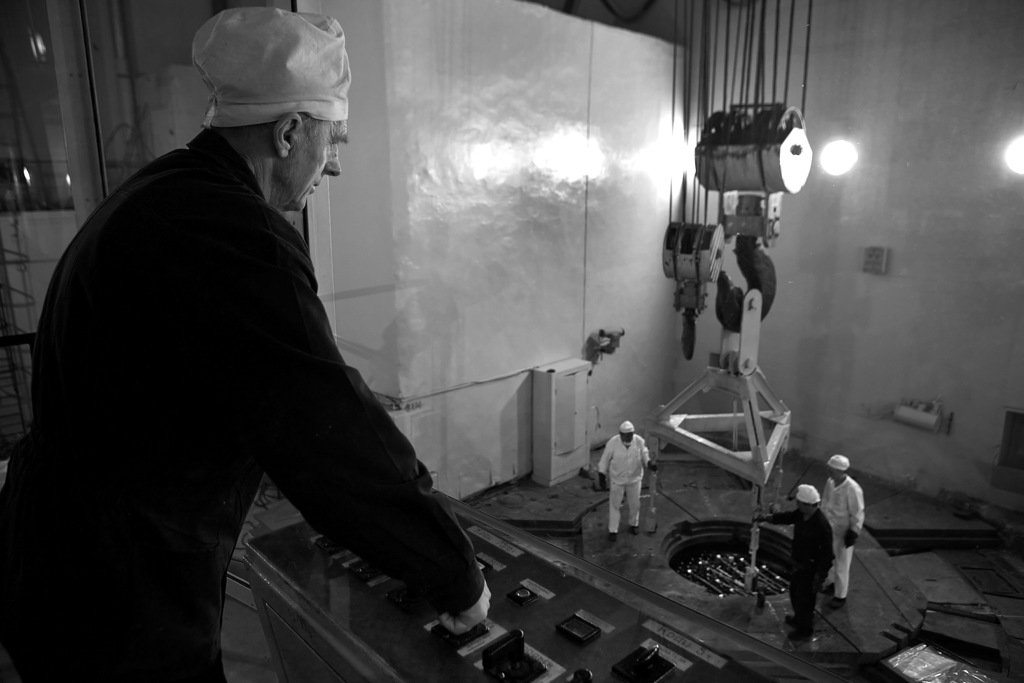
Object B-10. It was assumed that it would consist of three reactor installations and one turbogenerator. Moreover, the turbine appeared at the station of the first - it was old, it was almost found at the landfill. Turbines, actually, produced the Leningrad Metal Plant, and what was left of Leningrad after the war? Neither people nor specialists. So they found what they found, but nevertheless they were delighted: there is already one element of the first nuclear power plant, let's now quickly design the reactor.
- The terms were set as tough as when creating an atomic bomb?
- Yes, the creation of the station has become a largely priority political task: to show what we are for a “peaceful atom”. This, of course, helped a lot - there were no problems with financing, they gave as much as necessary, not like it is now. But the creation of the station was allotted only one year. This is because for the atomic bomb in Chelyabinsk-40 a large reactor was built in just two years-weapon plutonium was produced on it. Well, then they decided: since they made a large reactor in two years, then a small one, for the station, can be built in one. It turned out, of course, that in technical terms, this is a much more difficult task. The launch time was ultimately postponed twice.
- Weren't you afraid of repression?
- I saw the documents, of course, we were greatly scolded, but nevertheless treated with understanding. We explained the reasons for the delay, and we somehow believed us, although now it is even amazing. Everything was done in the end in three and a half years, and this, of course, was an emergency regime. The quality of work, equipment, some engineering solutions were not on top. When they started to let the station, there were enough troubles, but everything was, fortunately, without major accidents. For all 48 years of work, we did not send any of the staff to the next world. The environment, including the city of Obninsk, retained the natural radiation background.
- If when creating a bomb it was possible to focus on drawings stolen in the United States, then there was no world experience at all, did everything have to come up with it?
-Some technologies-the enrichment of uranium, the production of pure graphite-have already been developed for military needs, but much had to be done from scratch. When I came to work at the institute, I first got into a group that conducted the calculations of the future nuclear reactor of the nuclear power plant. We did not know anything at all, there was no constant. And after all, computers have not yet appeared. I was lucky, I had the best in the department the calculated device - "Triumph", a trophy German mechanical arithmometer. Everyone else, for girls-recounters, had domestic, brands “Felix Dzerzhinsky”. Not only was it inconvenient to count them, but it was also physically very difficult, it was necessary to constantly twist a tight handle, the girls had a terribly hurt her hands from her. I felt very well with my imported "triumph", but my calculations were the most voluminous. And so, of course, on the logarithmic rulers they considered it. The head of our group was completely counted in the accounts.
- You did not stay in the calculation department - when the station was launched, did you already work on the remote control?
- Yes, when they began to recruit the staff of the station, I was again called to the directorate and offered to go to the operating rooms, to the remote control. It was difficult to refuse, although, of course, I already got to the estimated group and wanted to stay there. But the bosses crushed, said that educated people needed the station.
- Remember the launch day?
- On July 1, 1954, a message appeared in Pravda that in the Soviet Union by the forces of workers, engineers and scientists, the world's first industrial nuclear power plant was created, it was synchronized with the Mosenergo network and the electric current began to enter nearby areas. The note said that the launch occurred on June 27, but in fact it happened at 5 o’clock 45 minutes in the morning on June 26, 1954. The authorities were very big. It is funny that everyone was so busy that they did not prepare a banquet, so everything was already organized along the way. Our director Blokhintsev took the entire top to his apartment, and there they already noted.
- And you?
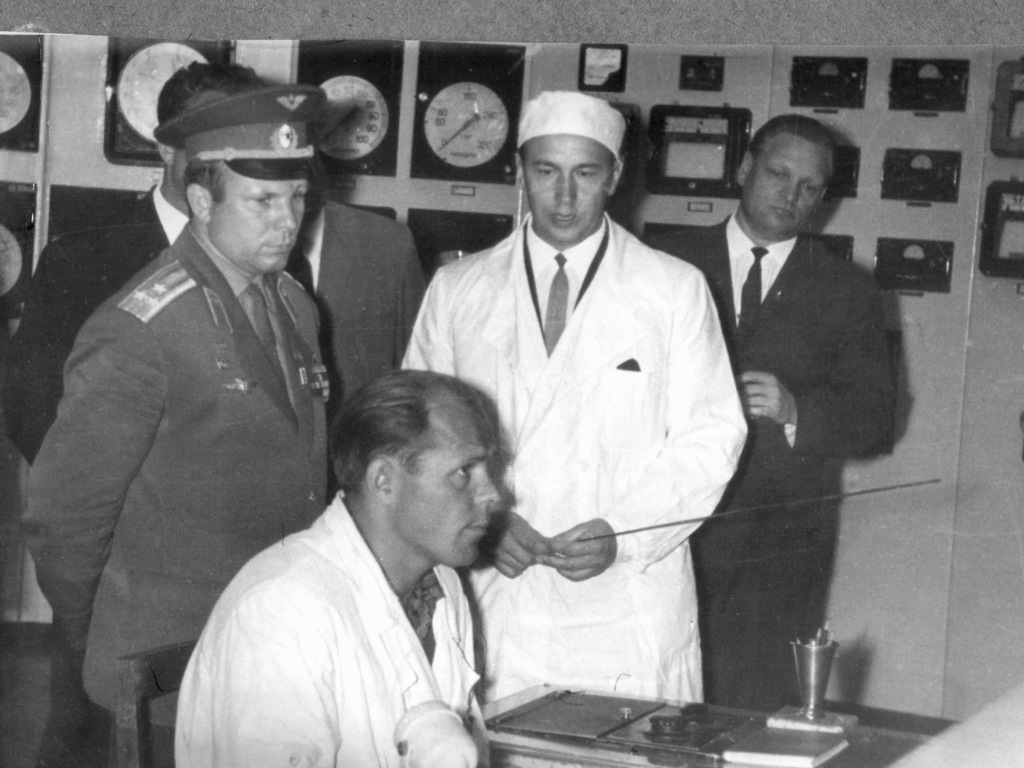
- Well, we were on the remote control. Of course, we were also happy, but the real understanding of what happened came to us much later. Somehow we could not truly appreciate what happened, we only understood that we should know which buttons to press in order not to arrange an accident. Honestly, at first we were afraid of all these buttons of the cursed ones. Over time, we got used, of course, a good education was very useful.
- There really was something to be afraid?
- As it turned out, yes. We just went to power, gave steam to the turbine, went the first month of operation. And here we began to flow in the fuel channels and in the channels of the reactor protection system. The reactor was cooled by water, it was under huge pressure: in old units - 100 atmospheres. And the thickness of the walls of the tubes that kept this pressure is only 0.4 mm. The design was such that chlorine corrosion could occur. And when the water enters the graphite masonry, in which the temperature is 600-700 degrees, it evaporates and a radiolise of the steam occurs under the influence of radiation, the water breaks into oxygen and hydrogen, and their mixture is very explosive, this is the so-called explosive mixture. When we reported on the leakie, Kurchatov immediately gathered a visiting session of scientific and technical
Council. Different sentences sounded there, someone said-to close immediately, someone-let him work for a couple of months. But in the end, the mind prevailed, Minister Efim Slavsky said: we stop for repairs, replace defective channels with normal ones. We need a reactor not for the performance, we need to develop atomic energy. As a result, from July to October, repair continued. On October 26, the reactor was again brought to maximum power, and since then they worked more or less normally.
- Tell me, the atmosphere, which is shown in the film “9 days of one year”, willingness to self -sacrifice for the sake of progress and science - was that all the truth?
- I do not remember such an atmosphere. We were afraid, although our leaders, responsible persons were probably afraid even more.
-People have a kind of irrational fear of radiation, radiation is some kind of incomprehensible, invisible killer. Especially this paranoia intensified after the accident at the Chernobyl nuclear power plant. Have you experienced something like that?
- No. We were reasonable people, and we had experience. And experience sometimes gives a person more than education. You know how everything works, what is dangerous and what is not. You feel by yourself if something is wrong. Of course, everywhere, including us, there were people who said all the time: it is not necessary to study nuclear energy, too dangerous. Well, this is true, but the farther, the more dangerous in the world appears. And with statistics, one cannot but reckon. So far, in the nuclear industry, the damage to human health has not been so big. Another thing is that after Chernobyl there was very high material damage and moral. Well, they are to blame for themselves: they scared people, because everyone was concealed for some reason. It was not necessary to do this.
- Obninskaya NPP is officially recognized as the world's first industrial nuclear power plant. Did she really work and was useful in this capacity?
- In fact, the station did not give electricity to the network very long. But we supplied heat until the very closure, heated our institute and neighboring plants. In addition, radiation products were produced: isotopes for medicine and not only. This is not to mention the fact that on
The reactor conducted many experiments. In fact, the Obninsky nuclear power plant is, of course, an experimental installation, and in this capacity it was very important. It, for example, conducted studies of elect generating channels for space reactors for installations "Buk" and "Topaz". 32 Buk reactors and three Topaz reactors visited orbit - we developed them at our institute.
-The station was stopped in 2002, in just two years to the 50th anniversary. Why did you do this?
- There were other research reactors in the country, there were many of them. It was more likely that we ourselves wanted to reach the 50th anniversary, but somehow it became hard financially, and it was already possible, to be honest, it was already possible to serve on a concrete plant with other methods. In a word, the station became simply not particularly needed.
- And the production of medical radioisotopes could not correct the financial situation?
- It was very little money. It was the same for the treatment of people, it was a shame to somehow discuss the money. Although the isotopic group was very good for us. In Moscow there is an institution of radiation medicine, the largest scientific and medical center in the country. And they convinced us to give them a bunch of fast neutrons on our experimental reactor to treat patients with some types of tumors. They believed that this would be more effective and less painful treatment. At first we resisted, but in the end we agreed: we are responsible only for the quality of the bundle, you are responsible for treatment. They built an extension, brought a bunch there. Through this device, 500 people managed to go through the reactor to stop. They said that the treatment was successful in almost 90 percent of cases.
- I saw a photograph in which you stop the Obninsky nuclear power plant. You smile there. Was it not a difficult moment for you?
- We were already ready for this, we realized that we have nowhere to go. In addition, the moment of stopping was quite conditional - we had long work to withdraw the station out of operation. And this red button we pressed so many times. I generally refused to do this - he said, let the director will click or just the operator. But they told me: you started the station, you are still alive - here you are and press. I had to obey.
- After the closing of the nuclear power plant, nuclear safety should be provided first, and then radiation. In Obninsk, as I understand it, the first stage is finished, and the second is still ongoing. And what is the difference between them?
- Nuclear security means that a self -supporting nuclear reaction cannot spontaneously arise on an object. So the first thing we did was unloaded the reactor from the fuel and gave all the unused fuel elements. Now we do not pose nuclear danger. But the reactor details, of course, are radioactive - metal parts, graphite, concrete protection, in addition, we have two more graves that are now stacked. This is all eliminated, exported and buried.
- And the green lawn will remain on the site of the station.
-You know, near our nuclear power plant there used to be a Tu-3 nuclear station. She was made at the Kirov factory in Leningrad, the entire installation was located on four tank platforms. It was the idea of Efim Pavlovich Slavsky: a mobile station for remote areas, for the Far North. There was a funny idea, to drive these platforms to the international exhibition to Belgium, thought that there in a week they would be able to connect with cables and launch nuclear power plants. But here, in Obninsk, it took a whole year and a half to connect the cables, so this installation, of course, did not go anywhere. They launched, she worked out a little, the experiment was recognized as successful, and everyone stopped. So now in its place, and this is only 100 meters from the first nuclear power plant, a really green lawn. So we have experience, let's hope that someday the same lawn will be in the place of the first nuclear power plant.