
Translated material
How much did you personally pay for the Crimea?
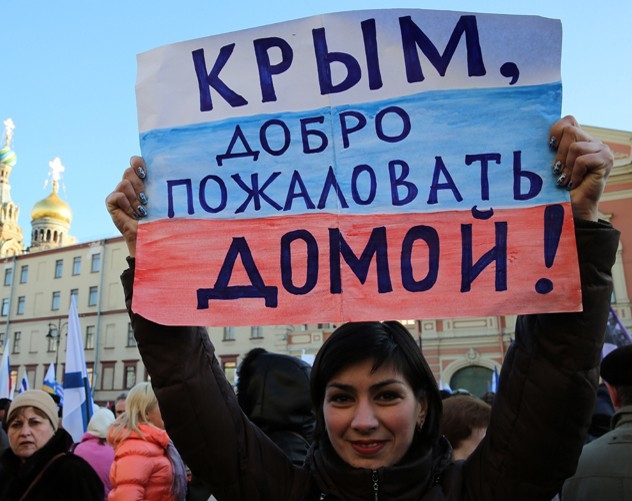
A scandal with pensions of Russians spent on Crimea gives a rare opportunity to look into the heads of ministers and translate their strange bureaucratic dialect into Russian. On Wednesday June 25, the Minister of Finance Anton Siluanov suddenly spoke about pension savings for 2014: “No one was going to return this money, because this money went to the Crimea, to take anti -crisis measures.” The next day, he was forced to recover and return to professional slang: “The Russian government never thought and was not going to spend money of pensioners ... Citizens will not lose anything, they will receive the same funds to their accounts, which will form a pension to working citizens.”
The bureaucratic syllable is heavy. But with some effort, the logic of both statements can be understood: we took, but then we will return it. True, before the authorities said that now the money will be spent on payments to current pensioners - we will explain this inconsistency later. And first, pay attention to the behavior of another minister - Alexei Ulyukaev. Of course, he is aware that they promise us to be returned. Nevertheless, from the very beginning of this maneuver with accumulations and still Ulyukaev calls on his colleagues to change his mind and give money to funds and companies as soon as possible. “We assume citizens' appeals to the court and believe that they will have a good judicial perspective,” he admitted back in October last year.
If the money is returned anyway, then what's the difference, in what form? If there is no catch in the scheme, then why does the government not legalize it in the form of a separate law? The problem is that there is a catch. Siluanov talks about the seizure of 243 billion rubles, but in fact the state took 500 billion rubles of pension money to the budget. And how much will be returned to us after 20, 30, 40 years, ministers cannot promise, because they do not know themselves.
How much did you take?
The minister’s scandalous statement confirms that each Russian is younger than 47 years old (those who are not formed for those who are older) this year the government takes an additional 6% with each official salary. The average salary in Russia in the first quarter of this year is 30 thousand rubles a month. If you officially receive so much, then every month you give the state about 1.8 thousand rubles, except for the main tax and insurance payments to the Pension Fund and the MHIF. Per year it is 21,600 rubles. It is this money that goes to current anti -crisis measures: support for state banks, corporations and regions, and 130 billion rubles will be spent on Crimea.
How many Russians were injured?
There is no information about how many Russians the government has deprived of accumulations in open official sources. Even in authoritative business media you will find only vague: “At the beginning of 2012, 77 million citizens had the right to funded pensions.” However, the exact relevant figures are in the PFR budget for 2014. They are cited in their report by the National Association of Non -State Pension Funds (NAPF), which has access to the documents: now 46.2 million Russians have funded accounts. Perhaps not all of them pay contributions this year: someone went to work in the shadow sector, someone stopped working at all. But in any case, there are few of them, and their number is replenished with those who are the first to enter the labor market this year.
How much did the state receive?
It is known that this year 243 billion rubles will enter the state budget, which were supposed to go to the NPF and the Criminal Code (management companies). But none of the officials mentions that about the same amount of pension deductions of the silence for this year is added to this. Until January 2014, 6% of the salary of Soldunes went to the formation of their funded pensions in the state vneseconobank. At the end of 2013, simultaneously with the announcement of the seizure of pension savings from the NPF and the Criminal Code, the government decided: since 2014, there will be no funded pension, and all their contributions will go to the insurance part.
“In 2014, the VEB was supposed to receive approximately 250 billion rubles of pension savings,” said Alexander Baranov, deputy general director of the Pallada UK. In VEB they refused to comment on this figure, but it approximately corresponds to the distribution of customers between the NPF and VEB (the Criminal Code now does not occupy a significant share in the market). According to the NAPF, 22.2 million Russians were entrusted with non -state pension funds, another 6 million wrote applications for the transfer of funds in the NPF since 2014, but their money will be transferred there only in the next. Deputy Minister of Finance Alexei Moiseev confirms that together with these 6 million new customers in the NPF will be a little more than half of all owners of funded accounts. So, now there are slightly smaller than that of VEB.
Instead of VEB, NPF and the Criminal Code, they go to the common boiler of the Pension Fund for payments to current pensioners. But this does not mean that there is more money in the FIU - exactly the Ministry of Finance reduces the same amount of the PFR from the budget and receives additional money in the budget. As Siluanov himself admitted, the removal of funds from the NPF and the Criminal Code allowed the Ministry of Finance to save 243 billion rubles on the transfer in the FIU. The funds of the silence were added even more to this.
In fact, all this means that this year the government has an additional about 500 billion rubles, 46.2 million Russians with personal accounts. This is an average of 10.8 thousand rubles per person. 130 billion rubles will be spent on Crimea, or on average 2.8 thousand per person. A simple calculation shows that these average figures correspond to a white salary of 15 thousand rubles per month: if you get more, you gave more. So, with a salary of 30 thousand rubles a month this year, you give the government 21.6 thousand rubles for anti -crisis measures. Of these, 5.6 thousand will go to the Crimea.
They robbed us?
Not quite, rather, an unequal exchange was imposed on us. Siluanov partly rights, claiming that we are not losing anything: this money from us would be taken away in any case. The difference is that before they would go to individual accumulative accounts in funds and management companies, and then, when retiring, we would have received back not only denominations of accumulations, but also income to invest them over all these years.
The average return on investment according to the results of last year is 8.6% per annum among the TOP-40 NPF (they account for 96% of all savings at the disposal of the NPF) and 7.2% among the TOP-30 management companies , including the State Criminal Code of the VEB (its yield 5.1%). This money is guaranteed, the state by law cannot claim them in any way. Moreover, they are inherited.
Now they promise us an increase in the insurance pension. That is, now they will spend money, and virtual figures will be recorded on our insurance accounts. In the fall, Anton Siluanov promised that these amounts would be indexed by about 7% per year. Now he no longer remembered this, but imagine the best. In theory, 7% are not much less than they promise us NPFs and the Criminal Code. But since 2015, virtual rubles in our accounts in the FIU will turn into points to calculate the insurance pension. And the recalculation of points in rubles will be carried out taking into account several coefficients. “In the new pension formula, several lowering coefficients are laid. For example, if your experience is less than 30 years, the amount will decrease, ”warns Alexander Baranov.
In addition, the cost of each score when counting the rubles will decrease due to an increase in the threshold of the maximum contributable salary: the greater it is, the lower the relative value of your salary. That is, to predict the size of your future pension in general and the government “debt” for 2014 in particular, it is now impossible. It can only be assumed that the initial 500 billion rubles after recalculation in points and backward will noticeably dry. How the living speech of the accidental minister has dried up to the usual state -owned phrases.