
Translated material
Signatures for trips to Europe
The leaders of Georgia, Moldova and Ukraine, together with the leaders of the 28 countries of the European Union, signed on Friday in Brussels an agreement on the association of their countries with the EU
The leaders of Georgia, Moldova and Ukraine, together with the leaders of the 28 countries of the European Union, signed on Friday in Brussels an agreement on the association of their countries with the EU
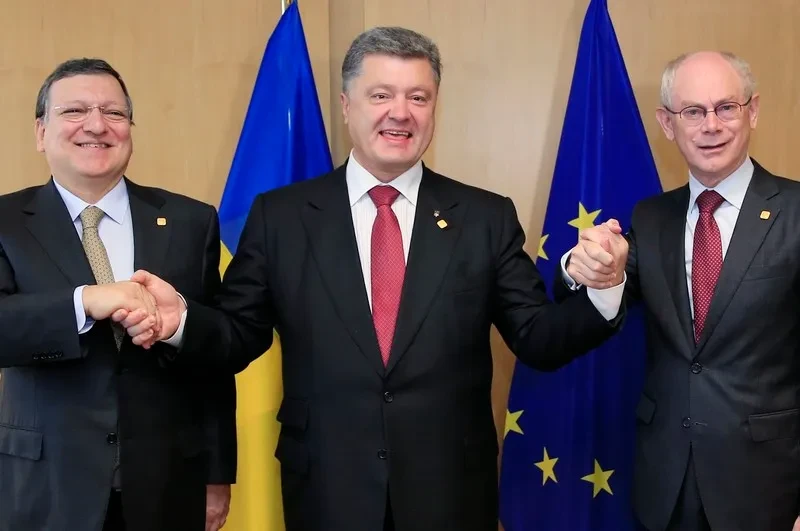
Petro Poroshenko took it out of his pocket and raised a fountain pen as a totem or a talisman. The very one in November last year in Vilnius was supposed to sign the same document: an agreement on the Association of Ukraine with the European Union. But I did not sign. The Vilnius summit was a failure because of this, but Lithuania President Dalya Grybauskaite gently saved a fountain pen.
“What is destined to happen is happening sooner or later,” said the new head of Ukraine.
Seven months have passed since that moment. During this time, Ukraine shocked the Maidan, it was on the verge of default, lost Crimea and received a “hot” war in the Donbass.
History does not know the subjunctive moods, and you can fantasize as much as you like, as if the events developed, sign Yanukovych then the agreement in Vilnius.
Now it has become a fact, although the process of ratification is ahead of the official entry into force. True, the European Commission said that the import of Ukrainian goods would be treated as if the agreement was already valid. That is, the path to the European market is open to them.
In addition to ratification, there is still an atypical circumstance: economic articles of the agreement will enter into force as consulting with Russia. According to Merkel, in order to “remove the concern of Russia” regarding the threat of tributary to the Russian market through Ukraine cheap and better than Russian, European goods.
The first round of tripartite consultations between Russia, Ukraine and the EU at the ministerial level will be held on July 11 in Brussels, and the European Commission will be represented by the Karel de Gyhta commissar.
On all three sides
Well, we said, came from the part of Russian politicians and experts, even in Brussels, we finally admitted that such affairs did not go without Russia. For six months, Europeans stubbornly refused to conduct tripartite negotiations on the Ukrainian agreement.
Of course, they recognized. Russia is a major economic and political player. But one thing is to coordinate with someone the third conditions of the future bilateral document, another is to consult how best to comply with the already signed document ...
But still, a warning was made from Moscow: the defectors who have documented integration with Europe will receive serious consequences, Russia will take measures to protect its economy.
Poroshenko signed on the economic part of the Association Agreement. It provides for the “in -depth and comprehensive zone of free trade” and makes up the bulk of the total weight of the one and a half kilogram volume of the document. Before the May elections, the political unit was signed by the acting Premiere Arseniy Yatsenyuk, who decided that there was not enough legitimacy for the economic part of his legitimacy. It is she who promises Ukrainians difficult times of the transition period. Poroshenko has legitimacy.
He considers the economic hardships of the era of the transition of the justified price for the transformation of Ukraine into a European country without a vertical of power, with the supremacy of law, an independent judicial system, free media, wide local self -government instead of federalization that gives rise to regional tsari, with a European market market economy.
The only question is whether the Ukrainians will withstand this price, whether the “dashing 90s” was cursed in Russia later.
And free trade with Europe does not interfere with free trade with Russia. According to the Rules of the WTO, “free” in the sense of minimal state intervention and minimal barriers. Kyiv is not going to break out economic ties with Russia if it itself does not want to break it.
“The European Union is not a club. This is an idea, ”Poroshenko said. Having probably in mind that it is not necessary to be a formal member of the EU in order to become a European country. But the strategic goal still sets up Ukraine’s entry into the Union. Having declared this, he called on the EU officially to give her a “European perspective”, that is, to write in black and white in his document that, when fulfilling the necessary criteria, Ukraine will be accepted into the EU.
Such a promise from the EU has not yet followed. The European Union is not ready today. Chancellor Merkel, answering a direct question, said that at this summit the EU expansion was not discussed. According to the law, any European country has the right to ask for it. “But the EU’s ability to“ digest ”any new country is also a problem, and it must be solved in each individual case,” Merkel said.
In one language
When discussing the Ukrainian crisis, Poroshenko sat at the same table with the leaders of the EU countries. He spoke one language with this company - not only in the sense of his rather fluent English, but also in the sense of looking at things. From its submission, the main theses of the Decree of the European Council in Ukraine are formulated.
Even better, English by Prime Minister of Georgia Irakli Garibashvili, although he made a part of the speech in Georgian. Moldavian Yuri Launke preferred French, then switching to Romanian, also the official language of the EU, which, as he noted, is the language and his country.
All of them called this day historical, milestone, milestone. Everyone expressed hope to see their country once a member of the EU. Everyone turned to the inhabitants of the uncontrolled regions of their countries: Crimea and rebellious cities of Donbass, Abkhazia, South Ossetia and Transnistria. Agreements with the EU are signed in the calculation of them, Kyiv, Tbilisi, Chisinau and Brussels officials assure them. The benefits of European integration can also be used by residents of not recognized territories today. The calculation that the “soft power” of beneficial changes associated with Europeanization will someday attract them back to the state from which they have broken down. This may happen soon, but it should happen. Something like the unification of Germany ... True, a member of the EU Cyprus has not yet convinced the inhabitants of the northern part of the island ...
Meanwhile, economists and newspaper observers are trying to build forecasts about the scale of economic problems that the post-Soviet dissidents who have chosen Europe instead of the Eurasian Union will receive. It is noted that the share of the EU in the foreign trade of these countries, especially Georgia, is now more than Russia. But Kyiv and Chisinau strongly depend on Russian gas. Ukraine experienced in my own experience what the Russian trade war is, even unofficial. Did she scare the Azarov government in the fall, forcing to abandon the process of integration with the EU? In Tbilisi and Chisinau, they remember the prohibitions of Dr. Onishchenko on their wine, Borjomi and food.
The EU has no free billions for eating or a fee for loyalty. The money that Brussels and EU members is allocated from budgets in the form of macrofinance support and the program for the construction of state institutions will not help people feed them here and now. They are given for projects for reforming the system, and then Ukrainians, Moldovans and Georgians should, using the updated system, earn themselves. How the Germans, French, Swedes, Poles earn ...
On July 8, the European Commission organizes in Brussels an international conference of donors of economic assistance to Ukraine to add investors' money to 750 million budget money.
“Three countries (Georgia, Moldova and Ukraine) have chosen an ambitious path,” said the chairman of the European Council, Herman Van Rompei, at a press conference. - Before economic and social, as well as geopolitical challenges, the European Union on their side. These are the most far-reaching bilateral agreements that the EU ever concluded, the result of really collective efforts. ”
Package of sanctions
But not only about the prospects was on that day the speech at the summit. The Ukrainian crisis and EU relations with Russia were one of the main stimuli. Safety, according to Poroshenko, is a necessary condition for any reform.
The heads of state and governments of the EU countries have so far abstained from new sanctions against Russia and confirmed only the ban on Brussels to import goods from Crimea and Sevastopol, who do not have a Ukrainian certificate. But they announced their readiness to impose economic sanctions at any time. “Sectoral”, affecting entire industries of the Russian economy, the sanctions of the “third stage”, if we talk about the three -stage plan adopted in March. In their opinion, Russia does not suffer enough to de -escort the Ukrainian crisis, therefore, the threat of sanctions is not canceled.
The European Council "regrets that the ceasefire agreement, which is respected by the Ukrainian authorities, has not led to the complete termination of hostilities." He calls on all parties to fulfill the Poroshenko peace plan, calls for Russia to “actively use its influence on illegal armed groups in order to stop the flow of weapons and militants across the border, to achieve quick and tangible results in the de -escalation of the crisis.”
European leaders put forward something like an ultimatum, offering Russia and militants in the Donbass to fulfill four conditions by June 30: to sign an agreement on an effective control mechanism for the termination of fire in eastern Ukraine, to return to the Ukrainian authorities three border crossings captured by separatists, to release all the hostages, including OSCE observers, to begin subject negotiations on the fulfillment of the Poroshenko peace plan.
The official from the apparatus of the European Commission, explaining to me for a cup of coffee this resolution, said that the EU Council at the level of ministers and even ambassadors could make a decision on new measures against Russia if there is no de -escalation in the coming days. These can be new point measures in relation to individuals and enterprises (the so -called “phase 2 plus”). But the economic sanctions of the “third phase” are authorized to introduce only heads of state and governments. For example, at an extraordinary summit on July 16. A package of economic sanctions is ready and waiting in the wings. “The ball is on the side of Russia,” British Prime Minister David Cameron said at a briefing. And Angel Merkel and Francois Hollande promised on the weekend to talk again on the phone with Putin.
The main theme of the extraordinary summit will be not Ukraine, but the appointment of the leaders of the EU foreign policy (instead of Lady Ashton) and the eurozone. Just as the main topic of the past summit was the choice of replacement for the current chairman of the European Commission Jose Manuel Barrosa. For the first time raising the question of a formal vote, European leaders chose a candidate of the former Prime Minister of Luxembourg and the former chairman of the eurozone of Jean-Claude Junker. The heads of government voted against Great Britain and Hungary voted. It was not about the individual, but about the concept of further development of the EU. But about it somehow. Today for us more acute Ukraine and the agreements of the three countries about the association with the EU.
The summit began on Thursday in the IPRE in the Memory of Memory about the beginning of the First World War. There, on the Flanders, tens of thousands of her soldiers rest. At a briefing, Merkel admitted that in her life it was one of the most exciting events.
“The ceremony in Ipra is a reminder of the path we have passed. About what was a hundred years ago and where we are now ... signing agreements (about the association with three post -Soviet countries) is a very important step. "